

Many IT leaders assume private cloud networks are simply virtualized data centers, missing their true strategic value. In reality, private cloud networks provide isolated environments using software-defined networking that deliver security, scalability, and reliability far beyond basic virtualization. Organizations handling regulated data, AI workloads, or mission-critical operations need this clarity to make informed infrastructure decisions. This guide explores how private cloud networks function, their advantages over public and hybrid alternatives, practical challenges you'll face, and when they align with your enterprise goals.
Table of Contents
- Key Takeaways
- Understanding the core role of private cloud networks
- Ensuring scalability and reliability in private cloud environments
- Addressing challenges and limitations of private cloud networks
- Comparing private, public, and hybrid cloud: expert insights
- Explore flexible cloud solutions with Internetport
- What are the primary benefits of private cloud networks?
- How do private clouds differ from public clouds in cost and scalability?
- What challenges should organizations anticipate when adopting private clouds?
- When is a hybrid cloud strategy preferable to private only?
Key Takeaways
| Point | Details |
|---|---|
| Isolated networks via SDN | Private cloud networks create isolated environments using software defined networking to enforce security and workload boundaries. |
| Scalable workload domains | Private clouds group compute, storage, and network resources into scalable domains that can grow independently without disturbing other workloads. |
| Dynamic resource scaling | Auto scaling adjusts capacity based on utilization to meet demand while maintaining predictable performance. |
| Costs and vendor lock in | Upfront costs, potential vendor lock in, and migration or skills gaps can complicate adoption and future changes. |
Understanding the core role of private cloud networks
A private cloud network creates an isolated, dedicated cloud environment within your organization's infrastructure, giving you complete control over security policies, compliance requirements, and resource allocation. Unlike shared public cloud environments, software-defined networking technologies like NSX enable Virtual Private Clouds with multiple subnet types for granular workload isolation.
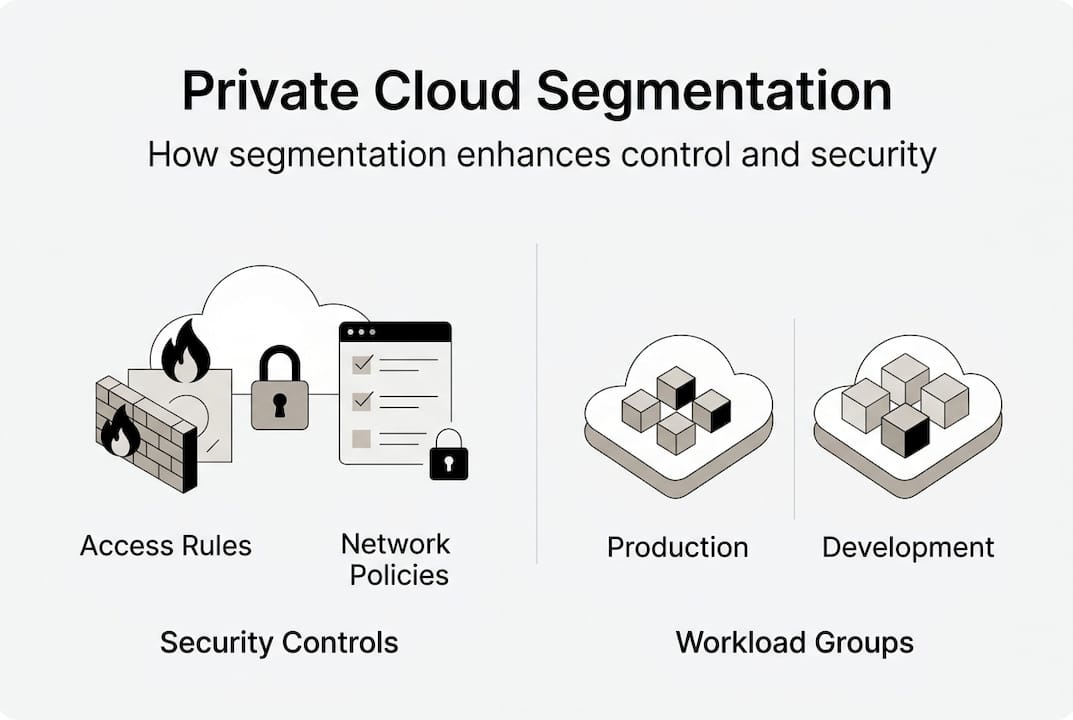
SDN separates the network control plane from the data plane, allowing you to programmatically manage network behavior without physical hardware changes. This architecture enables multi-tenancy, where different departments or projects consume isolated network segments from the same physical infrastructure. Each tenant gets self-service provisioning capabilities while maintaining security boundaries that prevent unauthorized access between workloads.
Private cloud networks typically include three subnet types serving distinct purposes:
- Private subnets host backend services and databases with no internet exposure
- Public subnets run internet-facing applications requiring inbound connectivity
- Isolated subnets provide air-gapped environments for highly sensitive workloads
This segmentation lets you apply different security policies, monitoring rules, and access controls based on workload sensitivity. For example, your payment processing systems might reside in isolated subnets with strict audit logging, while your marketing website operates in public subnets with standard protections. The flexibility to define these boundaries programmatically through SDN means you can adapt your network topology as business requirements evolve without physical infrastructure changes.
Pro Tip: Involve network architects in your private cloud planning from day one. Early SDN design decisions around subnet structures, routing policies, and security zones are difficult to change later and directly impact your ability to scale securely.
You can explore insights into private cloud compliance to understand how network isolation supports regulatory requirements. The NSX virtual private clouds documentation provides technical implementation details for organizations ready to deploy.
Ensuring scalability and reliability in private cloud environments
Private clouds achieve enterprise-grade scalability through workload domains, which are logical groupings of compute, storage, and network resources that scale independently. When your AI training workloads demand more GPU capacity, you add hosts to that specific domain without affecting production application environments. This compartmentalized approach to scaling hosts, storage, and network bandwidth prevents resource contention and maintains performance predictability.

Dynamic resource scaling mechanisms automatically adjust capacity based on utilization metrics. Auto-scaling policies monitor CPU, memory, and network throughput, triggering horizontal scaling when thresholds are exceeded. Unlike public clouds where you compete for shared resources during peak demand, private clouds guarantee resource availability through dedicated allocation. Your database clusters receive consistent IOPS performance regardless of what other workloads are doing.
Reliability in private cloud environments depends on multiple redundancy layers working together:
- Hardware redundancy with dual power supplies, redundant network paths, and RAID storage configurations
- Hypervisor-level high availability that automatically restarts failed VMs on healthy hosts
- Application-level clustering with load balancers distributing traffic across multiple instances
- Geographic redundancy through disaster recovery sites with continuous data replication
- Network redundancy using multiple switches, routers, and internet uplinks to eliminate single points of failure
These mechanisms combine to deliver stringent uptime guarantees. Many private cloud providers commit to 99.99% availability SLAs, translating to less than 53 minutes of downtime per year. For context, 99.9% availability allows over 8 hours of annual downtime, making that extra nine crucial for mission-critical operations.
"Private cloud infrastructure with 99.99% uptime guarantees ensures business continuity for revenue-generating applications where every minute of downtime costs thousands in lost transactions and customer trust."
Disaster recovery planning extends beyond technical redundancy to include documented procedures, regular failover testing, and recovery time objectives. You define how quickly systems must recover after failures and architect your infrastructure accordingly. Critical payment systems might require sub-minute recovery times, while internal reporting tools tolerate longer restoration windows.
Internetport's dedicated server reliability solutions demonstrate how hardware selection impacts availability guarantees. Understanding private cloud compliance and data locality becomes essential when reliability requirements intersect with regulatory mandates. The Aerospike scalability insights offer deeper technical perspectives on achieving both scale and reliability simultaneously.
Addressing challenges and limitations of private cloud networks
While private clouds offer compelling benefits, they introduce financial and operational challenges that demand realistic planning. The comparison between private and public cloud economics reveals trade-offs you must evaluate against your specific requirements.
| Factor | Private Cloud | Public Cloud |
|---|---|---|
| Upfront costs | High capital expenditure for hardware, software licenses, data center infrastructure | Minimal initial investment, pay-as-you-go model |
| Operational complexity | Requires dedicated teams for infrastructure management, patching, monitoring | Provider manages infrastructure, you focus on applications |
| Scalability ceiling | Limited by physical capacity, requires planning and procurement lead time | Near-unlimited elastic scaling on demand |
| Cost predictability | Fixed costs regardless of utilization, easier budgeting | Variable costs based on consumption, potential for bill shock |
| Performance consistency | Guaranteed resources, no noisy neighbor issues | Shared resources, potential performance variability |
Vendor lock-in and skills shortages create strategic risks that extend beyond initial deployment. Proprietary management tools, custom APIs, and specialized networking configurations make switching providers expensive and time-consuming. Your team needs expertise in hypervisor platforms, storage arrays, network virtualization, and automation tools, skills that command premium salaries in competitive markets.
Capacity planning becomes a constant balancing act. Overprovisioning wastes capital on idle resources, while underprovisioning causes performance degradation and emergency procurement cycles. You must forecast growth patterns, seasonal demand spikes, and new project requirements months in advance, then commit to hardware purchases with multi-year depreciation schedules. Public clouds eliminate this forecasting burden through instant elasticity.
Security compliance in private clouds requires continuous effort despite the control advantages. You own the entire security stack from physical access controls to application vulnerabilities, meaning every patch, configuration change, and access policy falls under your responsibility. Compliance audits examine your processes, documentation, and technical controls in detail. One misconfigured firewall rule or unpatched hypervisor can trigger audit findings and remediation requirements.
Migration challenges compound when moving existing workloads into private clouds. Application dependencies, network configurations, and storage architectures rarely map cleanly between environments. Achieving zero-downtime migrations demands careful planning, extensive testing, and often temporary hybrid configurations that increase complexity. Legacy applications built for physical servers may require refactoring before they benefit from cloud-native features.
Pro Tip: Conduct a comprehensive total cost of ownership analysis spanning five years before committing to private cloud infrastructure. Include hidden costs like specialized training, redundant components for high availability, disaster recovery sites, and the opportunity cost of capital tied up in hardware versus invested elsewhere.
Exploring virtual private server limitations helps contextualize when private clouds justify their complexity versus simpler alternatives. The colocation cost comparison reveals another middle ground between full private clouds and public cloud services. Detailed analysis of private cloud challenges provides real-world perspectives from organizations navigating these trade-offs.
Comparing private, public, and hybrid cloud: expert insights
Choosing the right cloud model depends on matching architectural characteristics to your workload requirements and organizational constraints. Each approach excels in specific scenarios:
- Private clouds suit regulated industries with data sovereignty requirements, predictable workloads needing guaranteed performance, and organizations with existing data center investments to leverage
- Public clouds excel for experimental projects with uncertain resource needs, applications with highly variable traffic patterns, and startups minimizing upfront capital expenditure
- Hybrid clouds bridge both worlds, keeping sensitive data on-premises while bursting overflow capacity to public clouds during demand spikes
| Characteristic | Private Cloud | Public Cloud | Hybrid Cloud |
|---|---|---|---|
| Performance predictability | High, dedicated resources | Variable, shared infrastructure | Mixed, depends on workload placement |
| Cost model | Fixed CapEx, predictable OpEx | Variable OpEx, pay per use | Combined CapEx and variable OpEx |
| Network latency | Low, on-premises placement | Higher, internet-dependent | Mixed based on data location |
| Data sovereignty | Complete control, choose location | Limited control, provider regions | Flexible, place sensitive data on-premises |
| Operational complexity | High, manage full stack | Low, provider abstracts infrastructure | Highest, coordinate multiple environments |
Private clouds excel for regulated and AI workloads because they provide the predictability and data sovereignty these applications demand. AI model training requires consistent GPU access over extended periods, making reserved private cloud capacity more economical than public cloud spot pricing. Financial services and healthcare organizations keep customer data within specific geographic boundaries to satisfy regulatory mandates that public cloud regions cannot always accommodate.
Architectural decisions significantly impact private cloud success. Integrated platforms reduce complexity compared to orchestrating separate compute, storage, and network products. Hyperconverged infrastructure works well for small to mid-scale deployments where simplicity outweighs the performance advantages of disaggregated architecture. Enterprise-scale private clouds benefit from disaggregated designs that let you scale compute and storage independently based on workload characteristics.
Data locality becomes critical for AI workloads processing large datasets. Moving terabytes of training data to public clouds incurs substantial egress fees and time delays. Keeping data and compute co-located in private infrastructure eliminates these bottlenecks. Low-latency applications like high-frequency trading or real-time analytics similarly benefit from on-premises deployment where network hops are minimized.
Hybrid clouds add flexibility but multiply operational complexity. You manage two different infrastructure platforms with distinct APIs, security models, and monitoring tools. Workload placement decisions require ongoing evaluation as data gravity, compliance requirements, and cost structures shift. Network connectivity between environments introduces another failure domain and potential performance bottleneck.
Understanding regulatory compliance in private clouds helps you evaluate when data sovereignty justifies the investment. Additional cloud strategy articles explore decision frameworks for different scenarios. The InfoWorld AI cloud analysis and Storage Swiss private cloud economics provide expert perspectives on when private infrastructure makes strategic sense.
Explore flexible cloud solutions with Internetport
Implementing the right infrastructure strategy requires partners who understand both the technical complexities and business objectives driving your decisions. Internetport delivers tailored cloud and hosting services designed for organizations demanding security, scalability, and reliability without unnecessary complexity.
Our solutions span the full spectrum of infrastructure needs:
- Webhosting services with SSD storage, free SSL certificates, and daily backups for organizations establishing secure online presence
- Virtual private servers running the latest Plesk control panel, offering self-service management with enterprise-grade performance
- Dedicated Dell Poweredge servers providing the foundation for private cloud deployments with guaranteed resources and customizable configurations
Our two fully equipped data centers feature redundant power, cooling, and network systems ensuring the fault tolerance your critical workloads require. PCI DSS certification and high-speed connectivity support organizations with stringent compliance and performance requirements. Whether you need colocation space to deploy your own hardware or fully managed infrastructure, we adapt our services to your operational model.
Pro Tip: Consult with infrastructure specialists before finalizing your private cloud architecture. Early conversations about workload characteristics, growth projections, and compliance requirements help you avoid costly redesigns and ensure your deployment scales efficiently from day one.
What are the primary benefits of private cloud networks?
Private cloud networks deliver enhanced security through dedicated infrastructure where you control every access policy, encryption standard, and audit mechanism. Compliance becomes manageable when you dictate exactly how data is stored, processed, and transmitted without relying on shared public cloud environments. Predictable performance results from guaranteed resource allocation, eliminating noisy neighbor problems that plague multi-tenant public clouds. You gain dedicated control over compute, storage, and network resources, allowing fine-tuned optimization for your specific workload profiles.
How do private clouds differ from public clouds in cost and scalability?
Private clouds require substantial upfront capital expenditure for hardware, software licenses, and data center infrastructure, making them expensive to establish initially. However, ongoing operational costs remain predictable since you're not paying variable per-use fees that fluctuate with consumption. Public clouds minimize initial investment through pay-as-you-go models, making them attractive for startups and experimental projects. Their elastic scaling capabilities handle unpredictable workloads better, though costs can spiral unexpectedly during traffic spikes or with inefficient resource utilization.
What challenges should organizations anticipate when adopting private clouds?
Expect high initial capital investments that require executive approval and multi-year financial commitments before seeing returns. Specialized skills in hypervisor management, software-defined networking, and storage administration are essential but difficult to recruit and retain in competitive markets. Vendor lock-in concerns arise from proprietary management tools and APIs that make switching providers expensive and disruptive. Migration complexities include application refactoring, network reconfiguration, and extensive testing to achieve production readiness. Capacity planning demands accurate forecasting months in advance, while security audits require continuous documentation and technical validation of your entire infrastructure stack.
When is a hybrid cloud strategy preferable to private only?
Hybrid clouds balance private infrastructure security for sensitive data with public cloud flexibility for variable workloads and rapid experimentation. Organizations with seasonal demand spikes benefit from keeping baseline capacity on-premises while bursting overflow traffic to public clouds during peak periods. Development and testing environments often run in public clouds for cost efficiency, while production systems remain in private infrastructure for performance guarantees. The approach introduces significant operational complexity through managing multiple platforms, coordinating security policies, and maintaining network connectivity between environments. Hybrid strategies suit enterprises with diverse application portfolios where different workloads have conflicting requirements that no single cloud model satisfies completely.