

Selecting the right web hosting provider is one of the most critical infrastructure decisions facing IT professionals and business decision-makers today. Your choice directly impacts site performance, security posture, and your ability to scale operations as demand grows. This article delivers a comprehensive checklist to evaluate hosting providers across key criteria including uptime guarantees, security features, scalability options, and support quality. By following this structured approach, you'll minimize risk and position your organization for sustainable online success.
Table of Contents
- Key Takeaways
- Essential criteria for evaluating web hosting providers
- Types of web hosting: shared, VPS, dedicated, and cloud
- Comparing web hosting options: features, costs, and performance
- Making the right web hosting decision for your business needs
- Explore flexible web hosting solutions at Internetport
- FAQ
Key Takeaways
| Point | Details |
|---|---|
| Uptime guarantees | Aim for 99.9 percent uptime or higher and validate performance with real time monitoring dashboards. |
| Security and backups | Require TLS/SSL support at no extra cost, strong firewall and DDoS protection, and daily automated backups with multiple restore points. |
| Scalability options | Choose cloud based resources that can be adjusted in real time without downtime and understand how CPU cores RAM and bandwidth can be upgraded. |
| Support and data centers | Ensure 24/7 support through multiple channels and verify data center locations near your users for latency and regulatory compliance. |
Essential criteria for evaluating web hosting providers
When assessing potential hosting providers, you need to examine several technical and operational factors that directly affect your business operations. These criteria form the foundation of any thorough evaluation process.
Uptime and reliability stand as the most critical factor. Reliable uptime guarantees prevent revenue losses from site unavailability. Look for providers offering 99.9% or higher uptime SLAs backed by service credits for violations. Request access to real-time monitoring dashboards that track server health, response times, and historical performance data. Providers who refuse transparency around uptime metrics should raise immediate red flags.

Security features protect your data and maintain customer trust. Modern hosting must include TLS/SSL certificate support, preferably at no additional cost. Evaluate firewall configurations, DDoS mitigation capabilities, and intrusion detection systems. Daily automated backups with multiple restore points are non-negotiable for business continuity. Ask providers about their backup retention policies and test restoration procedures before committing.
Scalability determines whether your infrastructure can grow with your business. Assess how easily you can upgrade CPU cores, RAM allocation, and bandwidth limits without service interruption. Cloud-based solutions typically offer the most flexibility, allowing you to adjust resources in real time based on traffic patterns. Fixed-capacity plans may require migration to larger instances, introducing potential downtime during transitions.
Control panel usability affects your team's operational efficiency. Platforms like Plesk or cPanel simplify server management, application deployment, and routine maintenance tasks. Evaluate whether the interface supports your preferred workflows and integrates with existing tools. A poorly designed control panel adds unnecessary complexity and training overhead.
Customer support quality can make or break your hosting experience. Verify that providers offer 24/7 support through multiple channels including phone, live chat, and ticketing systems. Test response times before purchasing by submitting pre-sales questions. Read independent reviews focusing on support experiences during actual outages or technical issues.
Data center location impacts both performance and regulatory compliance. Servers geographically closer to your user base deliver lower latency and faster page loads. If you handle EU citizen data, GDPR may require hosting within specific jurisdictions. Confirm that providers operate certified facilities with redundant power, cooling, and network connectivity.
Pro Tip: Request a trial period or money-back guarantee to test real-world performance under your actual workload before making long-term commitments.
Types of web hosting: shared, VPS, dedicated, and cloud
Understanding the fundamental differences between hosting types helps you match technical requirements to budget constraints and performance expectations.
Shared hosting places multiple websites on a single physical server, sharing CPU, RAM, and storage resources. This cost-effective option suits low-traffic sites like company blogs or informational pages. However, resource contention from neighboring sites can cause performance degradation. Security isolation is limited since all sites share the same server environment. Monthly costs typically range from $5 to $25, making shared hosting attractive for budget-conscious organizations with modest requirements.
VPS hosting creates isolated virtual servers on shared physical hardware. Each VPS receives dedicated resource allocations that other tenants cannot access. VPS hosting bridges shared and dedicated by providing isolated virtual servers with guaranteed resources. You gain root access for custom configurations while avoiding the full cost of dedicated hardware. VPS plans scale from $20 to $100 monthly depending on allocated resources. This option works well for growing businesses needing more control without dedicated server expenses.
Dedicated servers provide exclusive access to entire physical machines. Dedicated servers offer advanced control and resource isolation compared to shared hosting. You control all hardware resources, operating system choices, and security configurations. This hosting type supports resource-intensive applications like large databases, high-traffic e-commerce platforms, or custom enterprise software. Monthly costs start around $100 and can exceed $500 for high-performance configurations. Organizations requiring maximum performance, security, and customization benefit most from dedicated servers.
Cloud hosting distributes your application across multiple interconnected servers, providing elastic scalability and high availability. Resources scale automatically based on demand, and you pay only for actual usage. If one server fails, others seamlessly handle the workload. Cloud platforms support rapid deployment of additional instances during traffic spikes, then scale down during quiet periods. Pricing varies widely based on consumption but typically starts around $10 monthly for small deployments.
Each hosting type presents distinct tradeoffs:
- Shared hosting maximizes affordability but sacrifices performance and control
- VPS balances cost and capability for mid-sized deployments
- Dedicated servers deliver peak performance at premium prices
- Cloud hosting provides ultimate flexibility with variable costs
Comparing web hosting options: features, costs, and performance
A side-by-side comparison clarifies which hosting type aligns with your specific business requirements and budget parameters.
| Hosting Type | Monthly Cost | Typical Uptime | Best For | Key Limitation |
|---|---|---|---|---|
| Shared | $5-$25 | 99.5-99.9% | Small sites, blogs | Resource sharing impacts performance |
| VPS | $20-$100 | 99.9%+ | Growing businesses | Requires more technical knowledge |
| Dedicated | $100-$500+ | 99.95%+ | High-traffic applications | Highest cost per server |
| Cloud | $10-$500+ | 99.99%+ | Variable workloads | Complex pricing models |
Performance metrics reveal significant differences across hosting types. Shared hosting typically delivers 500ms to 2-second page load times depending on server load. VPS hosting improves this to 200-800ms with dedicated resources. Dedicated servers achieve sub-200ms response times for optimized applications. Cloud hosting performance varies based on configuration but can match or exceed dedicated servers when properly architected.
Feature sets differentiate providers within each hosting category. Most modern hosting includes control panels, though Plesk offers superior usability for managing multiple sites and applications. Free SSL certificates have become standard, but verify whether providers support custom certificates for enterprise needs. Backup frequency ranges from weekly to daily, with premium plans offering hourly snapshots. Support quality varies dramatically, with some providers offering only email tickets while others provide 24/7 phone support.
Ideal use cases by hosting type:
- Shared hosting: company websites, portfolios, small business sites under 10,000 monthly visitors
- VPS hosting: medium-traffic sites, development environments, small e-commerce platforms
- Dedicated servers: large e-commerce, SaaS applications, high-traffic content sites
- Cloud hosting: applications with variable traffic, microservices architectures, global deployments
Pro Tip: Choosing hosting with flexible resource allocation improves scalability without overspending on unused capacity during slow periods.
Making the right web hosting decision for your business needs
Applying a systematic decision framework ensures you select hosting that supports both current operations and future growth trajectories.
Prioritize scalability if you anticipate traffic growth or seasonal demand spikes. E-commerce sites experiencing holiday traffic surges need hosting that scales resources without manual intervention. Cloud and VPS platforms typically offer the smoothest upgrade paths. Ask providers about their scaling processes, including whether upgrades require downtime or can occur seamlessly. Test scaling procedures during trial periods to verify claims match reality.
Emphasize security when handling sensitive customer data, payment information, or proprietary business assets. Healthcare, financial services, and e-commerce organizations face strict compliance requirements that shared hosting often cannot satisfy. Verify that providers support necessary security certifications like PCI DSS, SOC 2, or ISO 27001. Request documentation of security practices including patch management, vulnerability scanning, and incident response procedures.
Consider total cost of ownership beyond monthly hosting fees. Calculate potential revenue losses from downtime by multiplying hourly revenue by expected outage hours. Factor in staff time required for server management, which decreases with managed hosting options but increases with self-managed dedicated servers. Include costs for SSL certificates, premium backups, and additional bandwidth if not included in base pricing. A $50 monthly plan requiring 10 hours of admin time may cost more than a $100 managed solution.
Validate provider reputation through independent research. Provider support responsiveness can critically impact issue resolution time during outages or security incidents. Read recent reviews on third-party platforms focusing on support experiences, billing transparency, and migration assistance. Contact existing customers if possible to gather unfiltered feedback about long-term satisfaction.
Follow this evaluation checklist before finalizing your decision:
- Document your current and projected resource requirements including storage, bandwidth, and processing power
- List mandatory features such as specific control panels, programming language support, or database types
- Identify compliance requirements based on your industry and customer base
- Request detailed quotes from at least three providers matching your criteria
- Test support responsiveness by submitting technical questions to each provider
- Review service level agreements carefully, noting uptime guarantees and compensation terms
- Verify migration assistance availability if moving from an existing host
- Start with month-to-month contracts when possible to minimize commitment risk
Explore flexible web hosting solutions at Internetport
Internetport delivers hosting infrastructure designed specifically for businesses requiring reliable, scalable, and secure online operations. Our webhosting services include shared, VPS, and dedicated options backed by redundant data center infrastructure and 24/7 technical support.
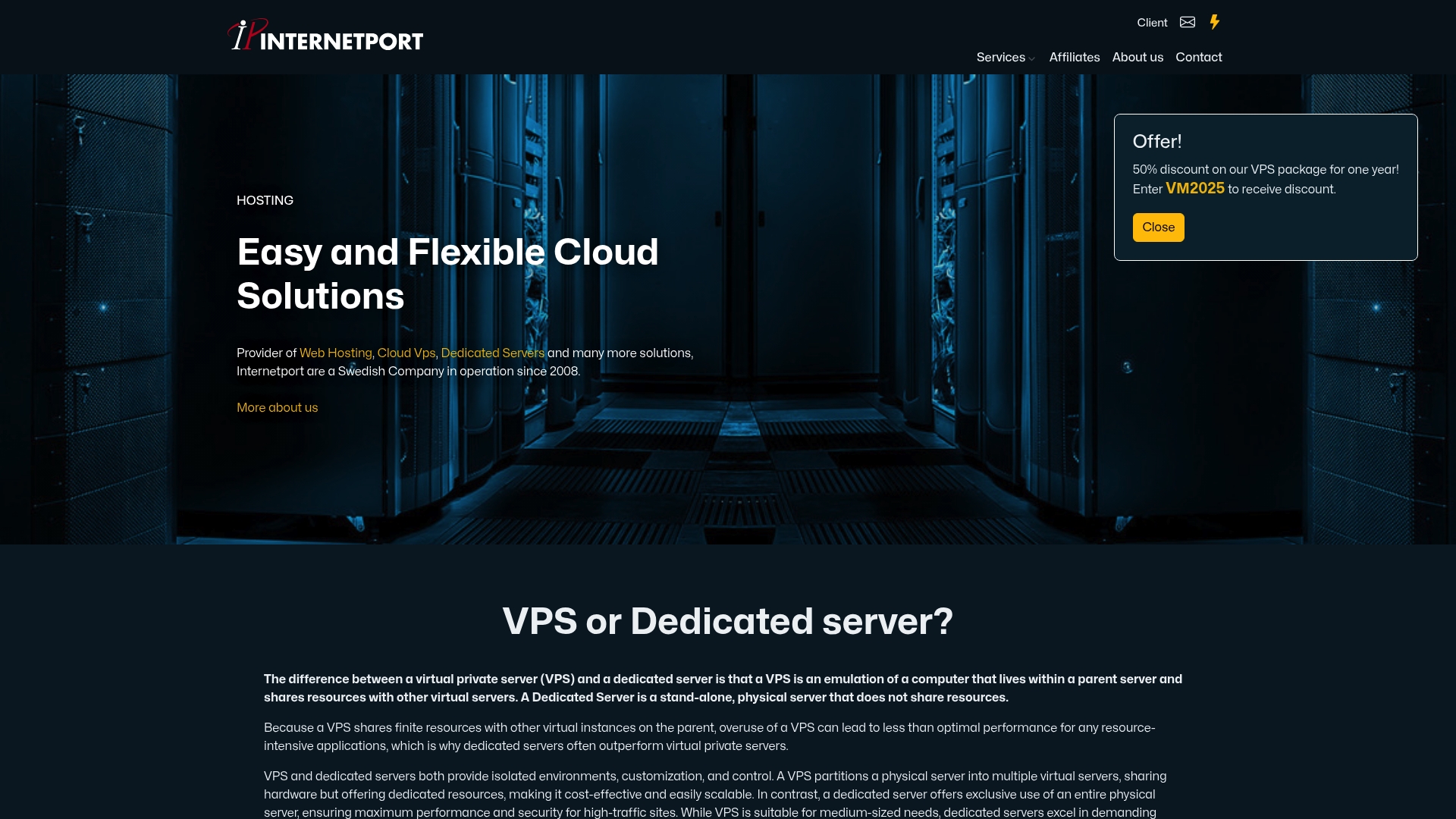
Our VPS hosting options feature SSD storage, the latest Plesk control panel, and daily backups as standard. For organizations needing maximum performance, our dedicated server offerings provide full hardware control in PCI DSS-certified facilities with redundant power and network connectivity. All plans include free SSL certificates and flexible resource scaling to support your growth without service disruption.
FAQ
What is the difference between VPS and dedicated hosting?
VPS hosting uses virtualization to create isolated server environments on shared physical hardware, providing dedicated resource allocations at lower cost. Dedicated hosting gives you exclusive access to entire physical servers, offering maximum performance and complete control over hardware configurations. Dedicated servers cost significantly more but deliver higher performance and stronger isolation for security-critical applications.
How important is uptime guarantee in web hosting?
Uptime guarantees directly affect revenue and customer satisfaction, with each hour of downtime potentially costing thousands in lost sales and damaged reputation. Service level agreements with 99.9% or higher uptime commitments provide financial compensation when providers fail to meet standards. Always verify that SLAs include automated monitoring and transparent reporting rather than relying solely on provider claims.
Can I upgrade my hosting plan easily as my business grows?
Most reputable providers support seamless upgrades within the same hosting type, such as moving from a smaller VPS to a larger instance. Cloud and VPS platforms typically offer the smoothest upgrade paths with minimal or zero downtime during transitions. Migrating between hosting types like shared to dedicated often requires more planning and may involve brief service interruptions, so choose a hosting type with sufficient headroom for near-term growth.
What security features should I prioritize in web hosting?
Prioritize providers offering free SSL/TLS certificates, automated daily backups with multiple restore points, and DDoS protection as standard features. Web application firewalls, malware scanning, and intrusion detection systems add critical layers of defense for business-critical sites. Verify that backup data is stored in geographically separate locations to protect against regional disasters or data center failures.
How does data center location affect my hosting performance?
Servers located closer to your primary user base deliver faster page loads through reduced network latency, typically improving response times by 100-300 milliseconds per thousand miles of distance. Data center location also affects regulatory compliance, with laws like GDPR requiring certain data to remain within specific jurisdictions. Choose providers operating facilities in regions serving your target audience while meeting applicable legal requirements.