

TL;DR:
- Traditional hosting no longer meets the demands of modern, high-traffic businesses due to limited scalability and security. Cloud VPS offers on-demand resources, greater control, and resilient infrastructure, making it a superior choice for growth and compliance needs. For most SMBs, migrating to cloud VPS enhances performance, security, and future-proofing while reducing long-term costs.
If your hosting can't keep pace with your business, you're already behind. The reasons to switch to cloud VPS come down to one core reality: traditional shared hosting and on-premise servers were built for a world where traffic was predictable and growth was slow. Neither is true anymore. This article walks you through nine specific, concrete reasons why cloud VPS outperforms older alternatives on scalability, security, cost, and control. Whether you're running an e-commerce site that spikes during promotions or managing internal tools for a growing team, this is the upgrade that earns its place.
Table of Contents
- Key Takeaways
- 1. The core reasons to switch to cloud VPS start with real scalability
- 2. Security isolation that shared hosting simply cannot match
- 3. Cost efficiency that actually holds up to scrutiny
- 4. Full control over your server environment
- 5. Predictable uptime through distributed infrastructure
- 6. Avoiding vendor lock-in with open standards
- 7. Better performance for your applications and users
- 8. Support for compliance and data governance requirements
- 9. Future-proofing your infrastructure as your business grows
- My honest take on making the switch
- Internetport's cloud VPS solutions for growing businesses
- FAQ
Key Takeaways
| Point | Details |
|---|---|
| Scalability on demand | Cloud VPS lets you add CPU, RAM, and storage instantly without migrating to a new server. |
| Predictable, low costs | Entry-level plans start around $3.32/month, making cloud VPS accessible for tight SMB budgets. |
| Genuine security isolation | Your environment is walled off from other users, reducing breach risk compared to shared hosting. |
| Full infrastructure control | Root access means you configure, secure, and tune the server exactly as your workload demands. |
| Business continuity built in | Distributed infrastructure and automated backups protect your operations when things go wrong. |
1. The core reasons to switch to cloud VPS start with real scalability
Shared hosting puts you in a resource pool with dozens or hundreds of other accounts. When traffic spikes on someone else's site, your site slows down. That's not a theoretical risk. It's the standard behavior of the environment.
Cloud VPS eliminates that dependency entirely. You get dedicated CPU and RAM that no other account can touch. When your campaign goes live, your server doesn't care what the neighbors are doing. Resources are yours.
The scalability story goes further than just isolation. With cloud VPS, you can increase your resource allocation without rebuilding your environment. Need to double your RAM before a product launch? You do it in minutes through a control panel, not weeks through a hardware procurement cycle. For businesses with seasonal traffic patterns like retail, events, or SaaS platforms, this kind of on-demand flexibility is worth more than any fixed spec list.

Pro Tip: Before you sign up for any VPS plan, pull three months of traffic analytics and identify your peak concurrent user count. That number, not your average load, should drive your minimum resource specification.
Shared hosting also fails at uptime in ways that compound over time. Cloud VPS runs on distributed infrastructure, meaning your instance isn't tied to a single physical machine. If one node has issues, your workload migrates. VPS hosting explained covers how this distributed model compares to older single-server setups in practical terms.
2. Security isolation that shared hosting simply cannot match
When you share a server, you share risk. A vulnerable application in another account on the same machine can expose you to attacks that have nothing to do with your code or configuration.
Cloud VPS provides workload isolation that eliminates that cross-account exposure. Your virtual machine is its own contained environment. What happens in another account stays there, and vice versa.
The security advantages don't stop at isolation. Root access on a VPS means you can:
- Configure custom firewall rules specific to your application
- Install and manage your own SSL certificates
- Set up intrusion detection and log monitoring tools
- Control exactly which ports are open and to whom
- Apply security patches on your schedule, not a shared provider's timeline
For businesses handling customer data, payments, or sensitive internal systems, these controls are not optional extras. They are the difference between compliance and liability.
"Isolated environments and root-level control in cloud VPS reduce the attack surface significantly compared to shared hosting, where a single misconfigured application can compromise neighboring accounts."
Data sovereignty is another consideration many SMBs overlook until it becomes a legal issue. Depending on your industry and customer base, storing data in a specific jurisdiction may be a regulatory requirement. Cloud VPS providers with data centers in defined regions, like Internetport's Swedish facilities, give you that geographic control.
3. Cost efficiency that actually holds up to scrutiny
The assumption that cloud VPS costs more than shared hosting is worth challenging directly. The math depends heavily on what you're comparing.
Entry-level VPS plans from quality providers now start around $3.32 per month, with uptime guarantees reaching 99.99%. At that price point, the gap between shared and VPS hosting is smaller than most people expect. And the hidden costs of shared hosting, including slow load times affecting conversions, limited support, and zero customization, make that comparison even more favorable for VPS.
The comparison with managed cloud services or on-premise infrastructure tells a very different story:
| Hosting Type | Typical Monthly Cost | Setup Cost | Control Level |
|---|---|---|---|
| Shared hosting | $3–$15 | Low | Very limited |
| Cloud VPS | $3.32–$80+ | Low | Full root access |
| Managed cloud (AWS/GCP) | $50–$500+ | Moderate | Limited by abstractions |
| On-premise server | Hardware equivalent | Very high | Full physical |
Managed services add convenience but frequently come with unpredictable bills, especially as usage scales. Developers and IT managers who migrated from managed platforms to self-hosted VPS consistently report better cost predictability. You know what you're paying each month. There are no surprise egress fees, no per-request charges, and no pricing tiers that quietly shift as you grow.
On-premise hardware carries the largest gap. Factor in server procurement, power and cooling, physical security, and the staff time required to maintain physical infrastructure, and the true total cost of ownership becomes very difficult to justify for most SMBs.
Pro Tip: When calculating total cost of ownership for hosting, include the value of engineering time spent on maintenance. An outage that takes four hours to resolve costs far more than the monthly server bill.
4. Full control over your server environment
Control is one of the most undervalued benefits of cloud VPS, particularly for teams that have spent time fighting against the limitations of managed platforms.
Root access means you decide what software runs on your server. You're not waiting for a shared platform to approve a PHP version update, support a specific database configuration, or add a module you need. You install it yourself and move on.
For many SMBs, the practical implications of this control include:
- Deploying custom application stacks without restrictions
- Running multiple websites or services from a single VPS instance
- Tuning kernel parameters, connection limits, and caching behavior
- Setting up staging environments that mirror production exactly
- Automating deployment workflows with tools like Kamal or Coolify
That last point matters more than it sounds. Deployment automation reduces the risk of human error during updates, which is one of the most common causes of production outages. Tools like Coolify have brought Docker-based deployment to teams without deep DevOps expertise, making VPS management far more accessible than it was five years ago.
If your team doesn't have strong sysadmin skills, cPanel simplifies VPS management through graphical dashboards that handle common tasks like domain management, email setup, and database administration. It reduces the learning curve without removing the underlying control that makes VPS valuable.
The key distinction from managed cloud hosting is ownership of the configuration. On a managed platform, the abstraction layer that makes things easier also makes certain customizations impossible. On a VPS, the server is yours to configure as you see fit.
5. Predictable uptime through distributed infrastructure
Traditional hosting ties your availability to a single machine. When that machine has a hardware fault, a network issue, or a maintenance window, your site goes down. That's a direct hit to customer experience and, depending on the nature of your business, revenue.
Cloud VPS infrastructure distributes your workload across redundant nodes, which fundamentally changes the uptime equation. Here's how that resilience works in practice:
- Your virtual instance runs on physical infrastructure with redundant power and network connections.
- If a physical node experiences a fault, the hypervisor migrates your workload to healthy hardware with minimal interruption.
- Scheduled maintenance happens on the underlying infrastructure without requiring your instance to go offline.
- Data redundancy and automated backups protect against data loss even in hardware failure scenarios.
For SMBs, this kind of built-in resilience replaces what used to require expensive disaster recovery contracts. You get continuity planning baked into the infrastructure rather than bolted on as an afterthought.
6. Avoiding vendor lock-in with open standards
This is the reason most businesses don't discover until they try to leave a platform. Managed cloud services make it convenient to adopt proprietary tools, custom APIs, and platform-specific configurations. Over time, those dependencies accumulate until migrating away requires rewriting significant portions of your application.
Cloud VPS running open-source tools sidesteps this problem entirely. Switching providers is a matter of provisioning a new server, copying your environment, and updating DNS. There's no proprietary database format to export, no custom runtime to replicate, and no support ticket to file asking for permission to access your own data.
This flexibility has practical value even if you never plan to switch providers. Knowing you can leave without pain gives you negotiating leverage and ensures your infrastructure choices are driven by technical merit, not migration cost.
7. Better performance for your applications and users
Performance isn't just a technical metric. It directly affects user behavior, search rankings, and conversion rates. A site that loads in under two seconds converts significantly better than one that takes four. That gap comes down to server performance.
Shared hosting environments create contention for I/O, CPU, and memory that degrades performance in ways that are difficult to diagnose and impossible to fix without upgrading. SSD VPS performance improvements are measurable in page load times, database query speeds, and application response rates across virtually every workload type.
With a VPS, you can also colocate your server in a region geographically close to your user base, reducing latency at the network level. For businesses with customers concentrated in specific regions, this geographic optimization can make a meaningful difference in perceived performance without any application-level changes.
8. Support for compliance and data governance requirements
If your business operates in healthcare, finance, retail payments, or any sector that handles personal data, your hosting environment is not just a technical choice. It's a compliance decision.
Shared hosting environments offer almost no ability to demonstrate control over data access, logging, or configuration. Auditors asking about your access controls, backup procedures, or network isolation will find shared hosting answers inadequate.
Cloud VPS gives you the documentation trail that compliance requires. You can demonstrate exactly who has access to the server, what firewall rules are in place, how backups are configured, and where data is stored geographically. Providers like Internetport offer hosting reliability with PCI DSS compliance capabilities built into the infrastructure, which simplifies the compliance process considerably for businesses in regulated industries.
9. Future-proofing your infrastructure as your business grows
The most expensive hosting mistake SMBs make is optimizing for today's needs and ignoring tomorrow's growth. Migrating a production application from shared hosting to VPS under pressure because of performance issues is painful, time-consuming, and risky. Doing it proactively, before you hit the wall, is straightforward.
Cloud VPS supports future-proofing because the infrastructure grows with you. Start with a small instance that matches your current workload and scale resources as your traffic, user count, and application complexity increase. You never need to rebuild your environment from scratch because you've outgrown the platform.
There is also a broader ecosystem benefit. Teams that run their own VPS develop internal infrastructure knowledge that compounds over time. Understanding your server environment makes you better at debugging, faster at deploying new services, and less dependent on external support for routine tasks. That capability is worth something real, even if it doesn't show up on a balance sheet.
My honest take on making the switch
I've watched a lot of businesses make this decision, and the pattern that shows up most consistently is this: the teams that wait until they're forced to switch have a much harder time than the teams that switch from a position of stability.
The self-hosting renaissance is real. Developers and IT managers who were burned by unpredictable managed cloud bills are moving back to VPS in significant numbers, and they're not going back. The control, the cost predictability, and the absence of vendor dependency are worth the additional operational responsibility.
That said, I think the industry undersells one important variable: your team's operational appetite. A VPS gives you control, but control requires time and attention. If your team has no one who wants to manage server configurations, a managed VPS or fully managed hosting may serve you better than an unmanaged instance you're reluctant to touch. The right balance of control and automation is the one your team will actually maintain.
My recommendation is to be honest about this tradeoff before you sign up. The best hosting environment is the one that matches both your technical requirements and the capacity of your team to manage it well. For most growing SMBs with even one technically capable person on staff, cloud VPS is the right answer. The economics, the security profile, and the flexibility make the case clearly.
— Peter
Internetport's cloud VPS solutions for growing businesses
If the reasons above match what you're looking for, Internetport has built its infrastructure with exactly this kind of business in mind. Since 2008, Internetport has provided cloud VPS and hosting solutions from data centers in Sweden and international locations, with SSD storage, up to 10 Gbps bandwidth, and PCI DSS compliance support for businesses in regulated industries.
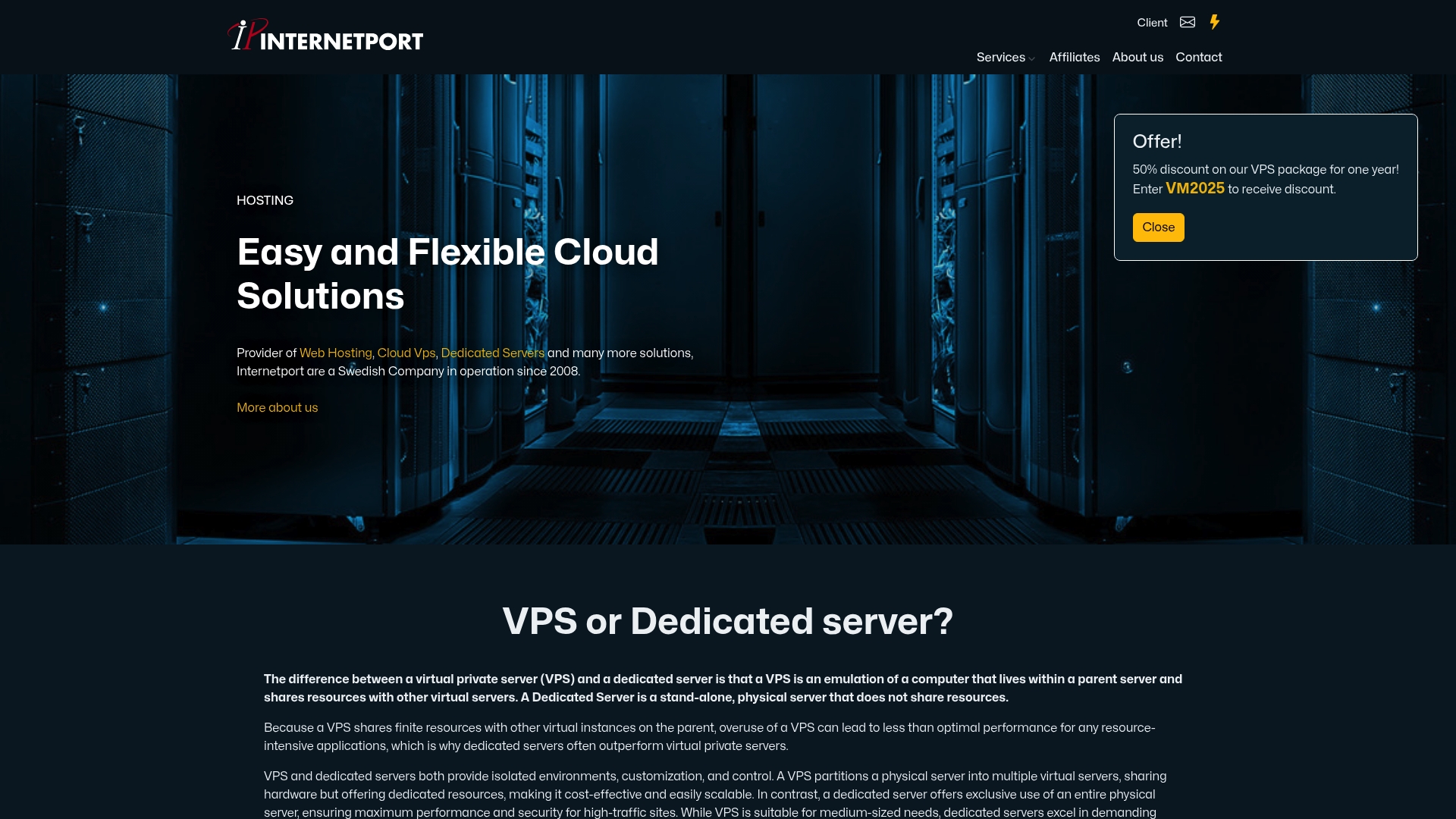
Whether you need a flexible entry-level VPS for a growing web application, dedicated server resources for high-performance workloads, or colocation options for businesses with existing hardware, Internetport's catalog covers the full range of SMB infrastructure needs. You get the technical depth of an enterprise provider without the price tag or the complexity. Explore Internetport's cloud solutions to find the right fit for your workload, your budget, and your team's capabilities.
FAQ
What is cloud VPS and how does it differ from shared hosting?
Cloud VPS gives you a dedicated virtual server with allocated CPU, RAM, and storage isolated from other users. Shared hosting pools resources across many accounts, making performance and security dependent on your neighbors.
Is cloud VPS worth it for small businesses?
Yes. Entry-level plans start around $3.32/month with 99.99% uptime guarantees, making cloud VPS accessible for small businesses that need reliable performance without large upfront costs.
How difficult is it to manage a cloud VPS?
Management complexity varies by configuration, but tools like cPanel reduce the workload significantly for teams without deep sysadmin experience. Managed VPS options are also available for businesses that prefer a hands-off approach.
Can cloud VPS help with compliance requirements?
Yes. The isolation, root access, and geographic control that cloud VPS provides make it far easier to document and demonstrate compliance for standards like PCI DSS compared to shared hosting environments.
How do I avoid vendor lock-in when using cloud VPS?
Choose a provider that supports standard Linux environments and open-source tooling. Avoiding proprietary databases or platform-specific configurations means you can migrate to a different provider by provisioning a new server and copying your setup.