
TL;DR:
- Direct cloud connectivity creates a private, dedicated network link to cloud providers, bypassing the public internet for predictability and security. It offers lower latency, consistent throughput, and reduces security and compliance risks, making it ideal for mission-critical workloads. Proper planning and coordination are essential for successful deployment, especially when involving multiple parties.
Direct cloud connectivity is a private, dedicated network connection between your organization's infrastructure and a cloud provider, completely bypassing the public internet. Unlike a standard broadband or VPN connection, it gives your traffic its own lane. No shared bandwidth, no public routing, no exposure to internet congestion or threats. For IT teams running mission-critical workloads, understanding what is direct cloud connectivity means understanding the difference between a network that performs predictably and one that doesn't.
The industry standard term for this concept is "dedicated cloud interconnect" or "private cloud connection," though "direct cloud connectivity" is the widely used shorthand across enterprise networking teams. Both phrases describe the same architecture: a physical or virtual circuit provisioned between your premises, a colocation facility, or a data center, and a cloud provider's edge. Services like AWS Direct Connect and Azure ExpressRoute are the most recognized implementations of this model.
What is direct cloud connectivity and why does it matter?
Direct cloud connectivity is defined as a private circuit connection that routes your traffic over a dedicated link rather than the shared public internet. The result is low latency, predictable throughput, and a stronger security posture. That combination matters enormously when your business depends on cloud applications for daily operations.

The public internet was designed for resilience, not performance. Traffic hops across dozens of routers, shares bandwidth with millions of other users, and takes unpredictable paths. A dedicated private link eliminates that variability. Your packets travel a fixed, known route from your network edge to the cloud provider's edge, every single time.
For businesses running financial systems, healthcare records, or real-time analytics in the cloud, that predictability is not optional. A few hundred milliseconds of added latency can break a database transaction or corrupt a real-time data feed. Direct connectivity removes that risk at the infrastructure level.
What are the key benefits of direct cloud connectivity?
The business case for direct cloud connectivity rests on four concrete advantages: security, performance, cost control, and compliance.
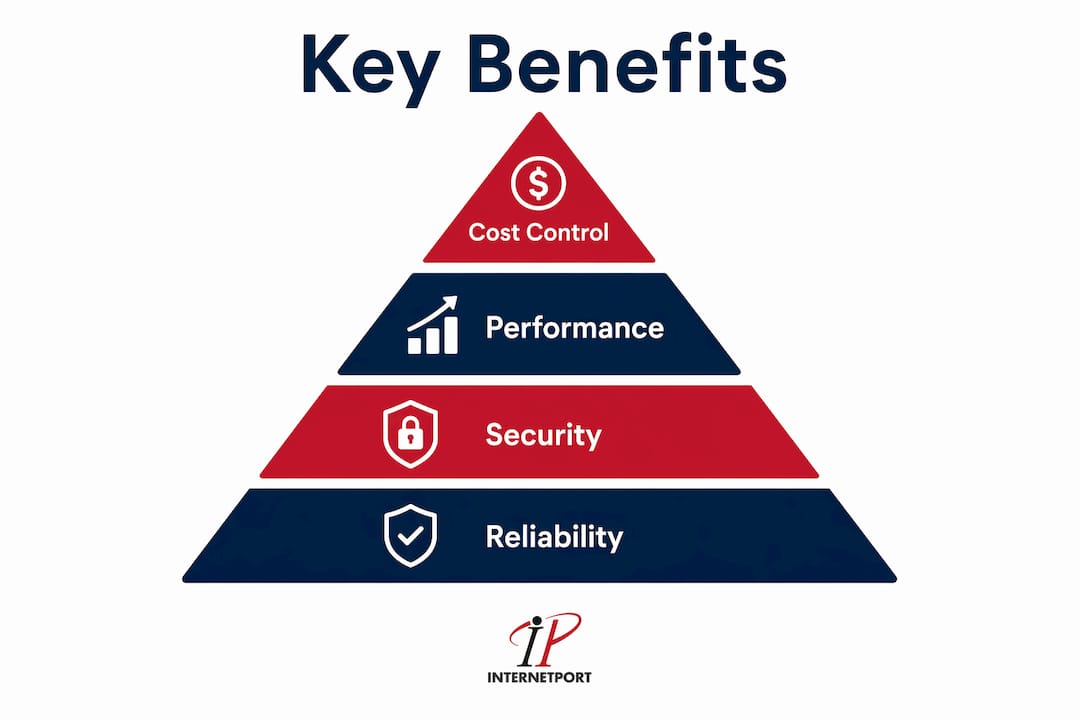
Security isolation is the most immediate gain. Direct private links isolate your traffic from the public internet entirely, which simplifies compliance with frameworks like PCI DSS, HIPAA, and ISO 27001. Your data never touches a public router, which eliminates an entire class of interception and man-in-the-middle risks.
Performance consistency is the second major benefit. Public internet connections introduce jitter and latency spikes that degrade cloud application performance. Direct connections deliver consistent, low-latency throughput because the path is fixed and the bandwidth is dedicated. Teams using cloud-hosted productivity suites, ERP systems, or video conferencing platforms notice the difference immediately.
Cost efficiency follows from bandwidth predictability. Direct connections reduce bottlenecks and bandwidth choke points that inflate data transfer costs on public internet connections. Many cloud providers charge lower data egress rates for traffic leaving over a direct connection compared to traffic leaving over the public internet.
Compliance and audit readiness round out the case. Regulators and auditors want evidence that sensitive data travels over controlled, documented paths. A private circuit provides exactly that: a documented, auditable network path with no public internet exposure.
Key benefits at a glance:
- Predictable latency: Fixed routing eliminates the variability of public internet paths.
- Dedicated bandwidth: No contention with other organizations or internet users.
- Reduced security exposure: Traffic stays off the public internet from end to end.
- Lower egress costs: Many cloud providers discount data transfer fees for direct connections.
- Compliance support: Private circuits satisfy data-in-transit requirements for regulated industries.
Pro Tip: Before committing to a direct connection, audit which of your cloud workloads actually require low latency or handle regulated data. Prioritizing those workloads first gives you the fastest return on the connectivity investment.
How does direct cloud connectivity work compared to indirect methods?
The core technical difference between direct and indirect cloud connections is the data path. Direct connectivity uses a dedicated fiber or private circuit provisioned specifically for your organization. Indirect connections, including site-to-site VPNs, route your traffic through the public internet using encrypted tunnels.
A VPN tunnel protects data in transit through encryption, but it does not change the underlying network path. Your packets still travel across public routers, compete for bandwidth with other internet traffic, and experience the same congestion and latency variability as unencrypted traffic. Encryption adds CPU overhead on both ends, which can further increase latency.
Direct connectivity removes the public internet from the equation entirely. Your circuit connects your network edge to a cloud provider's point of presence (PoP) through a carrier or colocation facility. From there, traffic enters the cloud provider's private backbone. The result is a network path you can measure, document, and rely on.
The table below compares the two approaches across the dimensions that matter most to IT teams:
| Criteria | Direct cloud connectivity | Indirect connection (VPN) |
|---|---|---|
| Network path | Private circuit, fixed route | Public internet, variable route |
| Latency | Low and consistent | Variable, higher under congestion |
| Security | No public internet exposure | Encrypted but traverses public internet |
| Bandwidth | Dedicated, guaranteed | Shared, subject to contention |
| Compliance fit | Strong, auditable path | Weaker, harder to document |
| Setup complexity | Higher, multi-party coordination | Lower, software-based |
| Best for | Mission-critical, regulated workloads | Development, low-sensitivity workloads |
Indirect VPN connections remain adequate for development environments, remote access, and workloads with low sensitivity or low performance requirements. The decision is not binary. Many organizations run direct connections for production workloads and VPNs for everything else.
What are the main cloud connectivity options for deployment?
Businesses implement direct cloud connectivity through several architectural patterns, each involving different combinations of providers and physical infrastructure.
Colocation-based interconnects
The most common deployment model routes your traffic through a colocation facility. Your organization places servers or network equipment in a shared data center. The colocation provider maintains cross-connects to cloud provider PoPs within the same facility or campus. This model gives you physical proximity to the cloud provider's edge, which minimizes the circuit length and latency. Colocation server environments at providers like Internetport support this architecture directly, with cross-connect options to major cloud networks.
Carrier-provisioned private circuits
Telecom carriers and ISPs provision dedicated circuits between your office or data center and a cloud provider's PoP. The carrier manages the physical layer, and you configure virtual interfaces on top. This model suits organizations with existing carrier relationships or those that need circuits spanning multiple geographic locations.
Virtual interfaces and VLAN partitioning
A single physical direct connection can serve multiple cloud environments through virtual interfaces and VLANs. Virtual interfaces allow simultaneous, secure access to multiple cloud services over the same physical link. This is the standard approach for multi-cloud environments where an organization uses more than one cloud provider. VLAN tagging keeps traffic from each cloud logically separated at the network layer.
Managed connectivity services
Managed connectivity services handle circuit procurement, configuration, and ongoing monitoring on your behalf. A managed service provider takes on the operational complexity of maintaining direct cloud links, including vendor coordination, performance validation, and incident response. This model works well for organizations that lack dedicated network engineering staff or want to reduce the internal overhead of managing multi-provider connectivity.
Pro Tip: If your organization uses more than one cloud provider, ask your colocation or carrier partner about multi-cloud exchange points. These facilities aggregate connections to multiple cloud providers under one roof, which cuts provisioning time and simplifies contract management significantly.
For a broader view of how these architectures fit into SMB infrastructure planning, the cloud networking examples guide covers practical configurations worth reviewing.
What should you consider before implementing direct cloud connectivity?
Implementation success depends on planning, not just technology. The biggest barrier to direct cloud connectivity is management complexity, not the underlying hardware or protocols.
-
Map your workload requirements first. Identify which applications need low latency, dedicated bandwidth, or regulatory compliance. Not every workload justifies the cost of a direct connection. Prioritize production databases, financial transaction systems, and regulated data pipelines.
-
Plan for multi-party coordination. Direct connect setup requires coordination between colocation providers, network transport carriers, and cloud vendors. Each party has its own procurement process, lead times, and technical requirements. Misaligned timelines between these parties can extend deployment by weeks or months.
-
Understand the cost structure. Direct connectivity costs typically include port hours (the ongoing cost of keeping the connection active), activation fees, and data transfer charges on outbound traffic. Inbound data transfers to the cloud are often free, which changes the cost calculation for workloads that primarily write data to the cloud.
-
Assess your internal network expertise. Configuring BGP routing, virtual interfaces, and VLAN tagging requires network engineering skills. If your team lacks that depth, a managed service provider reduces risk and accelerates deployment. Trying to self-manage a complex multi-cloud direct connect without the right expertise is one of the most common causes of performance problems post-deployment.
-
Build in monitoring from day one. A direct connection is not a set-and-forget solution. Establish baseline performance metrics during commissioning, then monitor latency, packet loss, and throughput continuously. Anomalies in a private circuit often indicate physical layer issues that require carrier intervention, and catching them early prevents extended outages.
-
Test failover before you need it. Direct circuits can fail. Plan for redundancy from the start, whether through a secondary circuit, a backup VPN, or a diverse carrier path. Testing failover in a controlled window is far better than discovering the gap during a production incident.
For teams evaluating cloud scalability and security alongside connectivity, the planning phase is where those concerns intersect most directly.
Key Takeaways
Direct cloud connectivity delivers consistent, secure, and auditable network performance that public internet connections and VPNs cannot match for mission-critical workloads.
| Point | Details |
|---|---|
| Core definition | Direct cloud connectivity is a private circuit that bypasses the public internet entirely. |
| Primary benefit | Dedicated bandwidth and fixed routing eliminate latency variability for production workloads. |
| Security advantage | Traffic isolation from the public internet simplifies compliance with PCI DSS, HIPAA, and similar frameworks. |
| Deployment complexity | Multi-party coordination across carriers, colocation providers, and cloud vendors requires careful planning. |
| Cost structure | Port hours and outbound data transfer fees are the main costs; inbound transfers are often free. |
Why I think most teams underestimate the planning phase
Most conversations about direct cloud connectivity focus on the technology. The circuit, the virtual interfaces, the BGP configuration. Those are real considerations, but they are not where deployments fail. Deployments fail in the coordination layer.
I've seen IT teams get the technical architecture exactly right and still spend three months waiting for a circuit to go live because the colocation provider, the carrier, and the cloud vendor were all working from different timelines. Nobody was wrong. Nobody was slow. The process just required more active management than anyone anticipated.
The lesson I take from that is simple: treat the procurement and coordination phase as a project in itself. Assign a single owner who is accountable for tracking progress across all three parties. That person does not need to be a network engineer. They need to be organized and persistent.
The second thing I'd push back on is the assumption that direct connectivity is always the right answer. Mission-critical workloads genuinely benefit from private circuits. Development environments, internal tools, and low-traffic applications generally do not. Applying direct connectivity uniformly across your cloud footprint inflates costs without proportional gains.
The teams that get this right start narrow. They identify the two or three workloads where latency, security, or compliance requirements are non-negotiable. They build the direct connection for those workloads first, validate the performance, and then expand. That approach also gives your network team time to build operational confidence before the architecture scales.
— Peter
How Internetport supports your cloud connectivity needs
Internetport's infrastructure is built for businesses that need reliable, secure cloud access without the overhead of managing it alone. Internetport operates data centers in Sweden and internationally, with colocation services that support cross-connects to major cloud networks. For teams that need dedicated compute alongside their connectivity, Internetport's webhosting and cloud VPS options provide PCI DSS-compliant infrastructure with private networking built in. Whether you are planning your first direct cloud connection or expanding an existing multi-cloud architecture, Internetport's technical team provides the guidance and infrastructure to support it.
FAQ
What is direct cloud connectivity in simple terms?
Direct cloud connectivity is a private network link between your business infrastructure and a cloud provider that does not use the public internet. It delivers lower latency, dedicated bandwidth, and stronger security than a standard internet or VPN connection.
How does direct cloud connectivity differ from a VPN?
A VPN encrypts traffic but still routes it over the public internet, which means variable latency and shared bandwidth. A direct connection uses a private circuit with a fixed route, giving you consistent performance and no public internet exposure.
Which workloads benefit most from direct cloud connectivity?
Mission-critical workloads such as financial transaction systems, healthcare data pipelines, and real-time analytics benefit most. Development environments and low-sensitivity applications typically do not require the added cost of a direct connection.
What does direct cloud connectivity cost?
Costs include port hours for keeping the connection active, one-time activation fees, and outbound data transfer charges. Inbound data transfers to the cloud are often free, which reduces total cost for write-heavy workloads.
How long does it take to set up a direct cloud connection?
Setup time varies based on provider coordination, but complex procurement processes involving colocation providers, carriers, and cloud vendors can extend timelines by weeks or months without active project management.