

TL;DR:
- Domain hosting manages your domain registration and DNS records, linking your domain name to your website's server. Web hosting stores the website files and delivers them to visitors, and both are essential for an active site. Proper management of DNS settings and choosing reliable providers prevent downtime and support your online reputation.
Domain hosting is the service that registers, manages, and connects your website's domain name to the hosting servers where your site's files live. Without it, your domain name is just a label with nowhere to point. The Domain Name System (DNS), overseen by the Internet Corporation for Assigned Names and Numbers (ICANN), translates human-readable domain names into IP addresses that computers understand. Domain registrars handle the registration side, while hosting providers store your actual website files. Understanding what is domain hosting, and how it differs from web hosting, is the first practical step toward building a reliable online presence as an individual or small business owner.
What is domain hosting and how does it work?
Domain hosting is the infrastructure layer that makes your chosen domain name functional on the internet. Think of your domain name as a street address and your web hosting server as the physical building at that address. The domain hosting service manages the address, while web hosting stores everything inside the building.

The DNS translation process follows four steps every time someone visits your site. First, a visitor types your domain into their browser. Second, the browser queries a DNS nameserver to find where that domain points. Third, the nameserver resolves the domain to a specific IP address. Fourth, the hosting server at that IP address delivers your website files to the visitor's browser.
DNS records called A records are the specific entries that link your domain name to your server's IP address. Nameservers are the directories that store those records. If either is misconfigured, your site goes offline, even if your hosting server is running perfectly. This is why DNS misconfiguration is one of the most common causes of unexpected website downtime for small business owners.
Pro Tip: After purchasing a domain and setting up hosting, check your DNS A records immediately using a free tool like MXToolbox. Catching a misconfiguration early saves hours of troubleshooting later.
Understanding DNS propagation also matters here. When you update DNS settings, the changes can take anywhere from a few minutes to 48 hours to spread across the global network of DNS servers. Plan any domain changes well before a product launch or site migration.
Domain hosting vs web hosting: what is the difference?
Domain hosting and web hosting are two separate services that work together to make a website function. Confusing them is one of the most common mistakes small business owners make when setting up their first website.
Domain hosting manages domain registration and DNS records, connecting your domain to an IP address. Web hosting stores your website files and serves them to visitors. You need both for a working website. Buying a domain without hosting is like printing a business address on a card but having no office at that address.
The table below shows the key functional differences between the two services.
| Feature | Domain hosting | Web hosting |
|---|---|---|
| Primary function | Registers and manages domain names | Stores and delivers website files |
| Core technology | DNS records, nameservers | Servers, storage, bandwidth |
| What it controls | Where your domain points | What visitors see on your site |
| Typical annual cost | ~$14.99/year | ~$7.99/month |
| Required for a live site | Yes | Yes |
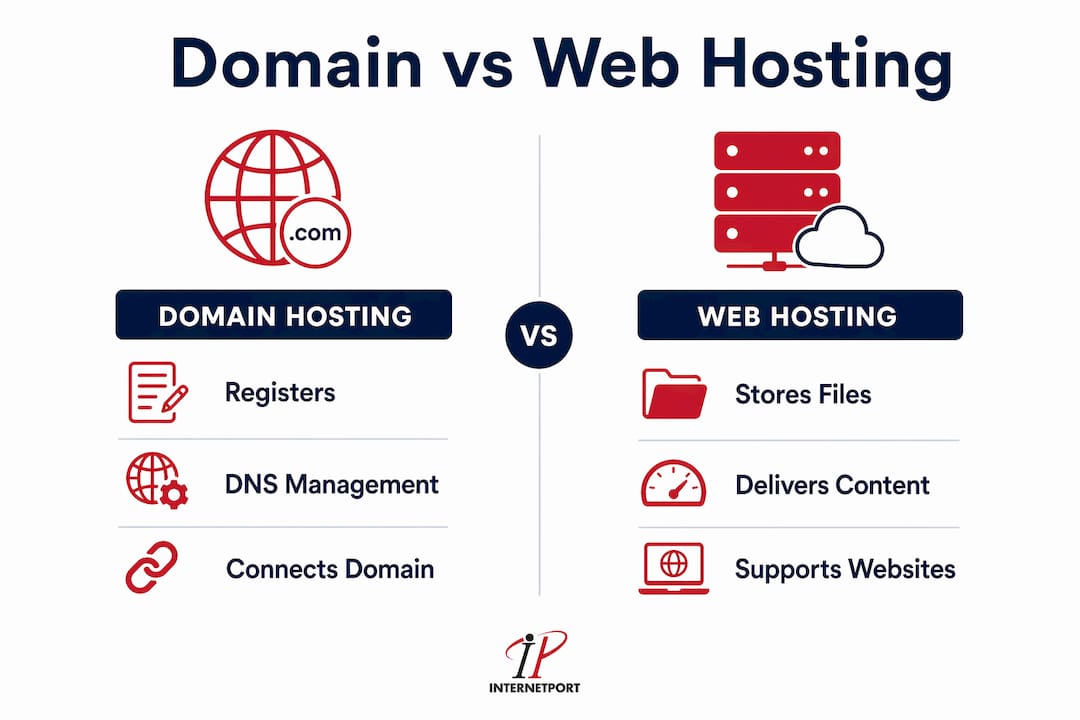
Purchasing a domain does not automatically include web hosting. These are separate purchases, even when offered by the same company. Many providers bundle them together for convenience, but you can also buy them from different companies and link them manually through DNS settings. The bundled approach is simpler for beginners. The split approach gives you more flexibility and control over each service independently.
A common misconception is that the company you buy your domain from automatically hosts your website. That is rarely true unless you explicitly purchase a hosting plan at the same time. Without active hosting, a domain name points to an empty server or a placeholder page, making your website completely inaccessible to visitors.
What types of domain hosting services are available?
Domain hosting services fall into three broad categories, each suited to different needs and budgets.
Basic registrar hosting is the entry point. You register a domain through a registrar and use their default DNS management tools. This option works well for individuals and small businesses that want simple control over their domain without advanced features. The DNS management panel lets you set A records, MX records for email, and CNAME records for subdomains.
Bundled domain and hosting packages combine domain registration with a web hosting plan under one provider. This is the most popular choice for small business owners because it simplifies billing and DNS management. You do not need to manually update nameservers to point your domain at a separate hosting server. Everything connects automatically within the same account.
Premium DNS services are a third category, designed for businesses that need faster DNS resolution, higher redundancy, and advanced security features like DNSSEC. These services sit on top of your existing domain registration and improve performance and protection. They are less common for small businesses but worth considering as traffic grows.
Pricing benchmarks help set realistic expectations. Domain registration averages around $14.99 per year, while web hosting averages around $7.99 per month. Some specialized domain hosting services charge about $30 per year or $75 for a three-year term, with first-year promotions often offered free when bundled with a hosting plan.
Most domain hosting plans include add-on services worth evaluating carefully.
- Domain privacy protection hides your personal contact information from the public WHOIS database, which lists domain owners. Without it, your name, email, and phone number are publicly searchable.
- Domain locking prevents unauthorized transfers of your domain to another registrar. This is a basic security measure every domain owner should activate.
- Auto-renewal settings prevent accidental domain expiration. Expired domains can be purchased by third parties within days, and recovering them is expensive and sometimes impossible.
- SSL certificates encrypt data between your site and visitors. Many hosting providers include a free SSL certificate, but confirm this before purchasing.
Pro Tip: Register your domain for two or more years upfront. Multi-year registrations often cost less per year, and they signal to search engines that your domain is established rather than temporary.
The digital presence of small businesses depends heavily on these foundational choices. A domain that expires or a DNS record that breaks can take a site offline for hours, damaging both customer trust and search engine rankings.
How to choose and manage domain hosting for your business
Choosing a domain hosting provider is not just a technical decision. It directly affects your site's speed, security, and reliability. Domain and hosting choices impact performance, security, and uptime, all of which matter for business credibility online.
The factors below are the ones that separate a reliable provider from a frustrating one.
- Uptime guarantees. Look for providers that commit to 99.9% uptime or higher. Even brief outages during business hours cost you visitors and sales.
- DNS management tools. A clear, accessible control panel for editing DNS records is non-negotiable. You will need to update records when you change hosting providers, add email services, or configure subdomains.
- Customer support quality. Technical DNS issues can surface at any hour. A provider with 24/7 support by phone or live chat is worth paying a premium for.
- Scalability. Start with a plan that fits your current needs, but confirm the provider offers managed hosting options that can grow with your traffic.
- Security features. DNSSEC, domain locking, and privacy protection should be standard or available as low-cost add-ons.
Managing DNS settings is where many small business owners run into trouble. When you register a domain and host your website with different companies, you must manually update DNS records in your registrar's control panel to point your domain at your hosting server. The specific records to update are the nameservers or the A record, depending on your provider's setup.
Self-hosting a website is generally not advisable for small business owners. The cost of maintaining a server, ensuring 24/7 uptime, and managing security patches exceeds what most small businesses can handle efficiently. Commercial hosting providers handle that infrastructure so you can focus on running your business.
Professional providers also manage the complex backend that keeps your domain resolving correctly across the global DNS network. That reliability directly supports your domain authority and technical SEO, since search engines factor uptime and site speed into rankings. Choosing the right provider from the start is far easier than migrating a live site later.
For businesses that need more control, a cloud VPS gives you dedicated resources and root access without the cost of a full dedicated server. This is a practical middle ground between shared hosting and enterprise infrastructure.
Pro Tip: Before migrating your domain to a new provider, lower your DNS TTL (Time to Live) value to 300 seconds about 24 hours in advance. This speeds up propagation when you make the switch and minimizes downtime.
Knowing how to choose web hosting that fits your specific needs is just as important as understanding domain hosting. The two decisions are connected, and making them together saves time and avoids compatibility issues later.
Key Takeaways
Domain hosting and web hosting are two distinct, equally necessary services that together make any website accessible and functional on the internet.
| Point | Details |
|---|---|
| Domain hosting defined | It registers your domain and manages DNS records that connect it to a hosting server. |
| DNS is the core mechanism | A records and nameservers link your domain name to your server's IP address. |
| Two services, not one | Buying a domain does not include hosting; both must be purchased for a live site. |
| Pricing benchmarks | Domain registration averages $14.99/year; web hosting averages $7.99/month. |
| Provider selection matters | Uptime, DNS tools, support quality, and security features determine long-term reliability. |
Why domain hosting decisions matter more than most people realize
People underestimate domain hosting until something goes wrong. A misconfigured A record, an expired domain, or a provider with poor DNS infrastructure can take a business offline at the worst possible moment. I have seen small business owners lose days of revenue because they did not realize their domain and hosting were managed separately, and no one told them to update their nameservers after switching hosting providers.
The address-and-building analogy is useful, but it undersells the stakes. Your domain name is also your brand identity online. Losing control of it, even temporarily, can mean losing email, losing search rankings, and losing customer trust. Recovering an expired domain that a third party has purchased can cost hundreds or even thousands of dollars.
The other thing most articles skip is the SEO angle. Reliable domain hosting with consistent uptime and fast DNS resolution contributes directly to how search engines perceive your site. A domain that frequently goes offline or resolves slowly signals instability. That signal compounds over time and is difficult to reverse.
My honest recommendation for small business owners is to bundle your domain and hosting with a single provider that offers strong DNS management tools and genuine 24/7 support. The small premium you pay for quality is trivial compared to the cost of a preventable outage. Review your DNS records at least once a year, keep auto-renewal active, and enable domain locking from day one. These are not advanced tasks. They are basic maintenance that most people ignore until it is too late.
— Peter
Internetport's hosting solutions for individuals and small businesses
Getting your domain and hosting set up correctly from the start saves significant time and frustration later. Internetport offers web hosting services built for individuals and small businesses that need reliable performance without managing complex infrastructure themselves.

Internetport's data centers operate in Sweden and internationally, with PCI DSS compliance and 24/7 technical support included. Plans cover shared web hosting, cloud VPS, and dedicated servers, so you can start with what fits your current needs and scale without switching providers. DNS management tools are included, and the support team can walk you through nameserver configuration if you are migrating an existing domain. Visit Internetport to review current plans and find the option that fits your setup.
FAQ
What is domain hosting in simple terms?
Domain hosting is the service that registers your domain name and manages the DNS records that connect it to your website's hosting server. Without it, your domain has no destination to point visitors toward.
Is domain hosting the same as web hosting?
No. Domain hosting manages your domain name and DNS settings, while web hosting stores your website files and delivers them to visitors. Both services are required for a fully functional website.
How much does domain hosting cost per year?
Domain registration averages around $14.99 per year, though prices vary by domain extension and provider. Some bundled plans include the first year free when purchased with a hosting plan.
What happens if my domain hosting expires?
An expired domain becomes available for others to register, sometimes within days. You can lose your domain name, your email addresses tied to it, and your website entirely if auto-renewal is not active.
Can I use different companies for domain hosting and web hosting?
Yes. You can register a domain with one company and host your website with another. You connect them by updating the DNS nameservers or A records in your domain registrar's control panel to point to your hosting provider's servers.