

TL;DR:
- Swedish hosting, governed by the 2026 Cybersecurity Act, emphasizes organizational security, compliance, and data sovereignty, making it highly strategic. Its expanding data center ecosystem offers sustainable, technologically advanced infrastructure capable of supporting demanding workloads and hybrid architectures. Choosing Swedish providers requires diligent assessment of legal, operational, and network performance factors to ensure secure, reliable, and compliant cloud solutions.
Sweden's new Cybersecurity Act, effective January 2026, fundamentally changes what "secure hosting" means for business decision-makers. Physical location is no longer just a latency consideration — it's a compliance statement. When you choose Swedish hosting, you're aligning with one of Europe's most mature cybersecurity governance frameworks, a data center market growing 15.5% annually, and a legal environment that treats sovereign data control as a contractual right, not a marketing promise. This guide covers the legal, operational, and technological dimensions that make Swedish hosting a serious strategic decision.
Table of Contents
- Understanding Sweden's cybersecurity landscape and legal advantages
- Sweden's expanding data center ecosystem: capacity, sustainability, and technological edge
- Sovereign control and jurisdictional benefits of Swedish hosting
- Optimizing network performance and infrastructure reliability with Swedish hosting
- Applying these insights: best practices for selecting a Swedish hosting provider
- My perspective: Why Swedish hosting is more than a location choice for future-ready enterprises
- Discover Internetport's flexible Swedish hosting solutions for your business
- Frequently asked questions
Key Takeaways
| Point | Details |
|---|---|
| Legal compliance advantage | Swedish hosting aligns with strong cybersecurity regulations raising the security baseline for cloud providers. |
| Sovereignty and jurisdiction | Keeping data within EU jurisdiction helps manage regulatory and geopolitical risks effectively. |
| Scalable infrastructure | Rapid data center market growth supports future-proof hosting for AI and hybrid cloud workloads. |
| Sustainability benefits | Free cooling and renewable energy reduce operational costs and environmental impact. |
| Performance validation | Real-world pilot testing is essential to confirm network latency and infrastructure benefits. |
Understanding Sweden's cybersecurity landscape and legal advantages
Why choose Swedish hosting starts with understanding what the legal environment actually requires of providers — and what that means for your organization's risk posture. Sweden's Cybersecurity Act raises baseline governance and operational requirements for ICT and cloud providers under the EU NIS2 Directive, which came into force in January 2026. This is not a minor update. It redefines the compliance floor for every provider operating in Sweden.
What makes this particularly significant for business clients is that the law doesn't just target IT teams. The Swedish Cybersecurity Act introduces a whole-entity approach with flexible, risk-based minimum security measures. That means your hosting provider must demonstrate that cybersecurity is embedded across their entire organization — procurement, leadership, incident response, and supplier management — not just patched onto their technical stack.
Here's what that translates to in practical terms for your due diligence process:
- Risk-based controls: Providers must implement security measures proportionate to actual risk, which produces more realistic and effective protections than checkbox compliance.
- Documented governance: Auditable compliance records give you verifiable proof of a provider's security posture, not just their marketing copy.
- Incident reporting obligations: Providers must report significant incidents to authorities within defined timeframes, which creates accountability and operational transparency.
- Supply chain security: The whole-entity requirement extends scrutiny to a provider's own vendors and subprocessors.
"Swedish cybersecurity law now requires providers to treat security as an organizational function, not a technical department. For clients, this means compliance becomes something you can contractually verify, not just assume."
Understanding how local data centers handle security and compliance matters because the legal framework is only as valuable as the operator's implementation. The NIS2-aligned Cybersecurity Act gives you a structured basis to audit providers and hold them accountable in ways that aren't possible in less regulated jurisdictions.
With this legal foundation clear, let's examine Sweden's data center ecosystem and its expanding infrastructure capacity.
Sweden's expanding data center ecosystem: capacity, sustainability, and technological edge
The benefits of Swedish data centers go well beyond governance. Sweden's physical and digital infrastructure has reached a scale that supports serious enterprise workloads, and the growth trajectory shows no signs of flattening.

Sweden's colocation market is reaching US$917.4 million in 2026, driven by AI workloads and hybrid cloud adoption. This growth signals a maturing vendor ecosystem with the capacity, redundancy, and competition needed to support demanding enterprise clients. When the market is growing at this pace, providers are investing in infrastructure — not coasting on existing assets.
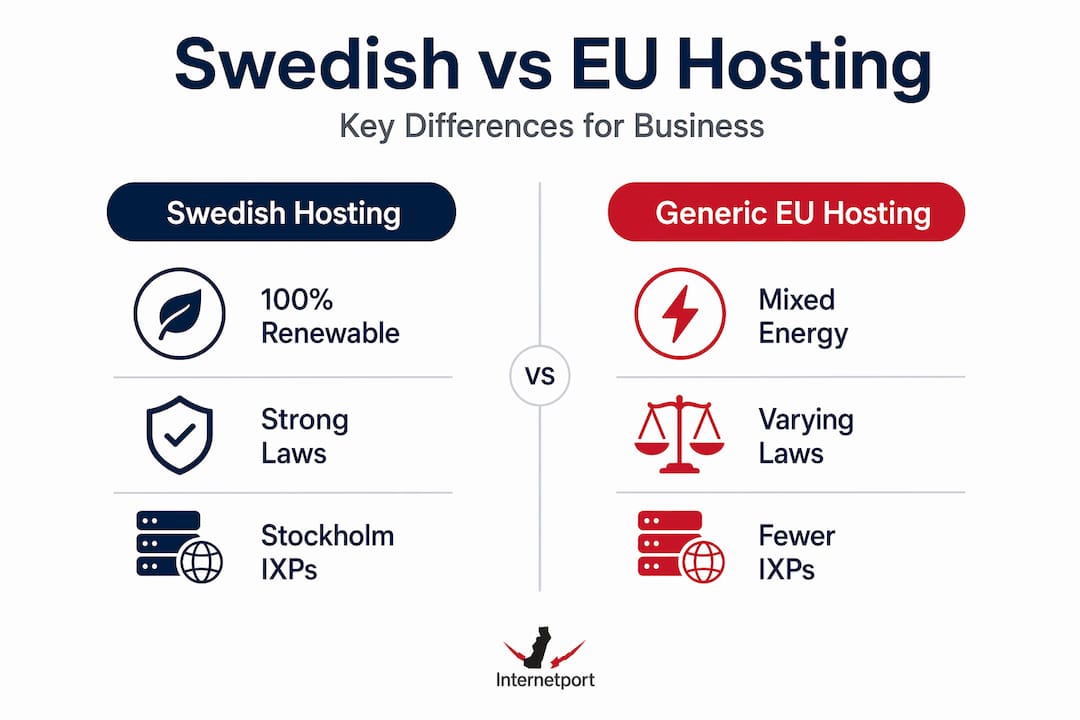
One of the less-discussed advantages of hosting in Sweden is what happens to the heat your servers generate. Swedish data centers have developed cooling technologies and renewable energy use that keep operational costs and emissions low even for power-intensive workloads. Free cooling uses Sweden's cold climate to reduce mechanical cooling loads significantly. Some facilities feed recovered heat back into district heating networks, turning an operational byproduct into a community resource. For organizations with ESG reporting obligations, this is a measurable, auditable sustainability credential.
| Feature | Swedish data centers | Generic EU data centers |
|---|---|---|
| Renewable energy use | Near 100% in most facilities | Varies widely |
| Free cooling availability | High (cold climate advantage) | Limited in warmer regions |
| NIS2-aligned legal framework | Enforced as of 2026 | Varies by country |
| AI and GPU workload capacity | Rapidly expanding | Mixed maturity |
| Internet exchange point access | Major Nordic IXPs in Stockholm | Depends on location |
Sweden's connectivity infrastructure also deserves attention. Stockholm serves as a major Nordic internet exchange point, which means data traveling between your users and your servers benefits from efficient regional routing rather than longer international paths.
Pro Tip: When evaluating Swedish web hosting features, ask providers specifically about their power usage effectiveness (PUE) rating and their renewable energy certificates. A PUE below 1.3 is strong. Combined with certified renewable sourcing, it gives you hard numbers to drop into sustainability reports.
Understanding hybrid cloud architecture is increasingly relevant here because Sweden's data center growth is partly driven by organizations running workloads across private and public cloud environments simultaneously. Sweden's infrastructure is built to support this architecture, not just single-tenant dedicated environments.
For decision-makers evaluating enterprise cloud solutions in 2026, Sweden's combination of regulatory maturity, physical capacity, and sustainability credentials creates a hosting environment that's genuinely difficult to match elsewhere in Europe.
Beyond capacity and innovation, the jurisdictional and sovereignty aspects further strengthen the Swedish hosting appeal.
Sovereign control and jurisdictional benefits of Swedish hosting
Here's where many organizations make a costly oversimplification. They assume that hosting data in an EU country automatically provides adequate data sovereignty. It doesn't. The actual sovereignty protections depend on the operator's legal entity, their cloud dependencies, and critically, what your contract says.
Sweden's laws and cybersecurity rules actively support keeping sensitive workloads under EU and Swedish jurisdiction, making them a preferred choice for organizations focused on sovereignty and regulatory risk management. But Sweden's legal framework only protects you if your provider is actually subject to it, and if your agreements enforce it.
Think of sovereign cloud not as a location label but as a contractual and placement design problem. Here's how to approach it:
- Classify your data before you negotiate. Separate your data into categories: publicly available, commercially sensitive, regulated, and critical. Each class may warrant different placement and contractual treatment.
- Specify geographic and jurisdictional placement in writing. Vague language like "data stored in Europe" is insufficient. Require your provider to commit to specific jurisdictions and data center locations.
- Require explicit sovereignty clauses. Your agreement should state which legal jurisdiction governs data processing, and it should exclude jurisdictions with laws that conflict with GDPR or your own regulatory requirements.
- Negotiate portability rights upfront. Contract clauses defining data placement, portability, and exit rights are essential for managing supplier risk. If you can't move your data without extraordinary cost or technical complexity, your sovereignty is theoretical.
- Map your provider's own cloud dependencies. A Swedish provider that relies on a US-headquartered hyperscaler for core services may be subject to CLOUD Act jurisdiction. This is a real exposure that due diligence must surface.
Pro Tip: Request a copy of your prospective provider's data processing agreement and their subprocessor list before signing anything. If they're reluctant to share either document, that tells you everything you need to know about how they'll handle your data sovereignty requirements.
Managing jurisdictional risk through local data centers is partly about trust, but mostly about enforceable contractual design. Sweden's legal system gives you a strong foundation. Your contracts determine whether you actually benefit from it.
Understanding Sweden's jurisdictional strengths closes the legal and regulatory picture. Now let's focus on operational performance advantages.
Optimizing network performance and infrastructure reliability with Swedish hosting
Sweden hosting advantages aren't only regulatory. For organizations serving Nordic and European markets, the network performance case is equally compelling — though it requires honest analysis rather than vendor promises.
Stockholm is home to major internet exchange points (IXPs) including Netnod, one of the largest in Northern Europe. Stockholm's Nordic internet connectivity position supports lower-latency networking for regional and European operations. IXPs allow networks to exchange traffic directly rather than routing through multiple transit providers, which reduces latency and improves reliability. For latency-sensitive applications — financial transaction processing, real-time communications, gaming infrastructure — this matters considerably.
But here's the nuance that vendors won't volunteer: performance gains depend heavily on your architecture and networking choices. Hosting your application in Stockholm doesn't automatically reduce latency for users in, say, Warsaw or Amsterdam. Your content delivery strategy, DNS configuration, and application caching all determine the actual user experience.
Key factors that determine your realized network performance from Swedish hosting:
- DNS provider selection: A globally distributed DNS network routes users to the nearest entry point. Using a single-origin DNS undermines geographic hosting advantages.
- CDN configuration: Static assets should be cached at edge locations closest to your users, regardless of where your origin server sits.
- Database query patterns: If your application makes frequent calls to a database in Sweden from application servers elsewhere in Europe, latency compounds. Architecture matters as much as location.
- Peering agreements: Ask your Swedish hosting provider which networks they peer with at Stockholm IXPs. Direct peering with major Nordic ISPs reduces transit hops.
Pro Tip: Before committing to a full migration, run a 2 to 4 week pilot with representative production workloads. Measure actual latency percentiles (p50, p95, p99) from your key user geographies, not just average ping times. Average latency can look excellent while p99 latency quietly destroys user experience for a meaningful share of your traffic.
Understanding network performance in the Swedish hosting landscape gives you a benchmark for comparing providers. Performance claims are easy to make. Measured latency distributions are harder to dispute.
With a clear grasp of operational and strategic benefits, let's address how to apply these insights when selecting a provider.
Applying these insights: best practices for selecting a Swedish hosting provider
Knowing the advantages of hosting in Sweden is one thing. Translating that knowledge into a sound vendor selection process is another. Here's a practical framework for business decision-makers evaluating Swedish providers.
- Conduct supplier due diligence beyond physical location. Due diligence must go beyond physical location to include who operates the hosting and how cloud dependencies are managed — this is critical for compliance with Sweden's Cybersecurity Act. Ask for the provider's legal entity, their registration with Swedish authorities, and their NIS2 compliance documentation.
- Scrutinize contract terms for sovereignty and exit rights. Review data processing agreements for jurisdictional commitments, subprocessor disclosure, and portability provisions. Vague terms benefit the provider, not you.
- Verify infrastructure capacity claims with realistic timelines. Power availability and infrastructure timelines require confirmation due to permitting and grid limitations when assessing vendor capacity claims. A provider may have expansion plans that depend on power grid capacity that isn't yet approved. Ask for current certified capacity, not future projections.
- Pilot services before full commitment. Deploy a representative subset of workloads for 30 to 60 days. Measure latency, availability, support response times, and failover behavior under realistic load.
| Evaluation criterion | What to ask the provider | Red flag response |
|---|---|---|
| Legal jurisdiction | Which entity processes your data? | "Our parent company handles that" |
| NIS2 compliance | Can you provide compliance documentation? | "We're working on it" |
| Subprocessors | Share your full subprocessor list | Refuses or provides incomplete list |
| Power capacity | What is your current certified power capacity? | "We have expansion plans" |
| Exit rights | How do you support data export at contract end? | Migration fees or format restrictions |
| SLA terms | What are your uptime guarantees and credits? | SLA applies only to hardware, not service |
Pro Tip: When evaluating local data centers, ask for reference clients in your industry who have already gone through the onboarding process. A provider confident in their service will connect you quickly. One who hesitates has something they'd rather you didn't hear.
Understanding hybrid cloud deployment models is also valuable at this stage because your Swedish hosting vendor may be one component of a broader multi-cloud architecture. Confirm that their infrastructure integrates cleanly with your existing cloud environments.
Having outlined practical selection steps, here's our editorial perspective on what Swedish hosting really means strategically.
My perspective: Why Swedish hosting is more than a location choice for future-ready enterprises
Most hosting discussions focus on price-per-core or uptime percentages. Those metrics matter, but they miss what actually differentiates Swedish hosting at an organizational level.
Sweden has done something genuinely unusual in the European hosting landscape. It has built a legal, environmental, and technical ecosystem where the incentives of providers, regulators, and clients are reasonably well-aligned. The Cybersecurity Act doesn't just raise compliance requirements — it creates a governance culture that filters out providers who treat security as an afterthought. That has real value for clients who need to trust their infrastructure without running continuous audits.
The sustainability angle is underrated in vendor selection conversations. Organizations report ESG metrics to boards, investors, and regulators with increasing frequency. Swedish data centers running on near-100% renewable energy with heat recovery programs offer something that's genuinely useful in those reports — not just a green badge, but auditable, measurable environmental performance. That's different from a provider claiming sustainability while quietly purchasing renewable energy certificates on a spot market.
What I'd push back on, though, is the instinct to treat Swedish hosting as a set-and-forget compliance solution. The local data center compliance picture is strong, but it doesn't absolve your organization of responsibility for your own security controls. Sweden's Cybersecurity Act makes providers more accountable. It doesn't transfer your obligations to them. The strongest implementations treat hosting choice as the foundation of a compliance strategy, not the entirety of it.
The performance validation point is one I feel strongly about. Too many organizations move to a new hosting environment based on vendor benchmarks and discover six months later that their actual user experience didn't improve as expected. Pilot testing isn't just prudent — it's the only honest way to evaluate a hosting choice for your specific workload profile.
Swedish hosting is a serious strategic asset when approached seriously. Treated as a location label, it delivers far less than it promises.
Discover Internetport's flexible Swedish hosting solutions for your business
If the benefits outlined here align with your organization's requirements, Internetport's hosting portfolio is worth a direct look. Operating since 2008 from state-of-the-art Swedish data centers, Internetport provides web hosting services designed for businesses that need reliable, compliant, and scalable infrastructure — not shared-resource environments built for personal sites.
For organizations requiring dedicated resources, Internetport's dedicated servers in Sweden deliver up to 10 Gbps bandwidth with PCI DSS compliance and full hardware isolation. If you're managing your own hardware or consolidating existing equipment into a professionally managed environment, the colocation server options offer rack space in redundant Swedish facilities with private networking and cloud connect capabilities. Every service tier reflects the Cybersecurity Act's governance standards — compliance isn't an add-on at Internetport, it's built into the infrastructure from the ground up.
Frequently asked questions
What makes Swedish hosting more secure than other hosting locations?
Swedish hosting operates under the 2026 Cybersecurity Act implementing EU NIS2, which requires comprehensive risk-based security and governance controls across entire provider organizations, not just technical functions. This creates a verifiable, auditable security baseline that most other EU jurisdictions haven't yet formalized.
How does Sweden support sustainable data center operations?
Swedish facilities use free cooling from the cold climate, heat recovery systems, and near-100% renewable energy, keeping operational costs and emissions measurably lower than typical EU data centers, especially for GPU and AI-intensive workloads.
Can hosting in Sweden help with EU data sovereignty and compliance?
Yes. Sweden's legal framework supports EU jurisdiction for sensitive workloads and enables contractual sovereignty protections including data placement commitments, portability rights, and exit terms — provided these are explicitly negotiated into your hosting agreement.
Is Swedish hosting suitable for AI and hybrid cloud workloads?
Absolutely. The Swedish colocation market is reaching US$917.4 million in 2026, driven specifically by AI/GPU demand and hybrid multi-cloud adoption, with the infrastructure investment and provider ecosystem to support high-performance, flexible deployments.