
TL;DR:
- Choosing local Swedish data centers offers critical advantages in latency, compliance, and support for sensitive or regulated data. However, grid capacity, permitting delays, and staffing shortages present tangible risks that require proactive planning and strategic architecture. Implementing structured audits, hybrid solutions, and multi-site redundancy can help organizations build resilient, compliant, and future-proof infrastructure.
Most IT managers assume that because cloud infrastructure is "somewhere in Europe," it meets their organization's needs. That assumption carries real risk. Where your data lives, how fast support responds, and which jurisdiction governs your systems are not abstract concerns. For Swedish organizations managing sensitive data, high-traffic applications, or strict compliance obligations, the physical location of your infrastructure shapes every operational outcome. This article breaks down the security, performance, and regulatory advantages of local data centers, addresses the genuine limitations, and gives you a practical framework for making smarter infrastructure decisions.
Table of Contents
- What makes local data centers vital for Swedish organizations?
- Security, compliance, and continuity: Core advantages of local hosting
- Potential pitfalls: Local data center limits you must factor in
- Building a resilient strategy with local data centers
- Why the Swedish local data center debate needs more nuance
- Ready to maximize your infrastructure with Swedish local data centers?
- Frequently asked questions
Key Takeaways
| Point | Details |
|---|---|
| Local boosts compliance | Hosting in Swedish data centers makes meeting regulatory and privacy requirements easier for IT managers. |
| Real-world limits | Constraints like power grid, permits, and talent can slow down local expansion, even in ideal locations. |
| Optimize for resilience | Combining local data centers with smart vendor evaluation and hybrid models maximizes reliability and scalability. |
| Strategic partnerships matter | Long-term, nuanced engagement with Swedish providers is essential for building future-proof IT infrastructure. |
What makes local data centers vital for Swedish organizations?
Sweden occupies a genuinely unusual position in the global data center landscape. The country offers some of Europe's most competitive energy costs, powered largely by renewable hydroelectric and nuclear sources. It sits at the intersection of major Nordic and transatlantic network routes, making it a natural hub. And yet, understanding the data center basics quickly reveals that not all Swedish facilities are built or positioned equally.
For IT decision-makers, three immediate priorities drive the choice of local facilities. First, latency matters. Round-trip times between Stockholm and a data center in Frankfurt or Amsterdam average 20 to 40 milliseconds. For a local Swedish facility, that number drops to single digits. That gap is trivial for static web content but becomes operationally critical for real-time transaction processing, live trading platforms, or latency-sensitive SaaS applications.
Second, compliance and data sovereignty are increasingly non-negotiable. GDPR requires that personal data be processed with adequate protection, and Swedish public authorities face additional constraints under national law about where specific categories of data can reside. Hosting locally eliminates an entire class of cross-border data transfer risk.
Third, there is the matter of trust and accountability. When something goes wrong, which it will at some point, local providers can send engineers on-site within hours. They speak the same language, operate in the same time zone, and understand the regulatory context your organization works within.
Here is what Swedish IT managers consistently rank as their top reasons for choosing local facilities:
- Sub-10ms latency to end users across Sweden
- Clear data residency for GDPR and sector-specific regulation
- Local support teams reachable during Swedish business hours
- Physical proximity enabling faster incident resolution
- Energy sourcing aligned with sustainability reporting obligations
- Easier audit and certification verification under Swedish law
However, the picture is not entirely straightforward. Swedish data center projects face bottlenecks that impact deployment timelines and investment planning, a reality that makes provider selection more consequential than it might appear on the surface.
Security, compliance, and continuity: Core advantages of local hosting
The security case for local data centers goes well beyond just keeping data inside Sweden's borders. It touches on how quickly threats are detected, how effectively they are contained, and how much control your team retains over physical and logical access to systems.

Swedish law, including the NIS2 directive now implemented across EU member states, places explicit obligations on organizations running critical infrastructure. Hosting locally means your incident response team can coordinate directly with your provider, with Swedish authorities if necessary, and with your internal security operations center without the friction of cross-border communication delays or jurisdictional ambiguity.
| Security dimension | Local data center | Remote/global data center |
|---|---|---|
| Incident response time | Hours (on-site possible) | Days (remote coordination) |
| Regulatory jurisdiction | Clear (Swedish/EU law) | Complex (multiple jurisdictions) |
| Physical access control | Auditable locally | Dependent on third-party reports |
| Data sovereignty | Guaranteed | Requires contractual assurances |
| Support language and hours | Swedish business hours | Varies by region |
Data center security at a local facility also means you can walk through the compliance audit process together with your provider, something that remote hyperscalers rarely accommodate. Certifications like ISO 27001, PCI DSS, and SOC 2 are worth requiring, and verifying them is far simpler when the provider is subject to Swedish regulatory oversight.
"A local provider that understands the Swedish regulatory environment is not just a vendor. They are a compliance partner who shares accountability for outcomes."
Permitting delays and workforce issues impact Swedish data center projects, which heightens the need for risk-aware provider selection. Organizations that lock into contracts with facilities still navigating permitting or staffing gaps face real continuity exposure.
On the business continuity front, industry research consistently shows that organizations with local, redundant infrastructure recover from outages faster. Colocation models, where you place your own hardware in a certified facility rather than relying entirely on shared cloud resources, give you physical proximity to your systems and the ability to escalate hardware issues within the same business day. The reliability case for colocation is particularly strong for organizations that cannot tolerate multi-hour recovery windows.
Pro Tip: When evaluating a Swedish data center provider, ask for their documented mean time to repair (MTTR) for critical incidents over the past 24 months. Any provider worth your contract should have this data ready and be willing to discuss it. Also cross-check their certifications against industry security best practices to ensure standards are current, not historical achievements from a one-time audit.
The combination of Swedish legal protections, local support accountability, and physical proximity creates a security and continuity baseline that distributed global infrastructure simply cannot replicate for most Swedish organizations.
Potential pitfalls: Local data center limits you must factor in
Choosing local does not mean choosing without risk. The same factors that make Sweden an attractive data center destination also create specific constraints that IT managers need to plan around rather than discover mid-deployment.
Grid capacity is the most pressing concern right now. Sweden's power grid, while renewable-heavy, faces regional congestion particularly around major metropolitan areas. Gothenburg and Stockholm both have zones where new large-scale data center connections face queuing delays of one to three years. This is not speculation. Power, permitting, and skilled labor can restrict Swedish data center expansion even when a geographic location appears ideal on paper.
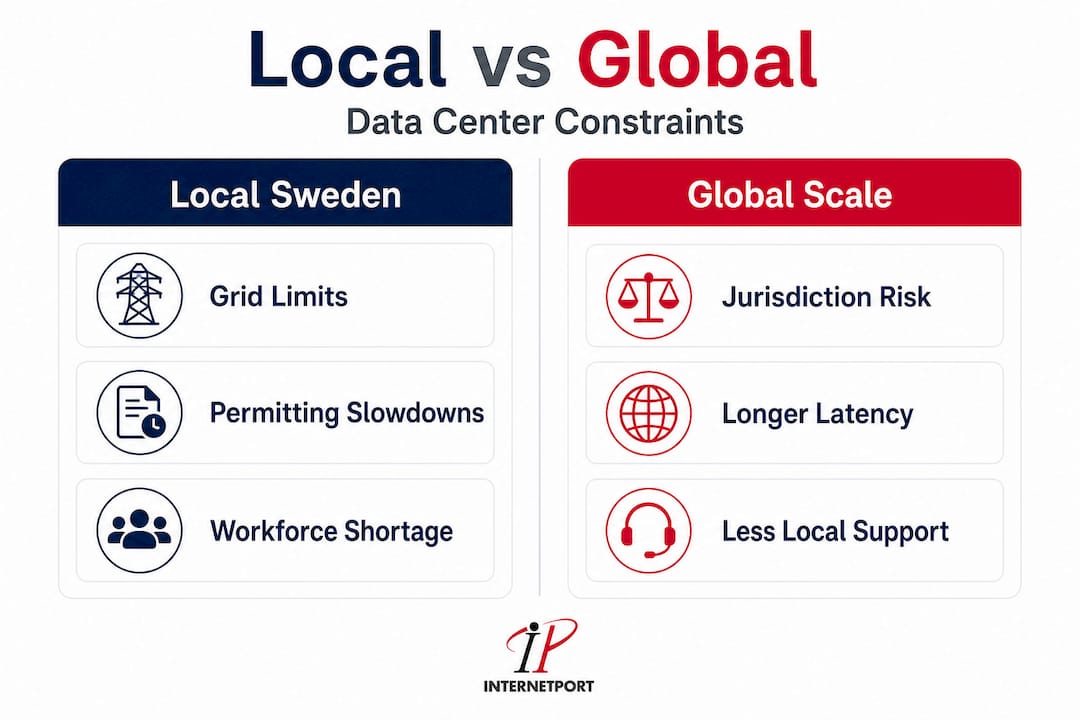
| Risk factor | Local Swedish data centers | Global/hyperscale data centers |
|---|---|---|
| Grid capacity constraints | Moderate to high in urban zones | Low (global resource distribution) |
| Permitting delays | Can be significant | Minimal for established campuses |
| Talent availability | Limited specialist pool | Large distributed teams |
| Scalability ceiling | Facility-dependent | Nearly unlimited on demand |
| Regulatory clarity | High (Swedish law applies) | Variable (multi-jurisdiction) |
| Latency performance | Excellent for Swedish users | Higher for regional users |
| Physical customization | High | Low to moderate |
The talent shortage is a separate but related issue. Skilled data center engineers and security specialists in Sweden are in high demand, and smaller local providers may face staffing gaps that affect service quality. This is not a reason to avoid local providers, but it is a reason to ask hard questions about staffing depth, escalation paths, and vendor support agreements before signing a long-term contract.
To build resilience around these constraints, Swedish IT teams should follow a structured approach rather than reacting after problems emerge. Here is a numbered framework for proactive risk mitigation:
- Audit grid connectivity early. Before committing to a facility, request documentation on power redundancy, available capacity, and planned grid upgrades in the provider's area. Confirm that the facility has at least N+1 power redundancy with diverse utility feeds.
- Check permitting status. If a provider is expanding capacity to accommodate your growth, ask for the current permitting stage and realistic timelines. Delays here directly impact your ability to scale.
- Evaluate hybrid architecture options. Pairing a local Swedish colocation facility with cloud burst capacity from a secondary provider protects you against local capacity limits without sacrificing the compliance and latency benefits of local hosting.
- Build a talent dependency map. Identify which services rely on specialists your provider employs. If key roles are single-threaded, negotiate contractual SLAs (service level agreements) with financial penalties for response time failures.
- Schedule annual infrastructure reviews. Infrastructure needs shift as your organization grows and as Swedish regulations evolve. A formal annual review with your provider keeps both sides accountable.
The outage prevention strategies that work consistently are the ones baked into procurement and contract negotiations, not patched in after an incident.
For organizations with aggressive growth trajectories, private cloud strategies offer a middle path. A private cloud hosted locally gives you the control and compliance assurance of dedicated infrastructure with more flexibility than a fully on-premise model.
Building a resilient strategy with local data centers
Knowing the benefits and the risks is only half the equation. The organizations that succeed with local data center strategies are the ones that turn this knowledge into structured, repeatable decision-making processes.
Start with a provider audit that goes beyond marketing materials. Skill shortages and infrastructure bottlenecks emphasize the need for careful, forward-looking partnerships rather than transactional vendor relationships. The providers worth working with are the ones that can show you their roadmap, not just their current spec sheet.
When auditing a potential local data center partner, cover these selection criteria:
- Physical security. Multi-factor access controls, CCTV coverage, and visitor log requirements are baseline. Ask to review a recent third-party physical security audit.
- Network redundancy. Multiple upstream carriers, ideally with diverse routing paths. Confirm the provider's peering relationships and ask for their network uptime history.
- Power and cooling. Power usage effectiveness (PUE) scores, UPS (uninterruptible power supply) capacity, and diesel generator test logs.
- Certifications. ISO 27001 and PCI DSS at minimum for most Swedish enterprise use cases. Ask for the most recent audit report, not just the certificate date.
- Support structure. Dedicated account managers with Swedish-speaking technical staff. Documented escalation paths for incidents at each severity level.
- Growth capacity. Available rack space, power headroom, and planned facility expansions with committed timelines.
- Contract flexibility. Exit clauses, data migration support provisions, and clear SLAs with measurable penalties.
Pro Tip: Run a tabletop incident simulation with your shortlisted providers before committing. Describe a realistic failure scenario, such as a RAID controller failure on a production database server at 2:00 AM on a Friday, and ask them to walk you through their response. The quality and speed of that conversation tells you more than any SLA document.
For organizations with operations across multiple Swedish cities or serving customers throughout the Nordic region, colocation and multi-site redundancy is worth serious consideration. A complete colocation setup guide covers the workflow in detail, but the core principle is straightforward. Distributing critical workloads across two Swedish facilities in different power zones eliminates single-site risk while keeping all data under Swedish jurisdiction.
Consider a scenario that plays out regularly for mid-sized Swedish organizations. A company running core business applications out of a single Stockholm facility experiences an unexpected power incident affecting their entire rack row. With a secondary colocation site in Gothenburg carrying a live replica of their database tier, the failover completes in under four minutes and end users see nothing. Without the secondary site, recovery would have taken four to six hours. That is the operational difference multi-site strategy delivers.
For teams evaluating how this integrates with broader cloud infrastructure options, the answer is almost always a hybrid model. Burst capacity in the cloud, core workloads on local dedicated or colocation infrastructure, and a clear data classification policy that dictates which category each workload falls into. You can also reference what providers like cloud deployment specialists offer in terms of flexible server configurations to understand what your baseline expectations should be.
Why the Swedish local data center debate needs more nuance
Most conversations about local versus global infrastructure get framed as a binary choice. Keep everything local for control, or go global for scale. That framing is not only simplistic, it leads Swedish IT leaders toward decisions that cost more and protect less than a more nuanced approach would.
The real question is never "local or global" but rather "which workloads belong where, and what does orchestration across locations actually require?"
Critical customer data, payment processing, and applications serving Swedish public sector clients belong on Swedish soil, under Swedish jurisdiction, with local support accountability. That is not a preference, it is increasingly a legal and contractual obligation. But a test environment running development builds, or a global CDN (content delivery network) layer serving static assets to international users, does not need to live in a Stockholm colocation cage.
Sweden risks losing competitiveness if local infrastructure bottlenecks are not addressed strategically. That concern is real, and it applies at the national level. But it also applies at the organizational level. Companies that fail to invest in smart local infrastructure strategies now will find themselves scrambling to retrofit compliance and security controls as regulatory requirements tighten over the next several years.
Executive buy-in changes how these decisions get made. When infrastructure strategy is treated as a technical matter for IT alone, it gets underfunded and under-prioritized. When executives understand that local infrastructure quality directly affects audit outcomes, insurance premiums, and customer trust, the conversation changes.
We have watched organizations go through painful migrations after starting with a purely cost-minimized global cloud approach, only to discover that their sector-specific compliance requirements made that architecture untenable. The rebuild cost three to four times what a thoughtful local-first strategy would have cost from the start.
Swedish IT leaders have a genuine opportunity to shape their organizations' resilience and, at a broader level, contribute to the national infrastructure strength that makes Sweden competitive as a technology hub. That requires enterprise colocation strategies that go beyond cost per rack unit and encompass long-term partnership, redundancy architecture, and proactive capacity planning.
The nuanced position is this: local data centers are not the answer to every problem, but they are the foundation that serious Swedish IT infrastructure cannot be built without.
Ready to maximize your infrastructure with Swedish local data centers?
Understanding the full picture of local data center strategy is the first step. The next is working with a provider that has already solved the hard problems around security, compliance, and scalability for Swedish organizations.
Internetport has operated certified data center infrastructure in Sweden since 2008, supporting IT teams that cannot afford to compromise on uptime, security, or regulatory alignment. From dedicated server options built for high-performance workloads to colocation hosting that puts your hardware in PCI DSS-compliant facilities with redundant power and up to 10 Gbps connectivity, the infrastructure is designed for organizations that take resilience seriously. Explore the full range of Swedish cloud solutions and connect with a team that understands both the technical requirements and the Swedish regulatory context your organization operates within.
Frequently asked questions
How do local data centers improve regulatory compliance in Sweden?
Data stored in local Swedish centers is subject to Swedish and EU jurisdiction, which directly simplifies GDPR compliance and data sovereignty obligations. Hosting data locally removes the legal complexity of cross-border data transfers and makes compliance audits more straightforward for organizations subject to Swedish sector-specific regulations.
Are local data centers more reliable than global ones?
Data center location impacts both outage risk profiles and support responsiveness, but reliability ultimately comes down to the individual provider's infrastructure quality, redundancy design, and operational discipline rather than geography alone.
What limits the scalability of Swedish local data centers?
Power, permitting, and labor availability are the primary constraints, with grid capacity in urban areas and permitting timelines for new facility expansions representing the most significant near-term bottlenecks for organizations planning rapid growth.
How can IT managers mitigate risks when choosing a local data center?
Conduct structured provider audits covering certifications, power redundancy, network diversity, and staffing depth, and build hybrid or multi-site colocation strategies into your architecture from the start rather than adding them after a failure event forces your hand.