
TL;DR:
- Colocation offers predictable costs, enhanced security, compliance, and scalability for enterprises.
- Moving from cloud to colocation can save millions and improve application performance.
- Hybrid infrastructure combining colocation and cloud provides flexibility and control for future growth.
When 37signals moved its infrastructure away from Amazon Web Services, the company didn't just cut costs. It saved $10M over five years while dramatically improving latency and gaining direct control over its hardware. This case study shattered a widely held assumption among IT decision-makers: that public cloud is always the smarter, cheaper choice. The reality is more nuanced. Colocation delivers enterprise-grade security, scalability, and operational efficiency that cloud providers often cannot match at scale. In this article, we'll walk through exactly how colocation works, what it costs, how it handles compliance, and how to integrate it with cloud for a future-ready hybrid strategy.
Table of Contents
- What is enterprise colocation and how does it deliver value?
- Real-world impact: Cost savings and performance gains with colocation
- Security, compliance, and risk: How colocation addresses key enterprise challenges
- Integrating colocation with cloud: Building hybrid and future-ready enterprise IT
- Why the real value of colocation is often overlooked
- Explore trusted colocation solutions for your enterprise
- Frequently asked questions
Key Takeaways
| Point | Details |
|---|---|
| Substantial cost savings | Enterprises may save millions by migrating workloads from public cloud to colocation. |
| Enhanced security and compliance | Colocation gives enterprises control over physical and regulatory safeguards for critical infrastructure. |
| Operational flexibility | Colocation enables hybrid IT strategies, blending on-premises hardware with scalable cloud capabilities. |
| Mitigated disaster risk | Quality colocation providers offer redundant power, disaster planning, and compliance that reduce outage risks. |
What is enterprise colocation and how does it deliver value?
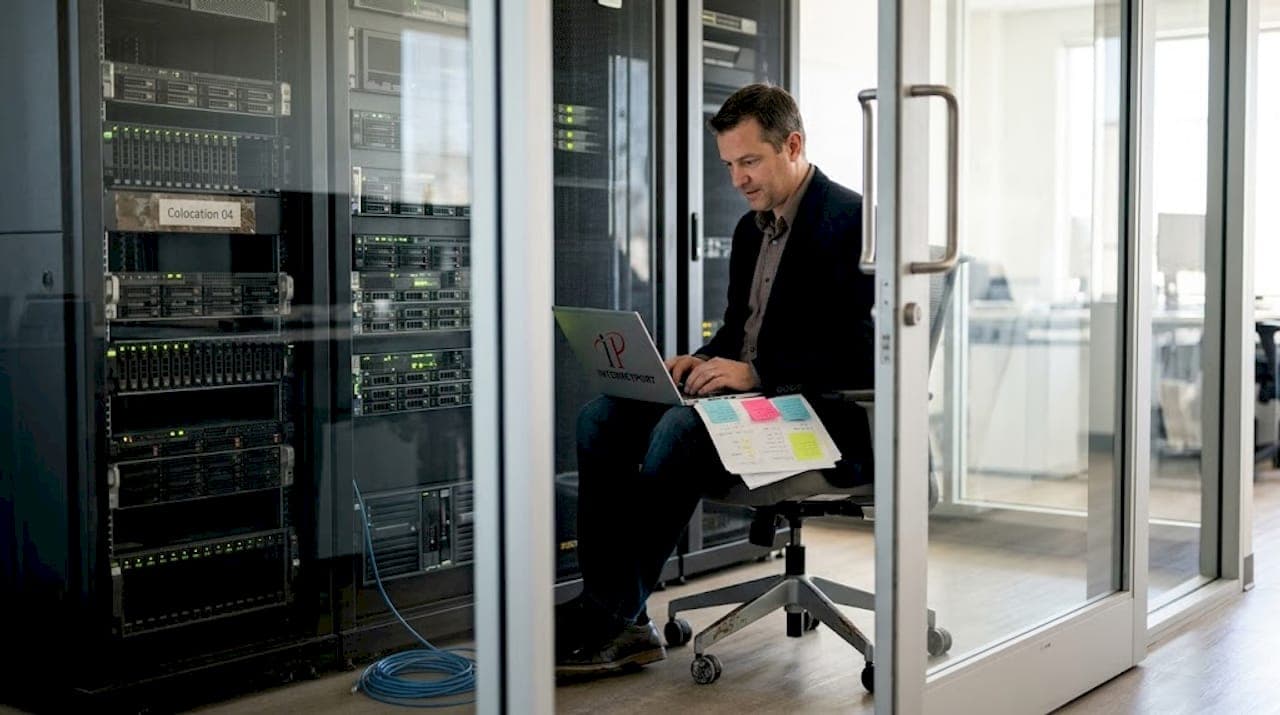
Colocation sits at an interesting crossroads between owning your own data center and renting compute from a public cloud provider. In simple terms, you own the servers and networking hardware, but you house them inside a professionally managed third-party facility. That facility provides the physical space, power, cooling, and connectivity. You handle everything inside the rack.
This model is fundamentally different from public cloud, where you rent compute capacity you never physically touch. It's also different from running an on-premises data center, where your team manages the building, the power infrastructure, and all the redundancy systems. Colocation gives you hardware ownership without the overhead of facility management.
Not every organization is the right fit for colocation. It works best for enterprises that need strict regulatory compliance, predictable performance, or custom hardware configurations that cloud providers won't support. Financial institutions, healthcare organizations, and high-frequency trading firms are classic examples. So are any enterprises with workloads that have grown large enough that cloud rental fees become painful.
According to a cost-effective, secure, scalable environment analysis for enterprises needing dedicated infrastructure, colocation consistently outperforms alternatives when control and predictability matter most. Here's a quick look at what it delivers:
- Cost efficiency: Replace unpredictable cloud bills with fixed, manageable monthly costs
- Security: Physical control of your hardware inside a hardened facility
- Compliance: Facilities certified for PCI DSS, SOC2, HIPAA, and other standards
- Reliability: Enterprise-grade redundancy for power, cooling, and network connectivity
- Scalability: Expand your footprint without rebuilding your architecture
"Organizations running high-performance, compliance-sensitive workloads consistently find that colocation reduces total cost of ownership while improving operational resilience." — Colocation industry analysis, 2025
Understanding preventable outages is also a key reason enterprises turn to colocation. Professional facilities invest heavily in redundancy that most companies cannot afford to replicate internally. For IT leaders exploring alternatives, reviewing private cloud advantages alongside colocation helps clarify which workloads belong where.
Real-world impact: Cost savings and performance gains with colocation
Let's put real numbers on the table. When 37signals left AWS, the financial impact was significant. Their cloud spend was running at approximately $3.2M annually. After moving to colocation, they projected total 5-year savings of $10M while also seeing meaningful latency reductions that improved application performance for end users.

This isn't an isolated story. It reflects a broader pattern called "cloud repatriation," where enterprises migrate specific workloads back from public cloud to owned or collocated hardware. It typically happens when a workload's resource consumption becomes predictable and high enough that cloud billing stops being flexible and starts being expensive.
| Infrastructure model | Estimated 5-year cost | Typical latency | Flexibility |
|---|---|---|---|
| Public cloud (AWS/Azure) | $10M+ at scale | Variable, often higher | High |
| Colocation | $4-6M at scale | Low, consistent | Medium-High |
| On-premises data center | $6-9M (capex + ops) | Lowest | Low |
The table above is illustrative, but the pattern holds across industries. Public cloud shines for variable workloads, rapid prototyping, and burst capacity. It becomes a liability when utilization is constant and high.
Hidden costs are a real problem. Cloud pricing models often understate what enterprises actually pay once you factor in egress fees, data transfer between availability zones, support tiers, and reserved instance lock-in. Colocation pricing is blunter but far more predictable.
Pro Tip: Before your next cloud contract renewal, run a utilization audit. If your average CPU and memory usage stays above 60-70% consistently, you're almost certainly paying a premium for flexibility you're not using. Colocation may already make economic sense.
For scalable hosting for SMBs growing into enterprise workloads, this inflection point often arrives earlier than expected. Understanding how to connect private cloud networks with colocation environments helps teams plan the transition strategically rather than reactively.
Security, compliance, and risk: How colocation addresses key enterprise challenges
Cost and performance are compelling. But for many enterprises, security and compliance are the deciding factors, and this is where colocation genuinely pulls ahead of standard cloud deployments.
Public cloud providers offer shared responsibility models. They secure the infrastructure. You secure everything running on it. That's a reasonable division for many use cases, but it creates real gaps for organizations operating under strict regulatory requirements. With colocation, your hardware never shares physical infrastructure with another company's workloads. That physical isolation is not something cloud can replicate.
When evaluating a colocation facility for compliance and disaster recovery strength, use a structured approach:
- Verify certifications: Confirm the facility holds relevant certifications (SOC2 Type II, PCI DSS, ISO 27001, HIPAA readiness)
- Assess location risk: Evaluate geographic hazards including flood zones, seismic activity, and proximity to industrial sites
- Review power redundancy: Look for N+1 or 2N power configurations with multiple utility feeds and diesel generator backup
- Examine network diversity: Confirm multiple carriers enter the facility through physically separate paths
- Test incident response: Ask for documented SLAs on response time, escalation procedures, and past incident reports
Here's a quick reference for what separates a strong facility from a weak one:
| Feature | Strong facility | Weak facility |
|---|---|---|
| Power redundancy | 2N (fully redundant) | N+1 or single feed |
| Network providers | 3+ carriers, diverse paths | 1-2 carriers, single path |
| Compliance certifications | SOC2, PCI DSS, ISO 27001 | Self-attested only |
| Physical security | Biometric, mantrap, 24/7 CCTV | Badge access only |
| Cooling design | Hot/cold aisle containment | Open floor |
Pro Tip: Always audit the physical location during a site visit. Ask specifically about the facility's flood plain status, the age of its power infrastructure, and when its last third-party security audit was completed. A sales pitch won't reveal these details, but a walkthrough usually will.
Connecting colocation to your broader enterprise hosting security posture requires deliberate planning. Understanding your hosting solution selection criteria before you tour facilities will help you ask the right questions and avoid being swayed by aesthetics over substance.
Integrating colocation with cloud: Building hybrid and future-ready enterprise IT
Very few enterprises operate entirely on colocation. The most effective infrastructure strategies today blend colocation with cloud resources to get the benefits of both without the downsides of either.
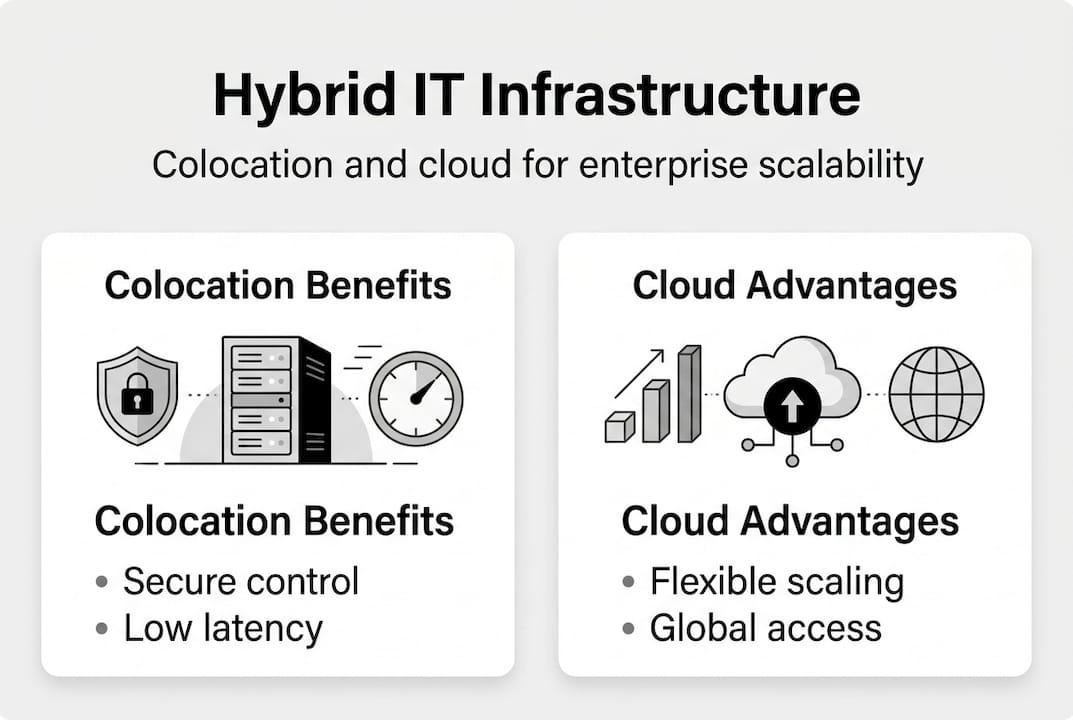
The architectural pattern is called a hybrid deployment. Your latency-sensitive, compliance-heavy, or compute-intensive workloads live in colocation. Burst capacity, development environments, and globally distributed applications run in the cloud. A direct connect link, such as AWS Direct Connect or Azure ExpressRoute, bridges the two environments with dedicated, low-latency bandwidth that bypasses the public internet.
Hybrid integration involves more than just plugging in a cross-connect cable. Rack design, airflow management, and redundancy planning all matter enormously. A poorly cooled rack in a colocation cage will cause hardware failures regardless of how good the facility is. A poorly planned hybrid network will create bottlenecks that eliminate the latency advantage you paid for.
Common use cases where hybrid colocation excels:
- Disaster recovery: Primary workloads in colo, failover environment in cloud
- Data sovereignty: Regulated data stays in colocation; analytics workloads run in cloud
- Latency-sensitive applications: Trading systems, real-time video, low-latency APIs in colo
- Dev/test environments: Spin up cloud instances for testing, deploy production to colo
- Compliance isolation: Sensitive workloads physically isolated in colo with cloud connectivity for non-regulated services
Enterprise IT leaders who build with adaptability in mind find that hybrid models don't just solve today's problems. They create optionality for tomorrow's decisions. Explore colocation server solutions as a foundation for this kind of architecture. Pairing them with a clear strategy for scalability and connectivity helps ensure the model scales as your organization grows.
Why the real value of colocation is often overlooked
Most total cost of ownership analyses compare cloud invoices against colocation invoices and call it a day. That misses the point entirely.
The real value of colocation is strategic leverage. When you own your hardware and control your facility relationship, you negotiate from a position of strength with every vendor in your stack. Cloud providers know that switching costs are enormous. Colocation narrows that advantage.
There's also a resilience argument that rarely makes it into spreadsheets. When you control your physical environment, you control your response to incidents. You're not waiting on a cloud provider's status page to tell you when your workload will recover. You have staff, you have contracts, and you have access.
Some IT leaders dismiss colocation as "old school." We'd argue the opposite. The smartest infrastructure decisions we've seen blend ownership and optionality, and that's exactly what a well-designed hybrid model delivers. Reviewing cloud solution examples alongside colocation architecture shows that the two aren't competitors. They're complements. The enterprises that figure this out earliest tend to operate with more flexibility and less vendor dependency than their peers.
Explore trusted colocation solutions for your enterprise
For organizations considering their next move with colocation, expert help makes all the difference.
At Internetport, we've operated enterprise-grade data centers since 2008, with PCI DSS certification, redundant power and network systems, and direct connectivity to both private and public cloud environments. Our enterprise colocation services give your team full control over your hardware inside a facility built for uptime and compliance. Whether you're migrating workloads, expanding capacity, or building a hybrid strategy, our team is ready to help you evaluate your options. Start with a conversation about your infrastructure goals, or explore our webhosting services for organizations looking to pair managed hosting with colocation flexibility.
Frequently asked questions
How does colocation lower costs compared to public cloud for enterprises?
Colocation lets enterprises own and manage their hardware, avoiding ongoing cloud rental fees and gaining cost predictability. Real-world migrations show enterprises saving $10M over five years by moving steady-state workloads from cloud to colocation.
What are the top security and compliance features in a quality colocation facility?
Key features include physical security controls like biometric access and 24/7 monitoring, redundant power and cooling, and formal certifications. Evaluating compliance and security standards like SOC2, PCI DSS, and ISO 27001 should be your starting point during any facility assessment.
Can enterprises combine colocation with cloud for hybrid solutions?
Yes. Most mature enterprise environments use colocation for stable, compliance-sensitive workloads while leveraging cloud for burst capacity and global distribution. Hybrid integration via direct connects is the standard architectural approach for bridging these environments securely.
What should enterprises evaluate when touring a colocation site?
Focus on location-based risk factors, power redundancy design, carrier diversity, physical security protocols, and cooling architecture. Reviewing power and redundancy specifics alongside certifications gives you a complete picture before signing any agreement.