

TL;DR:
- True data center certification involves independent audits, not just self-described Tier labels.
- Certification standards like Uptime Institute and TIA-942 address reliability, infrastructure, and operational practices.
- Ongoing operational rigor and staff competence are essential to maintain true data center reliability.
Not every data center that claims a "Tier" rating has earned one. That distinction matters more than most IT decision-makers realize. True data center certification is a rigorous, multi-stage process governed by independent bodies, and confusing marketing language with formal validation is a costly mistake. Self-claimed Tier status without a formal audit behind it tells you nothing about actual uptime performance, redundancy design, or operational discipline. For SMBs and enterprises weighing hosting partners, understanding what real certification involves and what it guarantees is the foundation for smart infrastructure decisions.
Table of Contents
- What is data center certification?
- Key certification standards: Uptime Institute vs. TIA-942
- Inside the certification process: Stages and must-know steps
- Impact on business: Uptime, risk reduction, and costs
- Planning for the future: Innovations and certification trends
- Why most organizations get data center certification wrong
- Take the next step: Reliable infrastructure for your business
- Frequently asked questions
Key Takeaways
| Point | Details |
|---|---|
| Certification is multi-stage | True certification requires documented audits, facility checks, and ongoing reviews for reliability. |
| Uptime and TIA-942 compared | These certification standards focus on different criteria and are often used together for full assurance. |
| Operations drive reliability | Operational excellence is crucial and certification alone does not prevent outages without proper procedures. |
| Future-ready standards | Emerging technologies like AI demand new certification addendums and frequent audit updates. |
| Business value matters | Certification helps minimize risk, reduce downtime, and support compliance for SMBs and enterprises alike. |
What is data center certification?
Data center certification is an independent, evidence-based process that validates whether a facility meets defined standards for infrastructure reliability, operational practices, and sometimes sustainability. It is not a badge a provider prints on a marketing page. Real certification requires formal audits, documentation reviews, and ongoing surveillance conducted by accredited third-party bodies.
The process typically moves through several structured stages:
- Gap analysis: The current facility is measured against the target standard to identify shortfalls.
- Design documentation review: Blueprints, power layouts, and cooling schematics are assessed before construction or major upgrades.
- Constructed facility audit: Physical infrastructure is inspected against the approved design.
- Operational sustainability review: Day-to-day procedures, staffing protocols, and maintenance records are evaluated.
This multi-stage process means certification is never a one-time event. It reflects both the design quality of the building and the discipline of the team running it.
A critical distinction worth repeating: a "Tier" label and a formal certification are not the same thing. Providers can describe their own infrastructure using Tier language without submitting to any audit. That practice is misleading because it borrows credibility without earning it.
Verified certification gives you an auditable trail. A self-applied label gives you nothing but a marketing claim.
For IT leaders researching hosting partners, understanding the data center essentials behind these standards is the first step toward building a reliable, compliant infrastructure strategy.
Key certification standards: Uptime Institute vs. TIA-942
Two systems dominate the global certification landscape. Knowing how they differ helps you ask the right questions when evaluating providers.
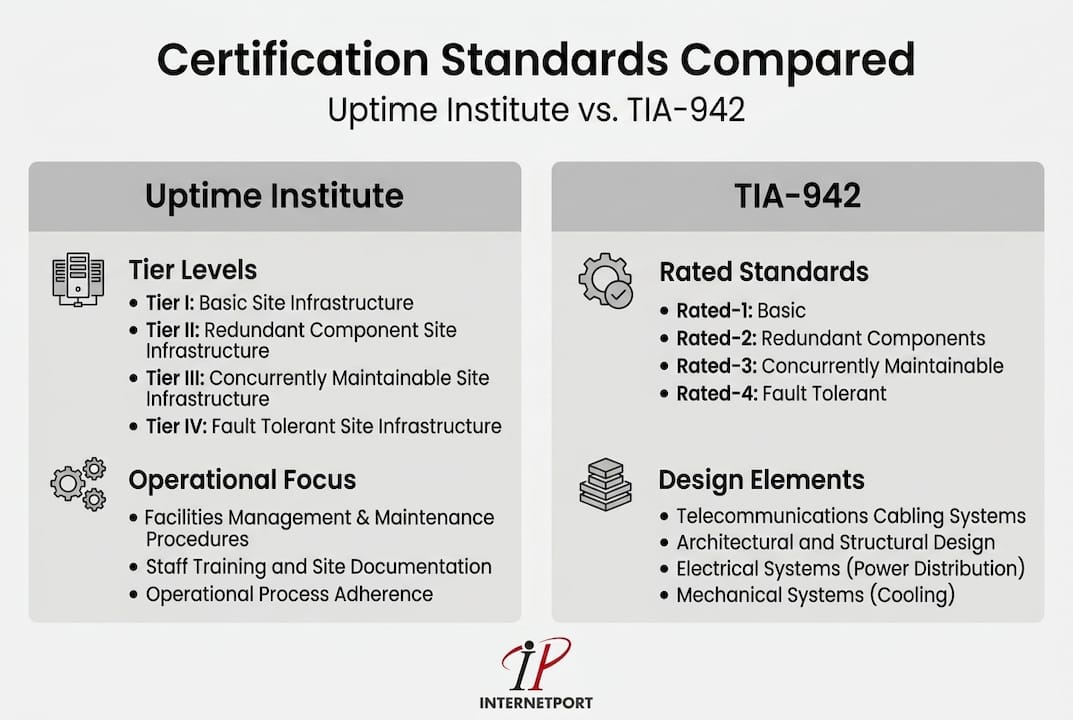
Uptime Institute Tier Certification uses a proprietary four-level framework (Tier I through Tier IV), with each tier adding layers of redundancy and fault tolerance. The process is managed exclusively by Uptime Institute, and certification requires documented design review plus a constructed facility evaluation. Tier IV, the highest level, guarantees fault tolerance meaning no single failure can cause a system outage.
TIA-942 (Telecommunications Infrastructure Standard for Data Centers) is published by the Telecommunications Industry Association (TIA) as an ANSI-recognized standard. It uses a Rated-1 to Rated-4 scale and covers a broader scope including architecture, electrical, mechanical, and telecom systems. TIA-942 relies on third-party auditors trained and licensed by TIA, making it more accessible globally but also variable in auditor quality.
| Criteria | Uptime Institute | TIA-942 |
|---|---|---|
| Scale | Tier I to Tier IV | Rated-1 to Rated-4 |
| Auditor | Uptime Institute only | TIA-licensed third parties |
| Scope | Reliability and redundancy | Full infrastructure (architecture, electrical, mechanical, telecom) |
| Standard type | Proprietary | ANSI standard |
| Global recognition | Very high | High and growing |
Neither is universally superior. Each certification addresses unique risks, and some enterprise-grade facilities pursue both to satisfy different compliance requirements. In practice, TIA-942 is often preferred for procurement and regulatory use cases because it maps to an open standard. Uptime Institute certification tends to carry more weight for operational SLA commitments.
For organizations focused on minimizing preventable outages, understanding which certification addresses which failure mode is essential before signing any hosting contract.
Inside the certification process: Stages and must-know steps
Certification sounds formal and distant until you realize your hosting provider's uptime guarantee depends on it. Here is what the process actually looks like, from start to renewal.
- Gap analysis: An auditor reviews current infrastructure against the target standard. This surfaces design gaps, missing documentation, and operational weaknesses before the formal audit begins.
- Documentation review: Detailed records of power distribution, cooling redundancy, fire suppression, and maintenance procedures are submitted and reviewed.
- On-site inspection: Auditors physically verify that the constructed facility matches the approved documentation. Nothing is taken at face value.
- Load testing and commissioning: Facilities move through commissioning levels (0 through 6), from basic inspection to full integrated system testing under real-world load conditions.
- Annual surveillance audits: Most frameworks require yearly check-ins to confirm ongoing compliance, not just at the time of original certification.
- Recertification: Periodic recertification ensures the facility continues to meet standards as equipment ages, technology evolves, and operational practices shift.
Two common pitfalls catch organizations off guard. First, skipping operational audits because the physical build passed inspection. Second, underestimating how much work recertification actually requires when equipment has been upgraded or procedures have changed.
Pro Tip: Before selecting any hosting partner, ask for the actual certificate document, not just a logo on the website. Verify the issuing body, the date, and the scope of certification. If a provider cannot produce that document, treat the claim as unverified.
For SMBs and enterprise teams building out server management strategies, pairing certified infrastructure with disciplined internal processes is what separates resilient environments from vulnerable ones.
Impact on business: Uptime, risk reduction, and costs
Certification is not free, and the cost difference between tiers is significant. But the financial argument for certified infrastructure becomes clear when you look at what unplanned downtime actually costs.
Downtime costs range from roughly $5,000 to $20,000 per hour for mid-sized operations, and far more for financial or healthcare environments. High-tier certified facilities typically cost three to twelve times more than basic Tier I environments, but they dramatically reduce the frequency and duration of outages. That math matters when a single incident can wipe out months of cost savings.
| Certification level | Expected uptime | Typical risk profile |
|---|---|---|
| Tier I / Rated-1 | 99.671% (28.8 hrs downtime/yr) | High, single points of failure |
| Tier II / Rated-2 | 99.741% (22 hrs downtime/yr) | Moderate, partial redundancy |
| Tier III / Rated-3 | 99.982% (1.6 hrs downtime/yr) | Low, concurrently maintainable |
| Tier IV / Rated-4 | 99.995% (~26 min downtime/yr) | Very low, fully fault tolerant |
Here is the uncomfortable reality: 45 to 54 percent of all data center outages are caused by human error. Not hardware failure. Not power loss. People making mistakes. That means a beautifully certified Tier IV facility can still suffer major outages if the operations team is undertrained or procedures are ignored.
Benefits of certified infrastructure include:
- Simplified compliance with frameworks like ISO 27002 compliance
- Stronger SLA commitments backed by auditable evidence
- Reduced cyber and physical security risk
- Faster vendor and customer trust-building in procurement processes
For IT leaders evaluating reliable hosting strategies or reviewing secure hosting solutions, tier-matched certification aligned with your actual workload criticality is the target. Not every workload needs Tier IV. But every workload deserves a certified environment.
Planning for the future: Innovations and certification trends
The data center industry is changing faster than most certification frameworks were built to handle. Two forces are driving that pressure: artificial intelligence and high-density computing.
AI workloads require rack densities that conventional cooling systems simply cannot support. Traditional air-cooled racks handle 10 to 30 kilowatts per rack. AI-optimized deployments routinely exceed 100 kilowatts per rack. That gap is forcing a complete rethink of power distribution, cooling architecture, and the physical safety requirements that certifications are designed to validate.
New TIA-942 addendums are actively being developed to address liquid cooling, direct-to-chip cooling, and the unique power density demands of AI-driven facilities. This is not a future problem. Providers building or upgrading facilities today need to design with these emerging requirements in mind.
Key trends IT decision-makers should track:
- Liquid cooling certification requirements are becoming a standard component of high-tier audits.
- Energy efficiency metrics (like Power Usage Effectiveness, or PUE) are increasingly embedded in certification criteria.
- AI-specific design standards are emerging from both TIA and independent bodies.
- Continuous audit culture is replacing point-in-time certification as the expected operational baseline.
Pro Tip: Review your hosting provider's certification dates and stated scope annually. A certificate issued before liquid cooling was required may not cover the infrastructure changes that have occurred since then.
Organizations keeping pace with cloud solution trends and evaluating scalable hosting options should specifically ask providers how their certifications account for AI infrastructure demands.
Why most organizations get data center certification wrong
After years of working with enterprise and SMB clients on infrastructure decisions, the pattern is clear: most organizations treat certification as a destination rather than a discipline.
They verify a provider's Tier rating during procurement, file the certificate with their compliance documentation, and move on. Annual surveillance audits are skipped or not verified. Staff training lapses. Operational procedures drift. And then an outage happens in a "certified" facility that everyone assumed was safe.
The uncomfortable truth is that 80 percent of failures are operational, not design-related. A Tier III building with a poorly trained night shift is genuinely more dangerous than a Tier II building with an exceptional operations team.
True reliability requires pairing formal certification with continuous operational rigor. That means verified staff competency, documented change management, tested incident response plans, and regular third-party operational reviews. Certification tells you the building was designed well. It says nothing about what happens inside it tonight.
Organizations that understand hosting selection best practices already know to ask about operational procedures, not just tier levels. Use certification as your baseline, then go deeper into how a provider actually runs the facility day-to-day.
Take the next step: Reliable infrastructure for your business
Understanding certification is only useful when it shapes real decisions about where your workloads live.
At Internetport, our data centers are built and operated to meet the standards that IT decision-makers actually care about, including PCI DSS certification, redundant systems, and high-speed connectivity. Whether you need certified dedicated servers for mission-critical applications, certified webhosting environments with built-in reliability, or secure colocation solutions to house your own hardware in a proven facility, we provide the infrastructure backbone your compliance and uptime requirements demand. Talk to our team and see how certified infrastructure translates into real business continuity.
Frequently asked questions
How do I verify if a data center is truly certified?
Request the actual audit certificate from the issuing body, such as Uptime Institute or a TIA-accredited auditor, and cross-reference it against the provider's public registry. Self-claimed Tier status without an audit trail is not valid certification.
Which certification is better for my business: Uptime Institute or TIA-942?
Uptime Institute tends to be stronger for operational reliability commitments, while TIA-942 covers broader infrastructure including architecture and telecom. Many enterprise-grade facilities hold both certifications for maximum coverage.
Does certification guarantee zero downtime?
No. Certification reduces risk significantly but cannot eliminate it. Since 80 percent of outages stem from operational failures rather than design flaws, strong procedures and trained staff are equally important.
How often must certification be renewed?
Most frameworks require annual surveillance audits and full recertification every two to three years. Always confirm the renewal schedule with the specific certification body involved.
Are certifications updating for AI and high-density data centers?
Yes. New TIA-942 addendums specifically address liquid cooling and the power density demands of AI-driven facilities, with additional standards still in development.