

TL;DR:
- SMBs often treat hosting as a one-time expense, risking higher costs and operational issues.
- Managed hosting reduces operational burdens by handling monitoring, backups, updates, and security.
- Choosing the right hosting model aligns infrastructure with workload, compliance, and team capacity.
Most IT managers at small to medium-sized businesses treat hosting as a line item, something you buy once and forget. That assumption is costing organizations real money and real risk. Hosting provides the foundational infrastructure for IT systems, enabling IT managers and sysadmins to focus on core business applications rather than hardware maintenance. The right hosting decision shapes your uptime, your security posture, your compliance readiness, and your team's capacity to do strategic work. This article breaks down how hosting actually functions as an IT management tool, which models fit which SMB scenarios, and what separates a reliable provider from a risky one.
Table of Contents
- Why hosting is foundational to IT management
- Managed hosting: Easing SMB operational burdens
- Comparing hosting options: Cloud, dedicated, on-premise, and hybrid
- Hosting reliability, uptime, and the mechanics behind it
- The overlooked risks and opportunities in hosting for SMB IT
- Choosing the right hosting solution for your IT management
- Frequently asked questions
Key Takeaways
| Point | Details |
|---|---|
| Hosting is the IT backbone | Reliable hosting infrastructure allows SMBs to focus on business operations, not hardware headaches. |
| Managed hosting reduces workload | Automated monitoring, updates, and backups free IT staff for strategic tasks. |
| Choose the right model | Cloud, dedicated, hybrid, and on-premise hosting fit different SMB needs and compliance requirements. |
| Uptime protects revenue | High reliability and proactive mechanisms minimize downtime, safeguarding business performance. |
| Test restores are vital | Regularly testing backup restores ensures effective disaster recovery for SMB IT. |
Why hosting is foundational to IT management
Hosting is not just a place to park a website. For SMBs, it is the digital layer that runs your applications, stores your data, and connects your users to the tools they need every day. Think of it like the electrical grid for your office: invisible when it works, catastrophic when it fails.
Foundational hosting infrastructure ensures accessibility, performance, and security without requiring you to manage physical servers in-house. That single shift changes everything for a lean IT team. Instead of patching hardware, chasing firmware updates, and managing cooling systems, your team focuses on application delivery, user support, and security policy.
The delegation of server management to a hosting provider is not just a convenience. It is a structural change in how IT resources are allocated. A hosting solution overview helps clarify how much operational weight a good provider actually lifts off your team.
Here is a direct comparison of what your team handles with each approach:
| Responsibility | Hosted infrastructure | On-premise infrastructure |
|---|---|---|
| Hardware procurement | Provider | IT team |
| OS patching | Provider (managed) | IT team |
| Network redundancy | Provider | IT team |
| Physical security | Provider | IT team |
| Scaling capacity | On-demand | Manual procurement |
| Uptime monitoring | Provider | IT team |
The table makes the operational gap obvious. On-premise environments require your team to own every layer of the stack. Hosted environments let you operate at the application and policy layer instead.
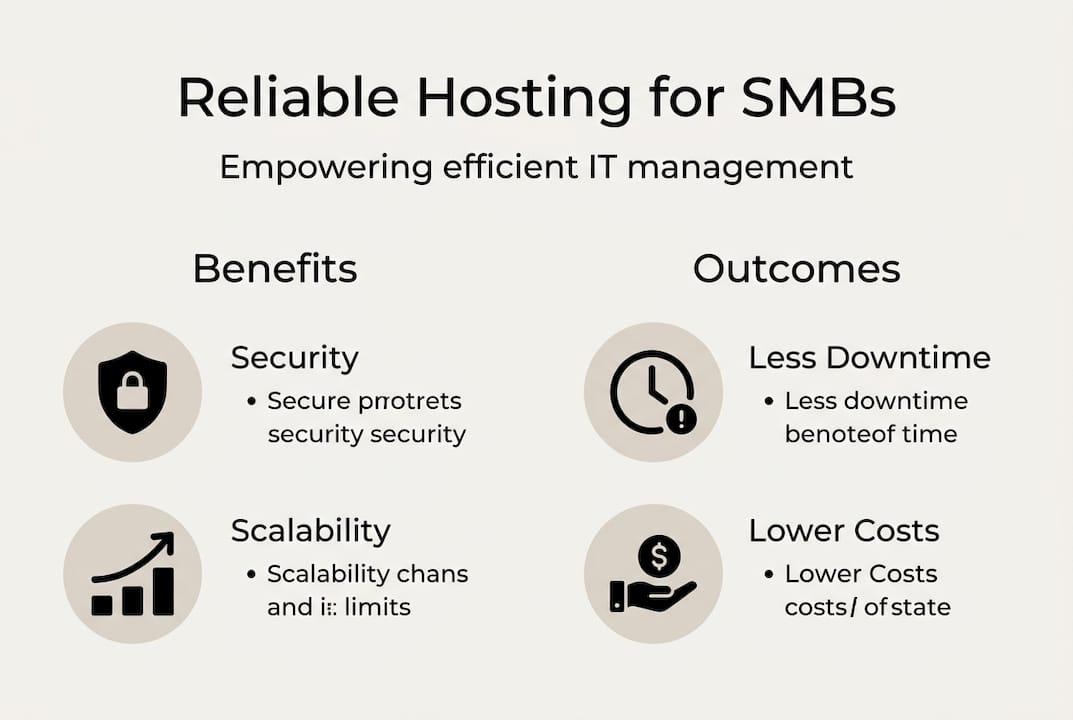
Key infrastructure advantages of hosted environments include:
- Reduced capital expenditure on server hardware and data center space
- Faster deployment of new environments without hardware lead times
- Built-in redundancy through provider-managed network and power systems
- Predictable monthly costs that simplify IT budgeting for SMBs
- Scalability on demand without physical constraints
For IT managers juggling limited budgets and small teams, these advantages are not abstract. They translate directly into fewer late-night emergencies and more time for proactive work.
Managed hosting: Easing SMB operational burdens
Managed hosting takes the foundational benefits of hosted infrastructure one step further. Instead of simply renting server space, you get a provider that actively runs and maintains that environment for you.
Managed hosting offloads server management tasks like monitoring, updates, backups, and security to providers, reducing the operational burden on SMB IT teams. For a team of two or three administrators supporting 50 to 200 users, that reduction is significant.
Here is what a quality managed hosting provider handles automatically:
- 24/7 infrastructure monitoring covering CPU load, RAM usage, disk I/O, and network throughput
- Automated daily backups with offsite or redundant storage
- OS and software updates applied on a tested, scheduled basis
- Firewall management and intrusion detection configuration
- Malware scanning with automated alerting and quarantine
- Proactive capacity planning before performance degrades
The managed hosting automation behind these features is what separates a managed provider from a basic shared host. Basic hosts tell you the server is up. Managed providers tell you a disk is trending toward failure before it causes an outage.
Security hardening is where managed hosting earns its price. Providers apply CIS benchmark configurations, manage SSL certificate renewals, and enforce access controls that many SMB IT teams simply do not have time to implement consistently. Reviewing your hosting uptime checklist alongside your managed provider's SLA is a practical way to verify coverage.

Pro Tip: Ask any managed hosting provider how often they perform test restores of your backups. Quarterly is the minimum acceptable standard. Providers who cannot answer this question clearly are not actually managing your backups.
Comparing hosting options: Cloud, dedicated, on-premise, and hybrid
Not every SMB needs the same hosting model. Choosing the wrong one creates either overspending or underperformance. Here is a clear breakdown of your options.
| Model | Upfront cost | Scalability | Control level | Data sovereignty |
|---|---|---|---|---|
| Cloud (public) | Low | High | Low to medium | Shared/provider |
| Dedicated server | Medium | Low | High | Full |
| On-premise | High | Low | Full | Full |
| Hybrid | Medium | High | Medium to high | Configurable |
Cloud hosting operates on an OpEx model, meaning you pay monthly for what you use. Hosting cost comparisons consistently show lower upfront costs and better scalability for SMBs compared to on-premise, though on-premise provides more control for regulated data environments.
Dedicated servers give you a physical machine allocated entirely to your organization. No shared resources, no noisy neighbors. Dedicated server strategies show they are best suited for workloads requiring consistent high performance or strict data isolation.
VPS hosting advantages sit between shared hosting and dedicated servers, offering isolated resources at a lower cost. For most SMBs running business applications, VPS is the practical starting point.
Private cloud benefits appeal to organizations that need cloud flexibility without multi-tenant risk. Hybrid models combine private and public cloud or mix hosted and on-premise systems.
Which model fits your scenario?
- Growing SMB with variable traffic: Public cloud or VPS with auto-scaling
- High-performance application workloads: Dedicated server
- Regulated data with compliance requirements: Hybrid or on-premise
- Cost-sensitive startup with limited IT staff: Managed VPS or managed cloud
- Multi-site organization needing centralized control: Private cloud or hybrid
Pro Tip: If your organization operates in healthcare, finance, or legal services, hybrid or on-premise configurations may be required for regulatory compliance. Cloud convenience does not override HIPAA, PCI DSS, or GDPR obligations.
Hosting reliability, uptime, and the mechanics behind it
Once you have chosen a hosting model, reliability becomes your primary operational concern. Uptime is not just a marketing number. It has direct financial consequences.
99.99% uptime means less than 4 minutes of downtime per month. 99.9% uptime means up to 43 minutes per month. For an SMB processing transactions or running customer-facing applications, that gap is the difference between a minor inconvenience and a serious revenue event.
Top providers achieve 99.99% uptime, with benchmarks showing providers like InMotion reaching that threshold consistently. That level of reliability does not happen by accident.
Here is how top-tier providers engineer it:
| Uptime level | Monthly downtime | Annual downtime | Suitable for |
|---|---|---|---|
| 99.9% | ~43 minutes | ~8.7 hours | Internal tools |
| 99.95% | ~21 minutes | ~4.4 hours | Business apps |
| 99.99% | ~4 minutes | ~52 minutes | Revenue-critical systems |
The mechanics behind reliable hosting include proactive monitoring, auto-scaling, VLAN network segmentation, and encrypted backups using a 3-2-1 strategy (three copies, two media types, one offsite).
Practical reliability features to verify with any provider:
- Proactive monitoring with sub-5-minute alert thresholds
- Auto-scaling to handle traffic spikes without manual intervention
- VLAN segmentation to isolate environments and reduce attack surface
- IPsec-encrypted backup transfers between primary and offsite storage
- Documented failover procedures with tested recovery time objectives
The hosting uptime strategies that matter most are the ones your provider can demonstrate, not just promise. Ask for incident history reports and SLA credit policies before signing. The hosting automation benefits of moving from a break-fix model to a managed service partnership are measurable in both reduced incidents and faster recovery times.
The overlooked risks and opportunities in hosting for SMB IT
Here is what most hosting guides will not tell you: the cheapest option almost always costs more in the long run. Not because of hidden fees, though those exist, but because cheap hosting providers optimize for acquisition, not retention. Support quality drops. Customization is locked. And when something breaks at 2 a.m., you are on your own.
Managed hosting reduces risk and time but may limit customization for advanced IT teams. That tradeoff is real. If your team needs kernel-level access or custom network configurations, a fully managed environment may frustrate you. The solution is not to avoid managed hosting. It is to choose a provider that offers tiered control options.
Lessons we have seen play out repeatedly in SMB environments:
- Traffic spikes during product launches expose providers that oversell capacity
- Compliance audits reveal backup gaps that were never tested
- Recovery time objectives written in SLAs are meaningless without documented test results
- "Unlimited" hosting plans have throttling built in that only appears under real load
The opportunity most SMBs miss is treating the hosting provider relationship as a strategic partnership rather than a vendor transaction. Providers who understand your growth trajectory can proactively recommend capacity changes, flag compliance risks, and reduce your incident response burden. Review your dedicated server perspective options when your workloads outgrow shared environments, because waiting too long to upgrade is a common and avoidable mistake.
Pro Tip: Run a full test restore of your backups every quarter. Document the time it takes and compare it against your recovery time objective. If they do not match, your backup strategy needs revision before an actual incident forces the issue.
Choosing the right hosting solution for your IT management
The insights in this article point to one clear conclusion: hosting decisions are IT strategy decisions. Getting them right means matching your infrastructure to your workload, compliance requirements, and team capacity.
At Internetport, we have been building hosting infrastructure for SMBs and enterprises since 2008. Our Webhosting solutions cover managed environments with daily backups and free SSL. Our Dedicated server options give high-performance workloads the isolation they need. And our VPS solutions offer SSD-based performance with Plesk control panel included, making them a practical starting point for IT teams ready to move beyond shared hosting. If you are evaluating your next hosting move, we are ready to help you match the right solution to your actual requirements.
Frequently asked questions
What is the difference between managed hosting and on-premise for SMB IT?
Managed hosting offloads server management tasks to providers, while on-premise keeps all maintenance and control in-house, which is better suited for environments with strict compliance or data sovereignty requirements.
How does hosting uptime impact my business operations?
99.99% uptime means less than 4 minutes of downtime per month, directly protecting revenue and customer trust for SMBs running transaction-dependent applications.
Is hybrid hosting a good choice for regulated sectors?
Hybrid models balance cloud scalability with on-premise data control, making them a practical fit for industries that need both flexibility and data sovereignty.
What are the signs of a reliable hosting provider?
Look for verified 99.9% uptime guarantees, proactive monitoring with documented alert thresholds, automated daily backups, and clear SLA credit policies.
How often should test restores of backups be performed?
Quarterly test restores are the recommended minimum, ensuring your recovery plan works before an actual incident forces you to find out it does not.