

TL;DR:
- Seventy-three percent of data center outages are preventable through better security practices.
- Modern threats exploit misconfigurations, human error, and AI automation, increasing risks significantly.
- Effective security relies on physical controls, network segmentation, privileged access management, and continuous monitoring.
Seventy-three percent of data center outages are entirely preventable, yet organizations continue losing millions of dollars, customer trust, and operational continuity to breaches that better practices would have stopped. The threat landscape is not just growing in volume. It's growing in speed, sophistication, and consequence. For IT managers and decision-makers, the pressure to protect critical infrastructure has never been higher. This article covers the real threats facing data centers today, examines high-profile breaches, explains the proven security frameworks that reduce risk, and gives you a clear, actionable path to evaluate and strengthen your organization's current posture.
Table of Contents
- Why data center security matters more than ever
- Types of threats and real-world consequences
- Core pillars of robust data center security
- How to evaluate and strengthen your data center security
- The uncomfortable truth about data center security strategy
- Easily secure your data center with trusted partners
- Frequently asked questions
Key Takeaways
| Point | Details |
|---|---|
| Most breaches are preventable | Human error and insufficient controls still cause the majority of data center incidents today. |
| Zero Trust reduces incidents | Implementing Zero Trust can cut total incidents by 67% and critical events by 78%. |
| Real-world breaches show risks | High-profile incidents like Capital One illustrate why misconfigurations and poor access management are so dangerous. |
| Continuous evaluation is vital | Regular reviews, training, and audits are essential to adapt to evolving threats. |
| Complacency is the real enemy | Assuming current solutions are enough leads to overlooked vulnerabilities and costly mistakes. |
Why data center security matters more than ever
The assumption that basic infrastructure protections are sufficient died years ago. Modern attacks do not break down doors. They slip through misconfigured APIs, exploit over-privileged accounts, and leverage automation to move faster than any human response team can track. Security teams are no longer just defending against opportunistic hackers. They're facing coordinated, well-resourced threats that use artificial intelligence to probe, pivot, and persist inside systems.
The numbers reinforce the urgency. Human error drives 95% of all data breaches, and AI-powered tools can now automate admin-level access attempts in under eight minutes using large language model orchestration. That eight-minute window is shorter than most organizations' detection protocols. By the time an alert fires, the attacker may already have moved laterally.
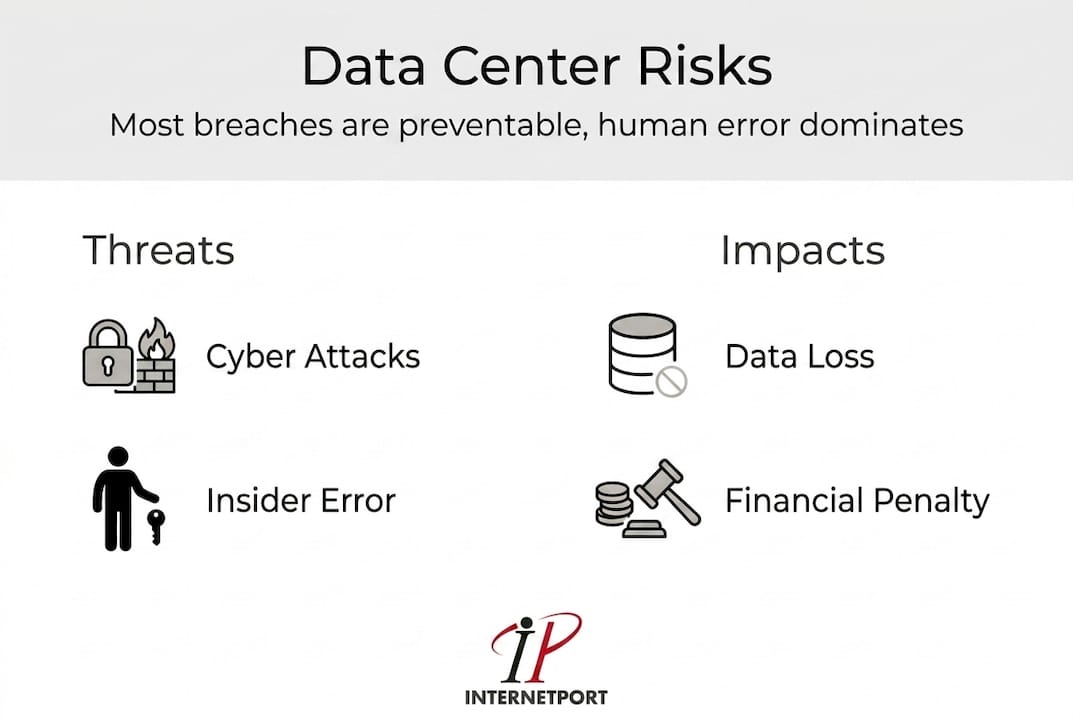
At the same time, the Uptime Institute's 2025 Security Survey of 982 data center professionals found that while impactful outages are less frequent overall, 1 in 10 still causes serious business disruption. That's a counterintuitive finding. Fewer incidents but higher stakes per incident. It means the margin for error is shrinking, not expanding.
Common misconceptions make this worse. Many IT leaders still believe that:
- Perimeter firewalls alone protect against modern intrusions
- Physical security is separate from cyber security and can be managed independently
- Compliance certification equals operational security
- Insider threats are less dangerous than external attacks
None of these assumptions hold up under scrutiny. Modern attacks routinely bypass perimeter defenses through phishing and supply chain compromise. Physical and cyber threats are increasingly linked, as the Verkada breach proved in 2021. Compliance frameworks set minimum standards, not optimal ones. And insider threats, whether malicious or accidental, are a top driver of preventable outages.
Security complexity has risen faster than security maturity in most organizations. The gap between what organizations know they should do and what they actually implement is where breaches live.
Understanding data center essentials is the starting point, but staying ahead requires continuous adaptation. The threat environment in 2026 rewards organizations that treat security as a living process rather than a one-time project.
Types of threats and real-world consequences
Understanding what you're defending against makes every security decision sharper. Data centers face a broad and evolving set of threats, and each category carries distinct business consequences.
The most common attack types include:
- Social engineering and phishing: Attackers manipulate employees into revealing credentials or bypassing authentication. Phishing remains the entry point for the majority of ransomware attacks.
- Privilege escalation: Once inside, attackers target accounts with elevated permissions to access sensitive systems and data.
- Misconfigurations: Incorrectly set cloud storage buckets, open ports, and improperly scoped IAM policies are among the most exploited vulnerabilities in modern environments.
- AI-accelerated attacks: Automated tools can now brute-force credentials, scan networks for vulnerabilities, and generate convincing phishing content at machine speed.
- Physical intrusion: Tailgating, social engineering of facility staff, and hardware tampering remain real vectors, especially in colocation environments.
Two breaches illustrate these risks clearly.
The 2021 Verkada incident involved attackers gaining super-admin access to a security camera network, compromising 97 major customers including hospitals, schools, and a Tesla factory. The attack succeeded not through sophisticated technical exploits but through credential theft. One stolen admin password opened the entire platform.
The 2019 Capital One breach exposed 106 million customer records through a server-side request forgery attack that exploited a misconfigured web application firewall. The attacker accessed AWS metadata to retrieve credentials, then used those credentials to download data from S3 buckets. The technical chain was straightforward. The failure was operational: a misconfiguration that should have been caught in routine review.
| Breach | Attack type | Impact | Lesson learned |
|---|---|---|---|
| Verkada (2021) | Credential theft, admin access | 97 customers compromised, camera feeds exposed | Privileged access must be strictly controlled and monitored |
| Capital One (2019) | SSRF, WAF misconfiguration | 106M records exposed | Misconfigurations require continuous auditing |
| Equifax (2017) | Unpatched software vulnerability | 147M records leaked | Patch management is not optional |
| SolarWinds (2020) | Supply chain compromise | Thousands of organizations breached | Third-party software requires deep vetting |
The business consequences of these events extend far beyond the immediate incident. Regulatory fines, class action lawsuits, customer attrition, and long-term reputational damage compound over years. The Uptime Institute data shows that serious disruptions from outages affect 1 in 10 major incidents, but reputational damage can affect far more, because customers and partners lose confidence long before a formal outage is declared.

For decision-makers evaluating preventable outages, the lesson is clear: most of these attacks succeeded because of gaps in process and oversight, not because attackers were unstoppable.
Core pillars of robust data center security
Security frameworks that actually work are built on four interconnected pillars. Weakness in any one area creates exploitable gaps across the entire environment.
The four pillars are:
- Physical security controls: Biometric access, CCTV surveillance, man-traps, and visitor management systems that prevent unauthorized physical access to hardware and network infrastructure.
- Network segmentation: Dividing networks into isolated zones so that a breach in one segment cannot propagate freely. Micro-segmentation at the workload level is the modern standard.
- Privileged access management (PAM): Controlling, monitoring, and auditing every account with elevated permissions. PAM solutions enforce just-in-time access, reducing the window an attacker can exploit stolen credentials.
- Continuous monitoring and incident response: Real-time visibility into network traffic, user behavior, and system changes, combined with a tested response plan that can activate within minutes.
Zero Trust Architecture (ZTA) integrates all four pillars under a single governing principle: never trust, always verify. Every access request, whether from inside or outside the network perimeter, is treated as potentially hostile until authenticated and authorized. The results are measurable. ZTA implementation reduces security incidents by 67% on average, cuts critical incidents by 78%, and improves mean time to detect (MTTD) by 43% across organizations that have made the transition.
Steps to implement these pillars:
- Conduct a full inventory of all physical and logical assets, including shadow IT and unmanaged devices.
- Map trust boundaries and define which systems communicate with which, then enforce those boundaries with network controls.
- Deploy a PAM solution and enforce the principle of least privilege across all accounts.
- Implement a security information and event management (SIEM) system for real-time log aggregation and alerting.
- Run tabletop exercises and breach simulations quarterly to test and improve your incident response plan.
Pro Tip: Review access logs weekly for anomalies, not quarterly. Attackers who gain initial access often wait and observe before making their move. Weekly reviews catch unusual patterns before they escalate into full breaches.
| Approach | Trust model | Visibility | Incident response time | Best for |
|---|---|---|---|---|
| Traditional perimeter | Implicit internal trust | Low | Slow | Legacy environments |
| Zero Trust | Verify everything | High | Fast | Modern, distributed environments |
| Hybrid | Partial verification | Medium | Moderate | Transition-phase organizations |
For organizations evaluating secure hosting solutions, applying these pillars in a managed environment reduces the internal burden of security operations while maintaining control over data and access policies.
How to evaluate and strengthen your data center security
Knowing the frameworks is one thing. Applying them to your actual environment requires a structured evaluation process that surfaces real gaps rather than theoretical ones.
Follow these steps to assess and improve your security posture:
- Audit all existing controls. Document every physical, network, and identity control currently in place. Map them against a recognized standard such as NIST SP 800-53 or ISO 27001 to identify gaps. Do not assume that legacy controls still work in modern environments.
- Benchmark your incident history. Review the last 12 to 24 months of security events. Look for patterns: repeated phishing attempts targeting specific teams, recurring misconfiguration alerts, or access anomalies that were investigated but not resolved. Patterns reveal systemic weaknesses.
- Simulate a breach response. Run a tabletop exercise that walks your team through a realistic incident, such as a ransomware infection spreading from a compromised vendor account. Measure how long it takes to detect, contain, and recover. Document every gap.
- Evaluate advanced solutions. Assess Zero Trust tools, AI-powered behavioral monitoring, and endpoint detection and response (EDR) platforms against your current gaps. Prioritize tools that integrate with your existing stack rather than creating new silos.
- Invest in staff training. Because human error drives 95% of breaches, technical tools only solve part of the problem. Security awareness training should be continuous, scenario-based, and tested with simulated phishing campaigns.
- Document and iterate. Security posture degrades without maintenance. Schedule quarterly reviews, annual third-party audits, and continuous monitoring reviews to keep your program current.
When selecting infrastructure partners, prioritize those who offer scalability and security as integrated considerations rather than add-ons. Security that does not scale with your infrastructure becomes a bottleneck. Similarly, private cloud advantages include greater control over data residency, compliance boundaries, and network isolation, which are significant factors for organizations with strict regulatory requirements.
Pro Tip: Do not neglect insider threat reviews. They account for a significant share of serious breaches, and they are among the hardest to detect because insiders already have legitimate access. Quarterly reviews of privileged user behavior, combined with mandatory access recertification, are the minimum standard.
Build your evaluation using a checklist approach. Assign clear owners for each control area, set deadlines for remediation, and track progress against a defined security roadmap. Security without accountability is decoration.
The uncomfortable truth about data center security strategy
After years of working with organizations that have invested heavily in security tools, the most consistent finding is this: the technology is rarely the problem. Sophisticated SIEM platforms sit underutilized. Zero Trust architectures get partially deployed. Incident response plans stay in document repositories, untested and outdated. The tools exist. The discipline to use them consistently does not.
The 95% human error statistic does not reflect a failure of technology. It reflects a failure of culture, training, and process enforcement. A new AI-powered monitoring platform does not fix a team that clicks phishing links or an administrator who reuses passwords across systems.
What actually separates resilient organizations from vulnerable ones is their commitment to operational hygiene over time. They review access logs. They run drills. They decommission unused accounts. They treat security as a daily practice, not an annual audit. These habits are unglamorous. They do not make headlines. But they prevent the kinds of avoidable outages and breaches that do make headlines.
The speed of AI-powered attacks also changes the equation in a way many strategies have not yet absorbed. When a threat actor can automate lateral movement in minutes, the window for human-reviewed alerts to catch an intrusion is effectively closed. Response must be partially automated, and detection must be continuous. Speed of response is now a genuine competitive differentiator in security.
The most dangerous organizational state is confidence after a deployment. Buying and installing Zero Trust tools without enforcing them consistently creates false assurance. Complacency after investment is the overlooked risk that turns expensive security programs into expensive failures.
Easily secure your data center with trusted partners
Implementing all these layers of security in-house demands significant resources, expertise, and sustained operational attention. For many SMBs and enterprises, the smarter path is working with infrastructure partners who have already built security into their foundation.
At Internetport, we have operated fully equipped, PCI DSS-certified data centers since 2008, with redundant systems, high-speed connectivity, and physical security controls built into every layer of our environment. Whether you need VPS hosting with daily backups and free SSL, dedicated servers with direct network isolation, or colocation services that let you deploy your own hardware inside our secure facilities, we provide the infrastructure foundation your security strategy needs. Our team is ready to help you evaluate your requirements and configure a solution that fits your compliance needs and growth targets.
Frequently asked questions
What is the main role of data center security?
The main role is to protect sensitive data, IT infrastructure, and business continuity from both cyber and physical threats, ensuring operations remain reliable and compliant.
What are common causes of data center breaches?
Most data center breaches result from human error, misconfigurations, social engineering, and targeted cyber attacks, with human error involved in 95% of all recorded incidents.
How does Zero Trust Architecture improve data center security?
Zero Trust reduces security incidents by an average of 67% and cuts mean time to detect by 43%, making breaches far less likely to escalate into serious disruptions.
Which attack led to the compromise of 106 million records?
The Capital One breach in 2019 exposed 106 million records through a server-side request forgery attack that exploited a misconfigured web application firewall and IAM controls.
What is the greatest overlooked risk in data center security?
Complacency after deploying new tools is the most overlooked risk, because human error and poor process discipline remain the dominant cause of breaches regardless of what technology is in place.