
TL;DR:
- Hosting compliance involves strictly adhering to legal, regulatory, and security standards to protect data within hosting environments.
- It is a shared responsibility where both providers and clients must demonstrate effective controls, audits, and evidence to maintain regulatory coverage.
Compliance in hosting is defined as the practice of meeting legal, regulatory, and security standards that govern how data is stored, processed, and protected within hosting environments. For business owners and IT managers, the role of compliance in hosting goes far beyond checking boxes. Frameworks like NIS2, FedRAMP, and PCI DSS create binding obligations that touch your infrastructure, your vendors, and your internal processes. Getting this wrong means fines, breaches, and reputational damage. Getting it right means operational confidence, client trust, and a defensible security posture that holds up under audit.
What compliance requirements do hosting providers face?
Hosting providers operate under a growing set of regulatory frameworks, and those obligations cascade directly to you as a client. Understanding what your provider must comply with tells you exactly what you can demand from them.

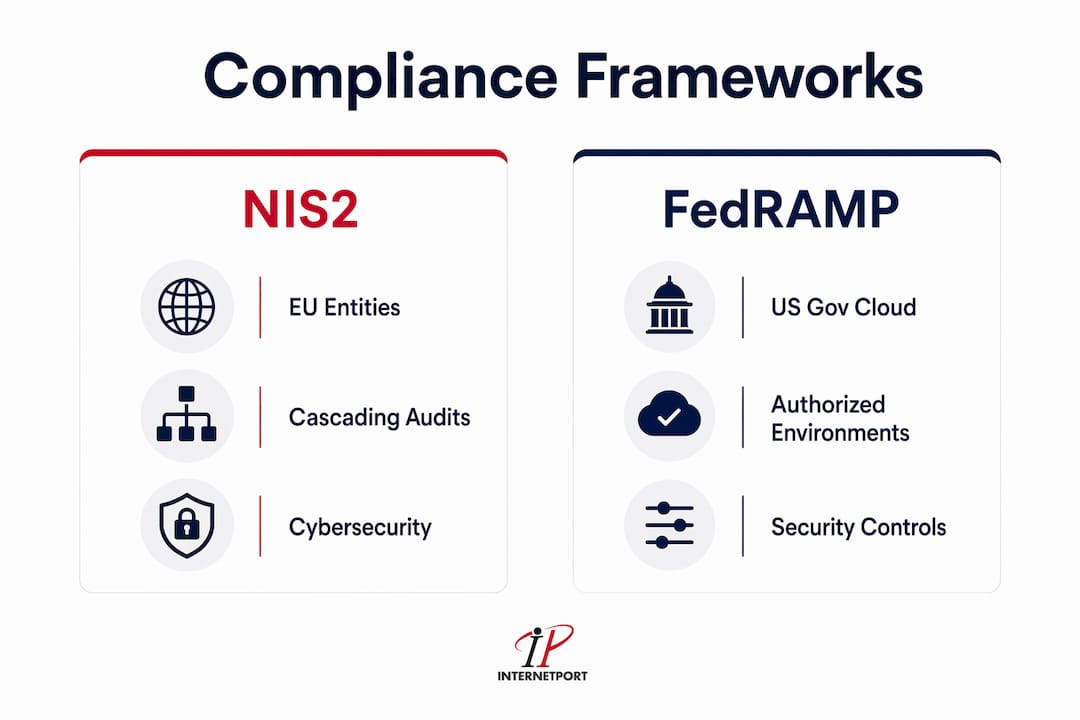
The NIS2 Directive classifies hosting and cloud providers as essential digital entities subject to strict regulatory oversight. That classification carries real weight. Providers must report security incidents with an initial warning within 24 hours and a detailed notification within 72 hours. Fines for non-compliance reach up to 10 million euros or 2% of global annual turnover. Those numbers reflect how seriously regulators treat infrastructure security.
FedRAMP presents a different but equally important challenge. Hosting in authorized environments like AWS GovCloud is necessary but not sufficient for FedRAMP compliance. Vendors must also implement and document application-level controls including identity governance, continuous monitoring, and configuration management. Many organizations assume that choosing a certified data center transfers compliance responsibility. It does not.
NIS2 also introduces what regulators call compliance cascading. Clients of NIS2 providers must assess their supplier's security practices to remain compliant themselves. This means your compliance program must include a formal process for auditing your hosting provider, not just trusting their certifications.
The table below compares the major frameworks affecting hosting decisions:
| Framework | Who It Applies To | Key Hosting Obligation |
|---|---|---|
| NIS2 | EU-regulated entities and their suppliers | Incident reporting, supply chain audits, management accountability |
| FedRAMP | US federal vendors and cloud providers | Authorized infrastructure plus documented application controls |
| PCI DSS | Any entity handling payment card data | Encryption, access controls, network segmentation, audit logs |
| GDPR | Any entity processing EU personal data | Data processor agreements, breach readiness, subprocessor transparency |
| ISO 27001 | Organizations seeking certified ISMS | Risk management, access control, physical and logical security |
Pro Tip: Ask your hosting provider for their NIS2 compliance roadmap in writing. If they cannot produce one, treat that as a red flag for regulated workloads.
How do compliance frameworks translate into technical controls?
Regulatory frameworks describe what outcomes you must achieve. Technical controls are how you actually achieve them. Knowing which controls to expect from a compliant hosting provider lets you verify rather than assume.
The baseline controls for any regulated hosting environment include:
- Encryption at rest and in transit using current standards such as AES-256 and TLS 1.3
- Multi-factor authentication on all administrative access points, not just user portals
- Network segmentation to isolate sensitive workloads from general traffic
- Audit logging with tamper-evident records retained for a minimum period defined by your applicable regulation
- Real-time monitoring with defined alert thresholds and escalation paths
- Documented incident response plans with tested runbooks and clear communication chains
Availability is a compliance requirement, not just a performance metric. Downtime constitutes a compliance failure in regulated settings. Your provider must demonstrate uptime guarantees backed by SLAs, documented recovery time objectives, and evidence of regular disaster recovery drills. A provider who cannot show you test results from a recent failover exercise is not ready for regulated workloads. For deeper context on building these controls into your infrastructure, the guide on hosting business continuity covers the operational side in detail.
One capability that separates compliant providers from merely certified ones is evidence-on-demand. Fast retrieval of logs, access reports, and configuration evidence during audits is a core compliance function. If your provider takes days to produce a specific access log or cannot generate a configuration snapshot on request, they are unsuitable for regulated workloads. This is not a theoretical concern. Audit timelines are short, and regulators do not extend deadlines because your vendor was slow.
Certificate management also belongs in this category. Short-lived TLS certificates reduce exposure windows, but they require active monitoring. Resources like certificate monitoring practices explain why automation is now a compliance necessity, not an optional upgrade.
Pro Tip: During provider onboarding, submit a test audit request. Ask for access logs from a specific date range and a current configuration report. Time how long it takes. That response time is your real SLA.
What responsibilities do business clients hold under hosting compliance?
The most common and costly misconception in hosting compliance is that signing a contract with a certified provider transfers your regulatory obligations. It does not. Your responsibilities as a client are specific, ongoing, and non-delegable.
Under GDPR, business clients remain data controllers responsible for auditing hosting providers, maintaining records of processing activities, and managing the full data lifecycle. Your hosting provider acts as a data processor. That distinction matters because regulators hold the data controller accountable when something goes wrong, regardless of which party caused the failure.
Here is what that accountability looks like in practice:
- Execute a Data Processing Agreement (DPA) with every hosting provider that touches personal data. The DPA must specify processing purposes, data categories, retention limits, and subprocessor lists.
- Verify subprocessor transparency. GDPR expects subprocessor disclosure and your right to object. If your provider cannot name their subprocessors, you cannot meet your own accountability obligations.
- Conduct periodic supplier audits. NIS2's supply chain requirements mean annual reviews are now a regulatory baseline, not a best practice. Document the audit, the findings, and any remediation steps.
- Maintain your own records of processing activities. Do not rely on your provider's documentation to satisfy your GDPR Article 30 obligations. Your records must reflect your processing, not theirs.
- Test your incident response integration. When your provider detects a breach, their 24-hour NIS2 reporting clock starts. Your own breach notification process must be ready to activate in parallel.
The benefits of meeting these obligations extend beyond legal defense. Organizations with documented supplier audits and current DPAs resolve security incidents faster because the communication channels and escalation paths already exist. Compliance creates operational infrastructure that pays off outside of audit season. For a practical look at how hosting security controls connect to these client-side responsibilities, that resource covers the technical layer in plain terms.
How do you select a hosting provider that supports compliance?
Choosing a hosting provider for a regulated environment is a procurement decision with legal consequences. The criteria go well beyond price and uptime percentages.
Certifications and compliance reports are the starting point, not the finish line. Look for providers holding PCI DSS certification, ISO 27001 accreditation, and documented NIS2 compliance postures. Ask for their most recent audit reports, not just their marketing page. A provider who cannot share a current SOC 2 Type II report or equivalent has not completed the work.
Server location and jurisdiction determine which laws apply to your data. Hosting infrastructure choices critically influence compliance by determining applicable jurisdiction, security protocols, and data management systems. Storing EU personal data on servers outside the EU without adequate transfer mechanisms violates GDPR. This is not a gray area.
Incident communication processes reveal how a provider actually behaves under pressure. Review their incident response policy before signing. Ask how they notify clients, what their internal escalation path looks like, and how they document post-incident reviews. Providers who treat incident communication as an afterthought will leave you scrambling when a real event occurs.
The table below summarizes key selection factors and what to verify for each:
| Selection Factor | What to Verify |
|---|---|
| Certifications | Current PCI DSS, ISO 27001, or equivalent audit reports |
| Data jurisdiction | Server locations and applicable data transfer mechanisms |
| Incident response | Written policy, client notification timelines, post-incident review process |
| Evidence-on-demand | Test log and configuration retrieval during onboarding |
| SLA terms | Uptime guarantees, recovery time objectives, financial penalties for breach |
| Support quality | Response times, escalation paths, dedicated compliance contacts |
Support quality is a compliance factor that most procurement checklists ignore. A provider with strong technical controls but slow or opaque support creates compliance risk. When an auditor asks for documentation on a Friday afternoon, you need a support team that responds in hours, not days. The article on support quality in hosting makes this case with concrete examples.
Managing supply chain risk also means reviewing contracts for audit rights. Your agreement should give you the right to request security assessments, review subprocessor changes, and terminate the contract if the provider fails a material compliance obligation. These clauses are negotiable. Providers who refuse them are telling you something important about their compliance culture.
Key takeaways
Compliance in hosting is a shared responsibility between providers and clients, and the frameworks governing it carry real financial and operational consequences.
| Point | Details |
|---|---|
| Compliance is not vendor-transferred | Clients remain data controllers under GDPR and must maintain their own records and audits. |
| NIS2 cascades to clients | You must audit your hosting provider's security posture to stay compliant under NIS2 supply chain rules. |
| Evidence-on-demand is a hard requirement | Test log and configuration retrieval speed during onboarding to avoid audit failures later. |
| Availability is a compliance pillar | Downtime in regulated environments constitutes a compliance failure, not just a performance issue. |
| Jurisdiction shapes your obligations | Server location determines which laws apply; storing EU data outside the EU without transfer mechanisms violates GDPR. |
Compliance in hosting is a leadership decision, not an IT checkbox
I have watched organizations spend months selecting a hosting provider based on price and uptime, then spend years managing the fallout from a compliance gap they never saw coming. The pattern is consistent. Leadership treats hosting compliance as an IT procurement task. IT treats it as a vendor responsibility. The vendor treats it as a marketing claim. Nobody owns it end to end.
The insight that changed how I think about this comes from watching what happens when a regulated organization faces an audit with a hosting provider who cannot produce evidence quickly. The cost of emergency remediation after a compliance failure at the infrastructure layer is always higher than the cost of getting it right at the start. Always. The organizations that handle audits well are the ones where a board-level decision was made to treat hosting compliance as a core risk management function, not a line item on an IT checklist.
The FedRAMP misconception is the clearest example of how dangerous assumptions get. I have seen technology teams genuinely believe that running workloads on a FedRAMP-authorized platform made their application compliant. It does not. The platform provides the floor. Your application controls, your documentation, and your audit evidence provide everything above it. That gap between infrastructure authorization and application compliance is where most regulated organizations get caught.
My practical advice: put compliance requirements into your hosting RFP before you evaluate a single vendor. Make evidence-on-demand a pass/fail criterion. Require written incident communication timelines as a contract term. And schedule a supplier audit within the first six months of any new hosting relationship. Compliance embedded at the start of a vendor relationship costs a fraction of what it costs to retrofit it later.
Internetport's hosting solutions built for compliance

Internetport offers a hosting portfolio designed for businesses that cannot afford compliance gaps. Their data centers in Sweden and internationally provide the jurisdictional clarity that GDPR and NIS2 require. Internetport holds PCI DSS certification and delivers secure web hosting with the technical controls, audit support, and SLA transparency that regulated workloads demand. Whether you need cloud VPS, dedicated servers, or colocation, Internetport's team provides the documentation and support access that turns compliance from a burden into a manageable operational discipline. Talk to Internetport about your compliance requirements before your next hosting decision.
FAQ
What is hosting compliance?
Hosting compliance is the practice of meeting legal, regulatory, and security standards within hosting environments to protect data integrity, privacy, and availability. Frameworks like GDPR, NIS2, PCI DSS, and FedRAMP define the specific obligations that apply.
Does using a certified hosting provider make my business compliant?
No. Under GDPR, your business remains the data controller and retains full accountability for auditing providers and maintaining processing records. FedRAMP-authorized infrastructure also requires separate application-level controls to achieve compliance.
What is compliance cascading under nis2?
NIS2 compliance cascading means that regulated entities must audit the cybersecurity practices of their hosting and cloud suppliers. Your compliance status depends in part on your provider's security posture, not just your own.
How do i test a hosting provider's compliance readiness?
Submit a test audit request during onboarding. Ask for access logs from a specific date range and a current configuration report, then measure the response time. Slow evidence retrieval disqualifies a provider for regulated workloads.
Why does server location matter for compliance?
Server location determines jurisdiction and which data protection laws apply to your data. Storing EU personal data outside the EU without valid transfer mechanisms is a direct GDPR violation.
— Peter