

TL;DR:
- Hosting is a strategic foundation for digital transformation, directly impacting website speed, security, and scalability. High-quality hosting improves SEO rankings, boosts customer trust, and prevents costly re-platforming as businesses grow. AI-enabled hosting solutions are already streamlining website creation and operational management, offering SMEs a competitive edge.
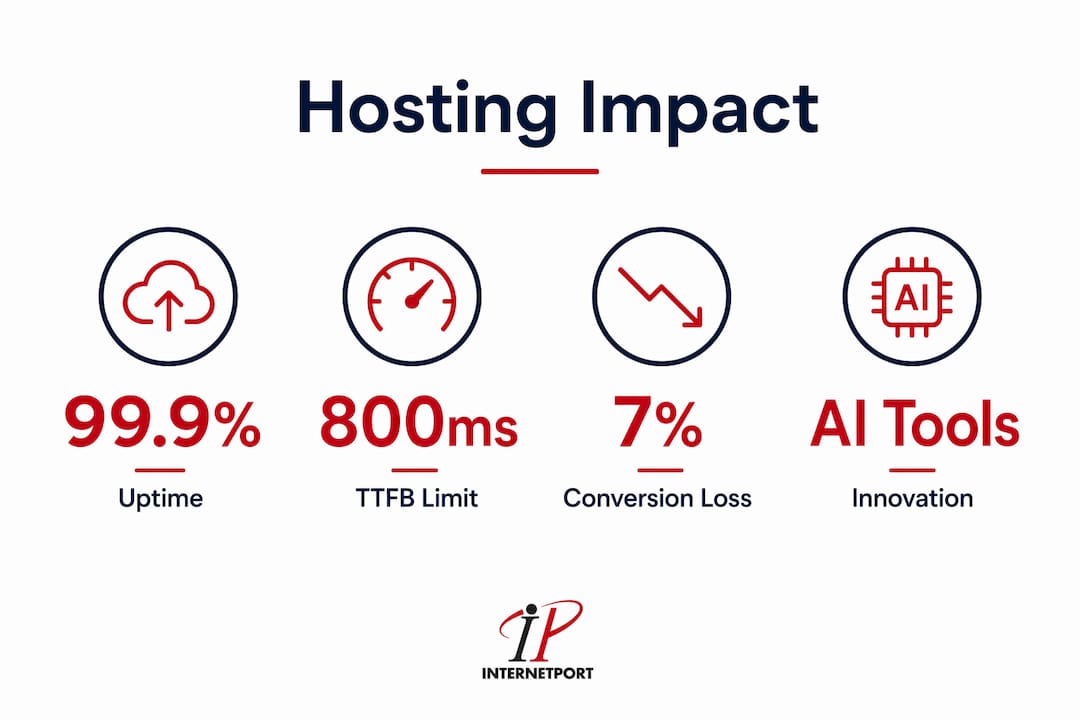
Hosting is the operational foundation of digital transformation: it determines how fast your digital products perform, how securely your data is stored, and how quickly your business can scale or deploy new capabilities. A one-second page delay cuts conversion rates by 7%, which means a slow server is not a technical inconvenience but a direct revenue problem. For SMEs, the stakes are even higher because every percentage point of lost conversion or search ranking matters more when margins are tighter. Platforms like Hostinger have already shown that AI-integrated hosting can compress website creation from days to minutes. The hosting decision you make today sets the ceiling on how far your digital strategy can go.
How hosting performance directly shapes digital transformation outcomes
Hosting quality is measurable in business terms, not just technical ones. Server response time, uptime, and security posture each translate directly into revenue, search visibility, and customer trust. Understanding those connections is the first step toward treating hosting as a strategic asset rather than a line-item cost.

Server response time and Core Web Vitals
Google's Core Web Vitals framework penalizes sites with a Time to First Byte (TTFB) above 800ms, and poor TTFB scores push pages down in search rankings regardless of content quality. Most entry-level shared hosting plans regularly exceed that threshold during traffic spikes because dozens of websites compete for the same server resources. The practical result is that your SEO investment, your content marketing, and your paid campaigns all underperform because the hosting layer is the bottleneck. Upgrading server infrastructure is often the single highest-return SEO action an SME can take.
Uptime, crawl budget, and search visibility
Reliable hosting with 99.9% uptime protects your crawl budget by keeping pages consistently accessible to Google's bots. When a site goes down during a crawl cycle, Google may de-index pages or reduce crawl frequency, which compounds over time into lost organic traffic. Beyond search, downtime destroys customer trust in ways that are hard to quantify but easy to feel. A B2B buyer who hits a 503 error during due diligence rarely comes back.
Security as a hosting-layer responsibility
Hosting providers that fail to patch server software or monitor for malware put their clients at risk of being blacklisted by Google's Safe Browsing database. Once blacklisted, a site loses virtually all organic traffic until the issue is resolved and the listing is manually reviewed. For SMEs without dedicated security teams, this risk is best mitigated at the hosting level through providers that offer server-side malware scanning, automatic patching, and PCI DSS compliance. The effect of hosting on transformation is therefore not limited to speed. It extends to whether your digital presence remains operational and trusted at all.
Key performance indicators directly affected by hosting quality include:
- Conversion rate: A one-second delay costs 7% of conversions per second of added load time.
- SEO rankings: TTFB above 800ms disqualifies pages from strong Core Web Vitals scores.
- Uptime: Sub-99.9% availability reduces crawl budget and damages customer confidence.
- Security posture: Server-level vulnerabilities can trigger Google blacklisting, wiping organic traffic overnight.
What hosting models work best for SME digital strategies?
Choosing the right hosting model is a strategic decision that affects cost, control, scalability, and your ability to run modern digital workflows. The five primary models each occupy a distinct position on the performance-versus-cost curve, and the right choice depends on where your business sits in its transformation journey.
| Hosting model | Typical cost range | Best for | Key trade-off |
|---|---|---|---|
| Shared hosting | Low end of market | Early-stage sites, low traffic | Noisy neighbor effect, limited control |
| VPS hosting | Mid-range | Growing SMEs needing compliance control | Requires some technical management |
| Managed hosting | Mid to high | Teams wanting hands-off infrastructure | Higher cost, less raw customization |
| Dedicated server | High | High-traffic, regulated industries | Expensive, overkill for most SMEs |
| Cloud hosting | Variable, usage-based | Businesses with unpredictable traffic | Cost can spike without monitoring |
Shared hosting sits at the low end of the market and works for early-stage sites with minimal traffic. The problem is the noisy neighbor effect: one high-traffic site on the same server degrades performance for everyone else. VPS hosting solves this by allocating dedicated CPU, RAM, and isolated storage, which also makes compliance controls more achievable. For SMEs handling customer data or operating in regulated sectors, VPS is often the minimum viable hosting tier.
Managed hosting removes the operational burden of server administration entirely. The provider handles patching, monitoring, backups, and scaling, which frees your team to focus on building digital products rather than maintaining infrastructure. This model is particularly valuable when you are integrating AI tools or running multi-site operations, because the coordination overhead of managing servers manually compounds quickly. You can explore how multi-site hosting fits into a broader digital strategy if you are running more than one web property.
Cloud hosting offers the most flexibility for businesses with variable traffic patterns. Usage-based pricing means you pay for what you consume, but costs can escalate without proper monitoring. For SMEs that experience seasonal spikes or are launching new digital products, cloud hosting provides the elasticity that fixed-resource plans cannot match. See scalable hosting options for a structured comparison of how different models handle growth.
Pro Tip: Avoid evaluating hosting purely on monthly price. Calculate the total cost of a migration if you outgrow your plan within 18 months. Re-platforming costs in developer time and downtime risk almost always exceed the savings from choosing a cheaper starting tier.
How are AI-driven hosting solutions changing digital business?
AI integration in hosting is not a future trend. It is already reshaping how businesses build, deploy, and maintain their digital presence. The shift matters for SMEs because it lowers the technical barrier to entry while simultaneously raising the ceiling on what is possible without a large IT team.
Hostinger's partnership with Anthropic's Claude model demonstrates the most visible dimension of this change. AI-assisted website creation now compresses what previously took days of developer time into a process measured in minutes. This is not just a convenience feature. It means a marketing team can spin up a campaign landing page, test it, and iterate without waiting for a development sprint. The speed advantage compounds over months of digital activity.
The more significant shift, however, is happening at the infrastructure layer. Agentic hosting environments are emerging where AI handles deployment, monitoring, and updates automatically. Hosting.com's AI application platform represents this category: infrastructure that does not just host your application but actively manages it. This moves hosting from a passive utility to an active participant in your digital operations.
"Hosting is the next layer AI will transform. The businesses that recognize this early will operate with a structural advantage over those still treating hosting as a commodity." — Vito Peleg, CEO of Atarim
The practical implications for SMEs include:
- Faster time to market: AI-assisted builds reduce the gap between idea and live product.
- Reduced operational overhead: Automated deployment and monitoring cut the need for dedicated DevOps resources.
- Continuous improvement: Agentic workflows allow sites to update and optimize without manual intervention.
- AI-ready infrastructure: Long-term digital transformation at scale requires hosting that supports automated, agentic workflows, not just static file serving.
Tools like Amaya AI illustrate how AI capabilities layered on top of modern hosting infrastructure can generate leads and automate website interactions that previously required human management. The hosting layer's capacity to run these tools reliably is what separates a functional AI integration from one that fails under real traffic conditions.
How do you choose hosting that supports your transformation goals?
Selecting hosting for digital transformation is different from selecting hosting for a brochure website. The criteria shift from "does it work?" to "does it scale with our ambitions and protect our operations?" Here is a structured approach for SME decision-makers.
-
Audit your current performance baseline. Measure your existing TTFB, uptime percentage, and Core Web Vitals scores before evaluating alternatives. Without a baseline, you cannot quantify the improvement a new hosting environment delivers. Tools like Google PageSpeed Insights and GTmetrix provide this data for free.
-
Map your compliance requirements. If you handle payment data, personal data under GDPR, or operate in a regulated industry, your hosting provider must meet specific standards. PCI DSS compliance, data residency controls, and server-side security monitoring are non-negotiable in these contexts. Verify these capabilities before signing a contract, not after.
-
Evaluate unified versus fragmented hosting stacks. Unified hosting platforms that host frontend and backend together eliminate split support queues and reduce deployment risk. Pantheon's approach demonstrates that consolidating your hosting stack reduces the coordination overhead that slows digital teams down. Fragmented stacks where your CMS, API layer, and frontend live on different providers create friction that compounds with every deployment.
-
Account for growth taxes from cheap hosting. SMEs that underinvest in hosting face costly re-platforming and re-optimization as traffic and demands grow. The migration cost in developer time, downtime risk, and potential SEO disruption almost always exceeds the savings from choosing the cheapest available option. Price the full lifecycle, not just the monthly invoice.
-
Confirm AI and automation readiness. If your digital strategy includes AI-assisted tools, chatbots, or automated deployment pipelines, verify that your hosting environment supports the runtime requirements. Entry-level plans often lack the CPU allocation, memory limits, and API connectivity that these tools require. Reliable hosting for SMBs that supports managed infrastructure is often the more cost-effective path when factoring in the operational time saved.
Pro Tip: Ask prospective hosting providers for their average incident response time and their process for handling server-level security events. A provider that cannot answer these questions clearly is not equipped to support a serious digital transformation program.
Key takeaways
Hosting is a strategic infrastructure decision that directly determines the speed, security, and scalability of every digital initiative an SME undertakes.
| Point | Details |
|---|---|
| Performance drives revenue | A one-second load delay cuts conversions by 7%, making server quality a direct financial variable. |
| VPS and managed hosting suit most SMEs | Dedicated resources and hands-off management support compliance and growth better than shared plans. |
| AI hosting is already operational | Platforms like Hostinger and Hosting.com use AI to compress build times and automate deployments today. |
| Unified stacks reduce friction | Hosting frontend and backend together eliminates split support queues and speeds up digital delivery. |
| Cheap hosting has a hidden price | Re-platforming costs from underinvesting in hosting typically exceed the savings within 18 to 24 months. |
Why I think most SMEs are still getting this wrong
I have spent years watching businesses pour budget into digital marketing, CRM platforms, and product development while treating hosting as an afterthought. The logic seems reasonable: hosting is invisible when it works, so it feels like a commodity. That reasoning is exactly what creates the problem.
The businesses I have seen execute digital transformation most effectively share one trait: they treat hosting as a business investment with a measurable return, not a utility bill to minimize. When you frame it that way, the calculus changes. A managed VPS that costs three times more than shared hosting but delivers 40% faster load times and zero unplanned downtime is not an expense. It is a performance multiplier across every digital channel you operate.
The operational challenge I see most often is fragmented hosting stacks. A company runs its CMS on one provider, its e-commerce layer on another, and its API services on a third. Each provider has its own support queue, its own deployment process, and its own incident response timeline. When something breaks at 2 a.m. before a product launch, nobody owns the problem end to end. Consolidating onto a unified, managed platform is not glamorous, but it is one of the highest-leverage operational decisions a digital team can make.
The AI dimension adds urgency to this conversation. Hosting is becoming the layer where AI agents live and operate. The businesses that build on infrastructure capable of supporting agentic workflows will iterate faster, respond to customers more quickly, and operate with lower overhead than those still running on entry-level plans. This is not a distant scenario. Platforms enabling this capability are already in production. The question for SME leaders is not whether to upgrade their hosting strategy. It is how quickly they can do it before the gap widens.
— Peter
How Internetport supports your digital transformation
Internetport provides cloud hosting built for SMEs that need more than a basic web presence. With data centers in Sweden and internationally, Internetport delivers the uptime, security, and scalability that digital transformation programs require. PCI DSS compliance, private networking options, and expert technical support are standard, not add-ons. Whether you need web hosting that scales with your traffic, a VPS with dedicated resources for compliance-sensitive workloads, or a dedicated server for maximum control, Internetport's infrastructure is designed to support serious digital operations. Their team works directly with SME decision-makers to match hosting architecture to business goals, so you are not left guessing which plan fits your transformation roadmap.
FAQ
What is the role of hosting in digital transformation?
Hosting is the infrastructure layer that determines how fast, secure, and scalable your digital products are. Without reliable hosting, digital transformation initiatives fail at the performance and availability level before strategy or content can make a difference.
How does hosting affect SEO and search rankings?
Hosting quality affects SEO through page speed, uptime, crawl budget, and security. A TTFB above 800ms produces poor Core Web Vitals scores, and sites that experience frequent downtime or malware infections lose search visibility directly.
What hosting model is best for a growing SME?
VPS or managed hosting suits most growing SMEs. VPS provides dedicated resources and compliance control, while managed hosting removes the operational burden of server administration, freeing teams to focus on digital product development.
How is AI changing hosting for small businesses?
AI-integrated hosting platforms now compress website creation from days to minutes and enable agentic workflows where deployment and updates happen automatically. Entry-level plans typically lack the resources to support these capabilities, making mid-tier or managed hosting the minimum viable option for AI-enabled operations.
What hidden costs should SMEs watch for when choosing hosting?
The most common hidden cost is re-platforming. SMEs that start on cheap shared hosting often face expensive migrations as traffic grows, including developer time, potential downtime, and SEO disruption. Pricing the full lifecycle of a hosting decision, not just the monthly fee, prevents this outcome.