

TL;DR:
- Global hosting distributes data across multiple regions to improve performance and reliability.
- It enhances uptime, security, and compliance, essential for SMB growth and international reach.
- Implementing global hosting now can prevent costly outages and support seamless scalability.
Performance failures don't announce themselves. A slow-loading product page during a regional traffic spike, or an outage that hits customers in three time zones at once, can quietly drain revenue before your team even opens a ticket. Most SMBs still run on local or single-region hosting setups, assuming global infrastructure is reserved for enterprise budgets. That assumption is increasingly wrong. Cloud maturity, competitive pricing, and multi-CDN (content delivery network) architectures have made global hosting solutions accessible to organizations of any size. This article breaks down what global hosting actually means, why it matters for SMB operations, and how to evaluate and implement it without unnecessary complexity.
Table of Contents
- What are global hosting solutions?
- Why SMBs need global hosting: Key business drivers
- Security, reliability, and scalability: The pillars of global hosting
- Assessing and implementing a global hosting solution
- Why the conventional approach to hosting isn't enough for SMBs
- Start your global hosting journey with Internetport
- Frequently asked questions
Key Takeaways
| Point | Details |
|---|---|
| Global hosting boosts uptime | Distributed infrastructure helps minimize outages for SMBs and keeps online services running. |
| Scalability supports growth | Global solutions allow businesses to quickly handle increased traffic and expand into new markets. |
| Security improves with distribution | Global hosting provides up-to-date defenses and helps mitigate regional cyber threats. |
| Multi-CDN increases reliability | Leveraging multiple CDNs ensures continuous access and regional speed optimization. |
What are global hosting solutions?
Global hosting solutions refer to infrastructure and services that distribute your website, application, or data across multiple geographic locations, often spanning several continents. Unlike local hosting, which places your data in a single data center, global hosting uses a network of servers and delivery points to ensure that users anywhere in the world get fast, reliable access to your resources.
The distinction between local, regional, and global hosting is more than just geography. Local hosting keeps everything in one place, which is simple but fragile. Regional hosting expands to a few locations, usually within one country or continent. Global hosting goes further, using interconnected nodes, redundant systems, and intelligent traffic routing to serve users wherever they are. If you want a broader overview of the landscape, reviewing the types of web hosting available today helps clarify where global solutions fit.
Core features that separate global hosting from basic plans include:
- Scalability: Resources expand automatically to handle traffic spikes without manual intervention.
- Redundancy: Multiple servers mean no single point of failure. If one node goes down, another picks up the load.
- Security: Distributed architecture spreads and updates defenses across regions, reducing exposure to localized attacks.
- Performance: Content is served from the node closest to the end user, cutting latency significantly.
Here is a quick comparison to make the differences concrete:
| Feature | Local hosting | Global hosting |
|---|---|---|
| Server locations | Single data center | Multiple regions/continents |
| Uptime resilience | Limited failover | Redundant failover built in |
| Latency for global users | High | Low |
| Scalability | Manual, slow | Automated, fast |
| Security posture | Centralized | Distributed, continuously updated |
| Cost model | Fixed, lower upfront | Usage-based, scalable |
Multi-CDN strategies enhance reliability through failover and regional optimization, and are recommended for high-traffic global sites. This approach is no longer a luxury. It is a baseline expectation for any organization that serves customers across borders or plans to grow beyond its home market.
Why SMBs need global hosting: Key business drivers
SMBs often operate under the assumption that global infrastructure is overkill until the moment it isn't. The business drivers are clearer than most realize.
Speed directly affects revenue. A one-second delay in page load time can reduce conversions by up to 7%. For an SMB generating $500,000 in annual online revenue, that is $35,000 left on the table annually from a single performance issue. Users in distant regions experience even worse delays with local hosting, compounding the problem.
Uptime is non-negotiable. Every minute of downtime carries a cost in lost sales, damaged reputation, and support overhead. Reliable hosting for SMBs is not just a technical concern. It is a business continuity issue. Global hosting with redundant architecture dramatically reduces the risk of extended outages.

Compliance and data residency are growing concerns. Regulations like GDPR in Europe and various national data laws require that certain customer data stays within specific geographic boundaries. Global hosting providers with multi-region infrastructure make compliance far easier to manage than a single-location setup.
Practical benefits for SMBs that make the switch include:
- Higher uptime through automatic failover across regions
- Faster load times for international customers
- Easier compliance with regional data regulations
- Faster scaling during product launches or seasonal peaks
- Improved customer satisfaction and retention in new markets
Before selecting a provider, working through a structured web hosting checklist helps you match your actual needs to the right solution.
| SMB outcome | Local hosting | Global hosting |
|---|---|---|
| Uptime during regional outage | Service disruption | Automatic failover |
| Load time for overseas users | 3 to 8 seconds | Under 1 second |
| Scaling for traffic spikes | Manual, risky | Automated, seamless |
| Regulatory compliance | Complex, manual | Built-in multi-region options |
Pro Tip: If your SMB is running any paid advertising to international audiences, slow load times in those regions are actively destroying your ad spend ROI. A multi-CDN approach routes traffic through the fastest available network at any moment, protecting both performance and revenue.
Security, reliability, and scalability: The pillars of global hosting
These three pillars are not marketing language. They are the operational outcomes that separate a resilient infrastructure from one that creates emergencies.
Reliability through redundancy is the most immediate benefit. When your hosting is distributed across multiple data centers, a hardware failure, a regional network issue, or even a natural disaster in one location does not take your service offline. Failover happens automatically, often within seconds, and your users may never notice.
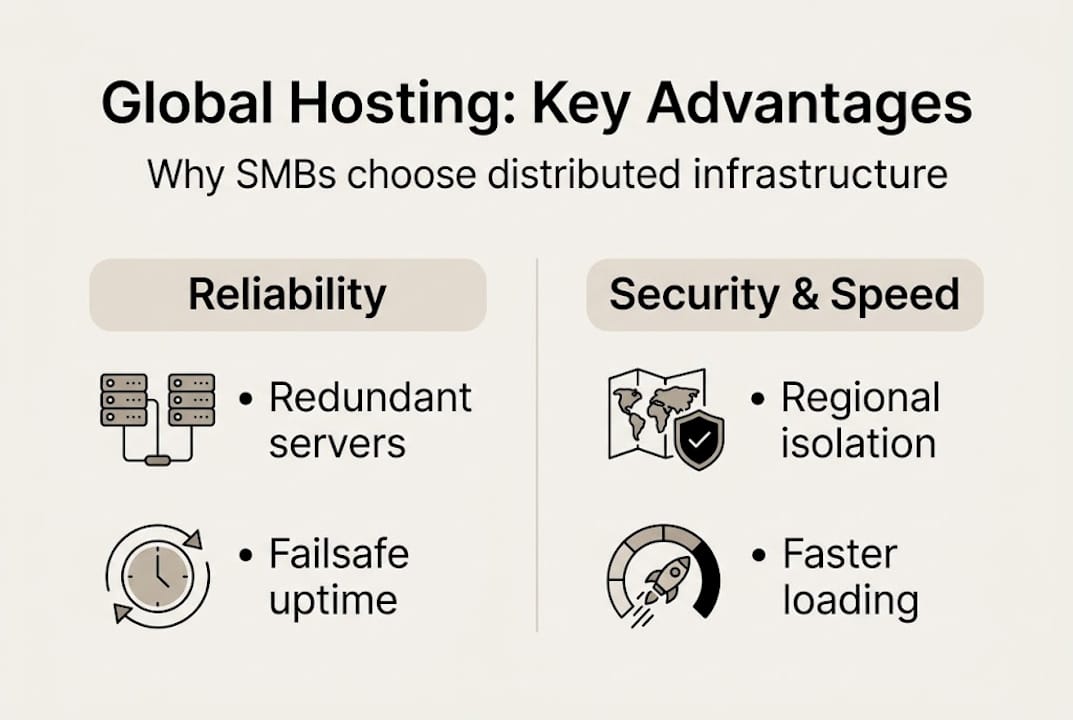
Security in a distributed model works differently than in a single-server setup. Threats are isolated regionally, meaning an attack targeting one node does not automatically compromise your entire infrastructure. Security patches and updates can be rolled out across nodes in sequence, reducing the window of vulnerability. This is especially relevant as cyberattacks on SMBs have increased significantly, with attackers targeting smaller organizations that often have weaker defenses.
Scalability means your infrastructure grows with your business rather than forcing you to over-provision resources you don't yet need. Global hosting platforms typically offer elastic scaling, where compute and storage resources adjust automatically based on real-time demand.
Here is a practical sequence for how global hosting improves your infrastructure:
- Audit your current setup. Identify single points of failure, geographic coverage gaps, and compliance risks.
- Select a provider with multi-region data centers. Ensure they offer redundant connectivity and documented failover procedures.
- Implement a CDN layer. Distribute static assets globally to reduce origin server load and improve response times.
- Configure automated scaling rules. Set thresholds for CPU, memory, and bandwidth that trigger resource additions without manual input.
- Test failover scenarios regularly. Simulate regional outages to confirm your setup behaves as expected.
For organizations planning significant growth, the enterprise hosting guide offers detailed guidance on architecture decisions that scale well. The hosting solution selection process also covers how to align provider capabilities with long-term infrastructure goals.
"Multi-CDN strategies enhance reliability by failover and regional optimization, recommended for high-traffic global sites." This principle applies equally to SMBs preparing for growth as it does to large enterprises already operating at scale.
Pro Tip: Plan your hosting architecture for the business you expect to be in 18 months, not the one you are today. Migrating infrastructure mid-growth is far more disruptive and expensive than building in headroom from the start.
Assessing and implementing a global hosting solution
Knowing you need global hosting and knowing how to get there are two different things. Here is a structured approach that works for SMB IT teams without requiring a dedicated infrastructure department.
Start with a needs assessment. Before you talk to any provider, answer these questions internally:
- Where are your current and target customers located geographically?
- What is your acceptable downtime threshold per month?
- Do you handle data subject to regional compliance requirements?
- What are your peak traffic patterns, and how much headroom do you currently have?
Once you have clear answers, the provider evaluation becomes much more focused. When comparing options, look at cloud solution examples that match your scale and industry to benchmark what good looks like.
The transition process itself follows a logical sequence:
- Map your current architecture. Document every component, dependency, and integration before touching anything.
- Choose a migration strategy. Lift-and-shift moves existing workloads as-is. Re-platforming optimizes them for the new environment. Most SMBs start with lift-and-shift for speed.
- Run parallel environments. Keep your existing hosting live while the new global setup is tested. This eliminates downtime risk during the transition.
- Migrate in phases. Start with lower-risk workloads, validate performance, then move critical systems.
- Decommission legacy infrastructure only after the new environment has run stably for at least 30 days.
When evaluating providers, prioritize these factors:
- Geographic coverage: Does the provider have data centers in your key markets?
- SLA commitments: What uptime guarantees are contractually backed, and what are the remedies for failures?
- Security certifications: Look for PCI DSS, ISO 27001, or SOC 2 compliance depending on your industry.
- Support quality: 24/7 access to technical support matters more than price when something breaks at 2 a.m.
- Scalability options: Can you scale up and down without lengthy procurement cycles?
A multi-CDN approach combined with a hybrid cloud model gives SMBs the flexibility to keep sensitive workloads on private infrastructure while leveraging public cloud capacity for variable demand. This is the architecture pattern that offers the best balance of control, cost, and performance for most growing organizations.
Why the conventional approach to hosting isn't enough for SMBs
Most SMBs inherit their hosting setup rather than choose it. A shared hosting plan from the early days of the business, a VPS added when traffic grew, a patchwork of solutions that technically work but were never designed to work together. This is the norm, not the exception.
The problem is not that local hosting is bad. It is that it was built for a different era of business. Digital-first operations, global customer bases, and always-on expectations have changed what "good enough" actually means. Sticking with local hosting because it hasn't broken yet is not a strategy. It is deferred risk.
What most hosting conversations miss is that the complexity barrier to global hosting has dropped dramatically. The hosting impact for SMBs is measurable and immediate. The hard-won lesson from organizations that have been through painful outages is simple: plan early. The right time to upgrade your hosting architecture is before a crisis forces your hand, not during one.
Start your global hosting journey with Internetport
If this article has clarified what global hosting can do for your organization, the next step is finding a provider that matches your specific requirements.
At Internetport, we have been building reliable, scalable hosting infrastructure since 2008. Our solutions are designed for SMBs and enterprises that need real performance, not just promises. Whether you are looking to explore webhosting options with free SSL and daily backups, or need the raw power of dedicated server solutions with full resource control, we have configurations that scale with your business. Our PCI DSS certified data centers, redundant connectivity, and hands-on technical support mean you get infrastructure you can actually rely on. Reach out to our team to discuss a hosting setup built around your goals.
Frequently asked questions
What are the main benefits of global hosting for SMBs?
Global hosting improves uptime through redundant failover, speeds access for users in different regions, and supports seamless scaling as your business grows. Multi-CDN strategies add another layer of reliability by routing traffic through the fastest available network at any given moment.
How does global hosting increase website security?
Distributed infrastructure isolates threats regionally and allows security updates to roll out across nodes without a single point of failure. This makes it significantly harder for attackers to compromise your entire environment through one vulnerability.
Can SMBs implement global hosting affordably?
Yes. Cloud-based global hosting and CDN options have made multi-region infrastructure accessible at price points that work for small and medium-sized businesses, especially when compared to the cost of downtime or lost customers.
What is a multi-CDN strategy, and why does it matter?
A multi-CDN strategy uses several content delivery network providers simultaneously, so if one experiences an outage or slowdown, traffic automatically shifts to another. This approach enhances reliability and optimizes speeds across different geographic regions.