

TL;DR:
- A hosting SLA is a formal contract that defines performance, availability, support standards, and accountability measures for providers. Its scope now extends beyond uptime to include response times, security, backups, and proactive monitoring, influencing business risk management. Evaluating SLA exclusions, measurement methods, and compensation caps is essential to ensuring actual protection aligns with operational needs.
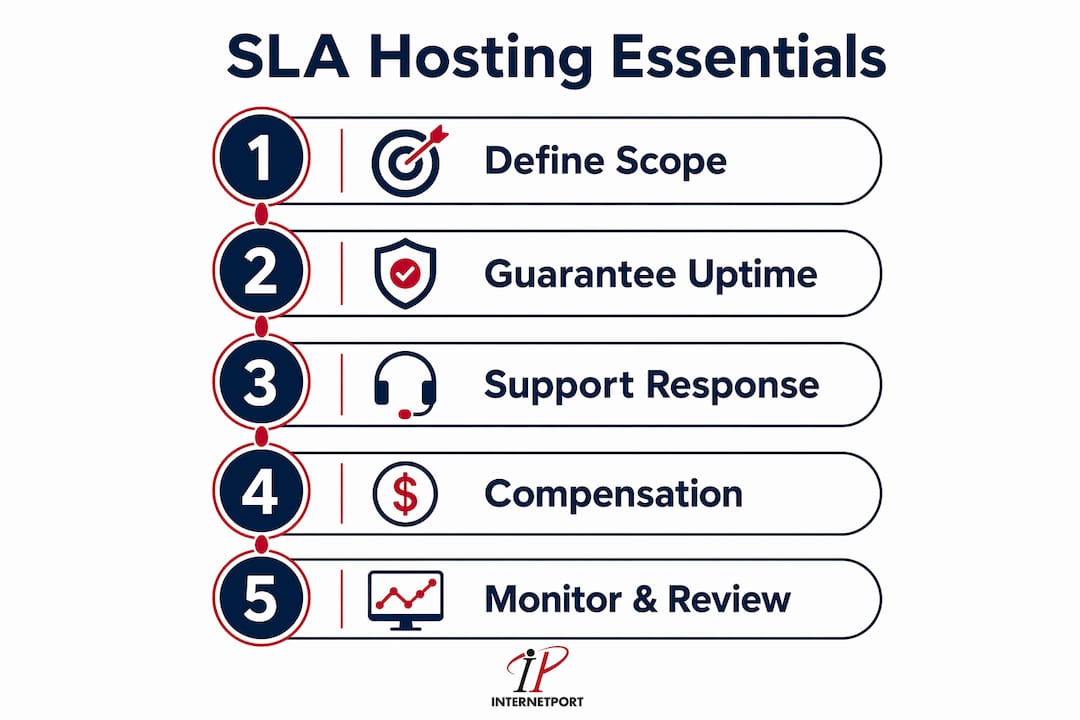
A Service Level Agreement (SLA) in hosting is a formal contract that defines the performance, availability, and support standards a hosting provider guarantees to its customers. For IT managers and business owners, this document is the single most important piece of paper between your infrastructure and a costly outage. The role of SLA in hosting goes far beyond uptime percentages. It sets the legal and operational framework for accountability, compensation, and response when things go wrong. E-commerce platforms, SaaS applications, and enterprise systems all depend on hosting SLA terms to protect revenue, reputation, and customer trust.
What does an SLA in hosting actually cover?
Modern hosting service level agreements extend well beyond uptime to include response times, support availability, security responsibilities, and backup standards. That scope matters because a provider promising 99.9% uptime without defining support response windows or security breach procedures is offering far less protection than the headline number suggests. Understanding each component lets you evaluate whether a provider's SLA actually matches your operational requirements.
Uptime guarantees and what the numbers mean
Uptime is expressed as a percentage of total monthly availability. The difference between 99.9% and 99.99% sounds trivial but translates to roughly 8.7 hours versus 52 minutes of allowable downtime per year. For a SaaS platform processing transactions around the clock, that gap is the difference between a minor incident and a major revenue event. Enterprise-grade providers typically offer 99.95% or 99.99% guarantees, while shared hosting plans often sit at 99.9%.

Support commitments: response time vs. resolution time
Response time guarantees define how quickly a support team acknowledges your ticket, not how quickly they fix the problem. Most SLAs guarantee response time. Far fewer guarantee resolution time, and those that do typically tier it by severity level. A critical outage might carry a four-hour resolution target, while a non-critical configuration issue could have a 48-hour window. Read both figures before signing.
The core components to verify in any hosting SLA include:
- Uptime percentage and measurement method: Is uptime measured by the provider's own monitoring tools or a neutral third party?
- Response and resolution time tiers: Are these differentiated by severity, and what counts as a critical incident?
- Compensation structure: Credits applied to future invoices or direct refunds?
- Scheduled maintenance exclusions: Does planned downtime count against your uptime calculation?
- Security and backup commitments: What recovery time objectives (RTOs) and recovery point objectives (RPOs) are guaranteed?
- Claim filing requirements: How long do you have to submit a credit request after an incident?
How compensation actually works
Service credits are the standard compensation mechanism in hosting SLAs, not cash refunds. A typical structure awards a 10% credit for one hour of downtime, scaling up to a maximum of 100% of your monthly fee. That cap is critical context. If a prolonged outage costs your business $50,000 in lost revenue, a credit worth $200 against next month's invoice is not meaningful compensation. It is an accountability signal, not a financial safety net.
Credits must be claimed by opening a support ticket within a defined window, usually 7 to 30 days after the incident. Automatic compensation is rare. If you miss the filing deadline, you forfeit the credit entirely. Build a process into your incident response workflow to file claims immediately after any qualifying outage.
How does an SLA affect hosting reliability and business risk?
An SLA functions as a risk management tool, not an insurance policy. It aligns the provider's operational behavior with your business requirements by creating measurable, contractual accountability. When a provider knows they face financial penalties for missing uptime targets, they invest more heavily in redundant infrastructure, monitoring, and incident response. That behavioral incentive is the real value of a strong SLA.
SLA strength should match your downtime tolerance. A personal blog can absorb a few hours of downtime without meaningful consequence. An e-commerce site processing $10,000 per hour cannot. Agencies managing client sites sit somewhere in between, because their exposure includes both direct revenue loss and reputational damage with clients. Mapping your SLA requirements to your actual business risk profile is the first step toward selecting the right hosting tier.
"The SLA is not the ceiling of your reliability. It is the floor. Your actual uptime should consistently exceed it, and you should be monitoring independently to verify that it does."
Consider three scenarios that illustrate the impact of SLA on hosting decisions. A fintech startup running payment processing needs a 99.99% uptime guarantee, a four-hour resolution SLA for critical incidents, and explicit security breach response timelines. A mid-size digital agency hosting 30 client sites needs a 99.9% guarantee with clear escalation paths and a support team available outside business hours. A content publisher running informational sites can accept 99.9% with standard business-hours support. Each scenario demands a different SLA, and choosing the wrong tier in either direction wastes money or exposes you to unacceptable risk.
Pro Tip: Complement your SLA with independent uptime monitoring tools like UptimeRobot or Pingdom. Provider-reported uptime and customer-experienced uptime sometimes diverge, and you need your own data to file accurate claims and hold providers accountable.
SLAs also affect business continuity planning directly. A provider with defined RPOs and RTOs in their SLA gives your IT team concrete parameters to build disaster recovery plans around. Without those commitments in writing, recovery timelines are guesswork.
What are the hidden pitfalls in hosting SLA terms?
Not all SLAs deliver the protection they appear to offer. Several structural features consistently reduce the practical value of even well-marketed guarantees.
| SLA Feature | What It Promises | What It Often Delivers |
|---|---|---|
| 99.9% uptime guarantee | Less than 9 hours downtime per year | Excludes scheduled maintenance, third-party outages |
| Service credit compensation | Financial remedy for downtime | Capped at monthly fee; requires manual claim filing |
| Response time guarantee | Fast acknowledgment of issues | Does not guarantee resolution speed |
| "Unlimited" resource plans | No usage restrictions | CPU, RAM, and I/O throttling buried in terms |
| Security SLA clauses | Breach response commitments | Often vague on timelines and notification requirements |
Scheduled maintenance and third-party failures are almost universally excluded from uptime calculations. A provider can take their infrastructure offline for four hours of planned maintenance every month and still technically meet a 99.9% SLA. Read the exclusions section of any SLA as carefully as the uptime headline.
Resource usage limits represent another category of hidden restriction. Plans marketed as unlimited often include CPU throttling, RAM caps, or I/O limits that activate under sustained load. These constraints directly affect application performance but rarely appear in the SLA summary. They live in the acceptable use policy or terms of service, which most buyers never read in full.
Measurement methodology is a third area of risk. When a provider monitors their own uptime and reports their own compliance, there is an inherent conflict of interest. Providers who publish real-time status dashboards and historical incident logs offer meaningfully more transparency than those who only report uptime figures on request. Ask any prospective provider how they measure uptime, who monitors it, and how you can independently verify their reported figures.
A high uptime percentage does not automatically mean better protection. A provider offering 99.99% with broad exclusions and a 100% monthly fee cap may offer weaker real-world protection than a provider offering 99.95% with narrow exclusions, proactive monitoring, and a responsive support team. The number is a starting point, not the full picture.
How are hosting SLAs evolving in 2026?
The SLA model is shifting from a reactive contract to a proactive infrastructure partnership. Providers are integrating AI-assisted monitoring, automated remediation, and customer experience guarantees that go well beyond traditional uptime metrics. This evolution reflects the reality that modern applications are judged on user experience, not just server availability.
Key trends reshaping hosting SLAs in 2026 include:
- Performance-based guarantees: SLAs now increasingly include latency targets, page load time commitments, and API availability metrics alongside uptime. A server that is technically online but responding in 8 seconds is failing its users even if it never goes down.
- Proactive monitoring and self-healing infrastructure: Leading providers are committing to predictive failure detection and automated remediation in their SLA terms. This means issues are resolved before customers notice them, not after a ticket is filed.
- Expanded security commitments: Breach notification timelines, vulnerability patching windows, and incident response procedures are appearing in SLA language as regulatory pressure from frameworks like GDPR and PCI DSS increases.
- Real-time transparency dashboards: Providers offering live status pages and historical incident data give customers continuous visibility into SLA compliance rather than relying on provider-reported summaries.
- Infrastructure partnership framing: Forward-looking providers position SLAs as collaborative performance frameworks rather than liability-limiting contracts. This shift in language reflects a genuine change in how accountability is structured.
For IT managers evaluating providers in 2026, the question is no longer just "what uptime do you guarantee?" The better questions are: What performance metrics beyond uptime are covered? How do you monitor and report compliance? What automated responses trigger before I need to file a ticket? These questions separate providers building genuinely reliable infrastructure from those marketing a number.
Enterprise IT leaders should also watch for SLA provisions covering multi-region failover, edge caching performance, and container orchestration availability as cloud-native architectures become standard. The SLA of 2026 needs to reflect the complexity of the infrastructure it governs.
Key takeaways
A hosting SLA's real value lies in the specifics of its exclusions, compensation structure, and measurement methodology, not its uptime headline.
| Point | Details |
|---|---|
| SLA scope goes beyond uptime | Modern SLAs cover support response, security, backups, and performance metrics. |
| Credits are not refunds | Compensation is capped at your monthly fee and requires manual claim filing within 7 to 30 days. |
| Exclusions reduce real coverage | Scheduled maintenance and third-party failures are typically excluded from uptime calculations. |
| Match SLA strength to risk | Transactional and client-facing sites need enterprise-level guarantees; informational sites can accept 99.9%. |
| SLAs are evolving fast | 2026 SLAs increasingly include latency, security response, and AI-driven proactive monitoring commitments. |
Why I read the exclusions before the uptime number
After years of evaluating hosting contracts for clients across fintech, e-commerce, and enterprise software, I have developed one firm habit: I read the exclusions section of an SLA before I read the uptime guarantee. The headline percentage is marketing. The exclusions are the contract.
I have seen businesses sign agreements with 99.99% uptime guarantees only to discover that the provider's scheduled maintenance window accounts for six hours per month, the compensation cap is 100% of a $30 monthly fee, and the claim window is seven days. In practice, that SLA offered almost no meaningful protection for a business generating $5,000 per hour in online revenue.
The other thing I have learned is that support quality matters as much as the uptime number. A provider with a 99.95% guarantee and a genuinely responsive technical team will outperform a provider with a 99.99% guarantee and a support team that takes 18 hours to acknowledge a critical ticket. The SLA sets the floor. The people behind it determine whether you ever need to invoke it.
My advice to any IT manager evaluating hosting SLAs: negotiate. Most providers treat SLA terms as fixed, but enterprise clients often have room to push for narrower exclusions, faster resolution commitments, and higher compensation caps. The worst outcome is they say no. The best outcome is you get a contract that actually reflects your business risk.
Finally, never treat an SLA as a substitute for your own monitoring and backup strategy. The SLA tells you what happens after a failure. Your monitoring tells you when one is starting. Your backups determine whether you recover in minutes or days. All three need to work together.
— Peter
Hosting with SLAs you can actually rely on
Internetport builds its hosting services around the kind of SLA transparency that IT managers and business owners need to make confident infrastructure decisions. From web hosting plans with clear uptime commitments to VPS solutions and dedicated servers designed for enterprise-level reliability, Internetport's offerings are backed by PCI DSS compliance, Swedish and international data centers, and technical support teams that understand what downtime actually costs. If you are evaluating hosting providers and want to see SLA terms that hold up under scrutiny, Internetport's hosting packages are worth a close look.
FAQ
What is an SLA in web hosting?
An SLA in web hosting is a formal contract that specifies the uptime, support response times, compensation terms, and performance standards a provider guarantees. It serves as the legal and operational baseline for the provider-client relationship.
What uptime percentage should I require in a hosting SLA?
Transactional and client-facing sites should require 99.95% or 99.99% uptime guarantees. Informational or lower-traffic sites can typically accept 99.9%, which allows up to 8.7 hours of downtime per year.
How does SLA compensation work when a provider misses their uptime target?
Most providers issue service credits applied to future invoices rather than cash refunds, typically capped at 100% of your monthly fee. You must file a claim within 7 to 30 days of the incident to receive the credit.
What exclusions should I watch for in a hosting SLA?
Scheduled maintenance windows and third-party infrastructure failures are the most common exclusions. These can significantly reduce the practical uptime protection a provider delivers despite a high published percentage.
How are hosting SLAs different in 2026 compared to previous years?
Modern SLAs increasingly include performance metrics like latency and API availability, proactive monitoring commitments, security breach response timelines, and real-time transparency dashboards, moving well beyond traditional uptime-only guarantees.