
TL;DR:
- Enterprise hosting is a distinct operational model that emphasizes managed services, SLAs, and accountability, rather than just hardware specifications. It guarantees high availability, compliance support, and proactive incident management, making it ideal for critical workloads; choosing the right provider involves evaluating their operational culture and support maturity. Successful enterprise hosting relies on a partnership approach where operational reliability and transparency are prioritized over cost or hardware alone.
Most IT leaders already know the difference between a $5 shared plan and a cloud server. What trips them up is assuming that "enterprise hosting" is just the next tier up on that same scale. It isn't. Enterprise hosting is a fundamentally different operating model, not a bigger server with a fancier price tag. The real differentiators are managed operations, formal service-level agreements (SLAs), and the kind of accountability that keeps business-critical systems running when everything else is under pressure. This guide walks you through what enterprise hosting actually means, how it works operationally, and how to make the right call for your organization.
Table of Contents
- Defining enterprise hosting: What sets it apart
- Key features and operational model of enterprise hosting
- Comparing enterprise hosting with traditional models
- How enterprise hosting enables reliability and scalability
- Choosing the right enterprise hosting model for your organization
- A fresh take: What most IT leaders miss about enterprise hosting
- Explore enterprise-ready hosting solutions with Internetport
- Frequently asked questions
Key Takeaways
| Point | Details |
|---|---|
| Operational accountability | Enterprise hosting is defined by managed services, SLAs, and business-critical reliability. |
| Beyond basic cloud | Enterprise hosting includes support, compliance, and guaranteed uptime not always found in standard cloud offerings. |
| Choose by needs—not just specs | Successful IT leaders base their hosting choice on operational partnership and accountability, not just technology features. |
| Reliability and scalability | Enterprise hosting solutions use proven architectures to deliver elasticity and support predictable business growth. |
Defining enterprise hosting: What sets it apart
The term "enterprise hosting" gets thrown around loosely, which is exactly why so many purchasing decisions go sideways. At its core, enterprise hosting means managed, enterprise-grade infrastructure and operations designed for business-critical workloads, often with dedicated or private resources and operational accountability, rather than basic shared hosting. That last phrase matters more than anything else in the definition.
It's not about raw compute power alone. It's about who is responsible when something breaks at 2 a.m. on a Sunday before a major product launch. Shared hosting puts that responsibility on you. Enterprise hosting puts it on the provider, contractually.
Here's how enterprise hosting distinguishes itself from the common hosting models you're probably already familiar with:
- Shared hosting: Multiple tenants share the same physical server, operating system, and resources. No SLAs, limited security controls, zero managed services. Fine for a small blog. Catastrophic for an ERP system.
- VPS (Virtual Private Server): A virtualized slice of a dedicated server. More isolation than shared, but still largely self-managed. You handle updates, security hardening, and incident response.
- Dedicated hosting: Your organization gets an entire physical server. More control, better performance. Still typically unmanaged unless you pay for add-ons.
- Enterprise hosting: Combines dedicated or private cloud infrastructure with a full operational layer: managed monitoring, proactive remediation, compliance support, defined SLAs, and escalation paths.
The foundational insight from our enterprise hosting guide is that what separates enterprise hosting isn't a hardware specification. It's the operating model surrounding that hardware.
"The real competitive advantage in enterprise hosting isn't the server spec sheet. It's the managed layer that ensures your workloads stay available, compliant, and recoverable when conditions degrade."
Think of it this way: a commercial airline and a private jet both get you from point A to point B. But the commercial airline has maintenance crews, air traffic control coordination, co-pilots, black boxes, and documented emergency procedures. Enterprise hosting is the operational infrastructure that surrounds the flight, not just the aircraft itself. For a deeper look at how scalable hosting solutions fit into this model, the distinctions become even clearer when you compare real-world deployment architectures side by side.
Key features and operational model of enterprise hosting
With a definition in hand, it's critical to look under the hood at the specific operational features that distinguish enterprise hosting from less robust alternatives. In practice, enterprise hosting focuses on operational mechanics like managed monitoring, security and compliance support, and meeting business-level availability expectations, often formalized via SLAs.
That operational focus translates into a specific set of features that you should expect from any legitimate enterprise hosting provider:
- Managed monitoring and alerting: 24/7 infrastructure monitoring with automated alerts and human response protocols. Not just ping checks. Deep application and network layer visibility with defined escalation paths.
- Proactive remediation: When anomalies appear, the provider acts first. You get notified after the issue is contained, not when it starts spiraling.
- Security and compliance support: This goes well beyond a firewall. Enterprise hosting providers handle patch management, vulnerability scanning, audit logging, and in many cases assist with compliance frameworks like PCI DSS, ISO 27001, or GDPR-aligned data handling.
- Guaranteed uptime SLAs: Typically 99.9% to 99.99% uptime commitments backed by financial penalties if the provider falls short. This is what "accountability" looks like in practice.
- Formal escalation procedures: Clear, documented paths from first alert to senior engineer. Not a ticket queue. A defined response chain with time-bound commitments.
- Dedicated account or technical support: A named contact who knows your environment, not a rotating helpdesk.
Understanding hosting security explained in depth is essential at this stage, because security is not a feature you bolt on after the fact in enterprise environments. It has to be woven into the operational model from day one.
Pro Tip: When reviewing SLA terms, go beyond the uptime percentage. Ask for the provider's definition of "downtime." Some contracts exclude scheduled maintenance windows, network degradation events, and third-party outages from their SLA calculations. A 99.99% uptime guarantee that excludes maintenance can functionally deliver far less availability than the number implies. Always request the provider's historical incident logs alongside the SLA documentation to validate their claims with real data.
The most important thing to recognize is that managed monitoring and compliance support aren't premium add-ons in a mature enterprise hosting relationship. They're baseline expectations. If a provider is treating them as upsells, that tells you something important about how they view operational accountability.
Comparing enterprise hosting with traditional models
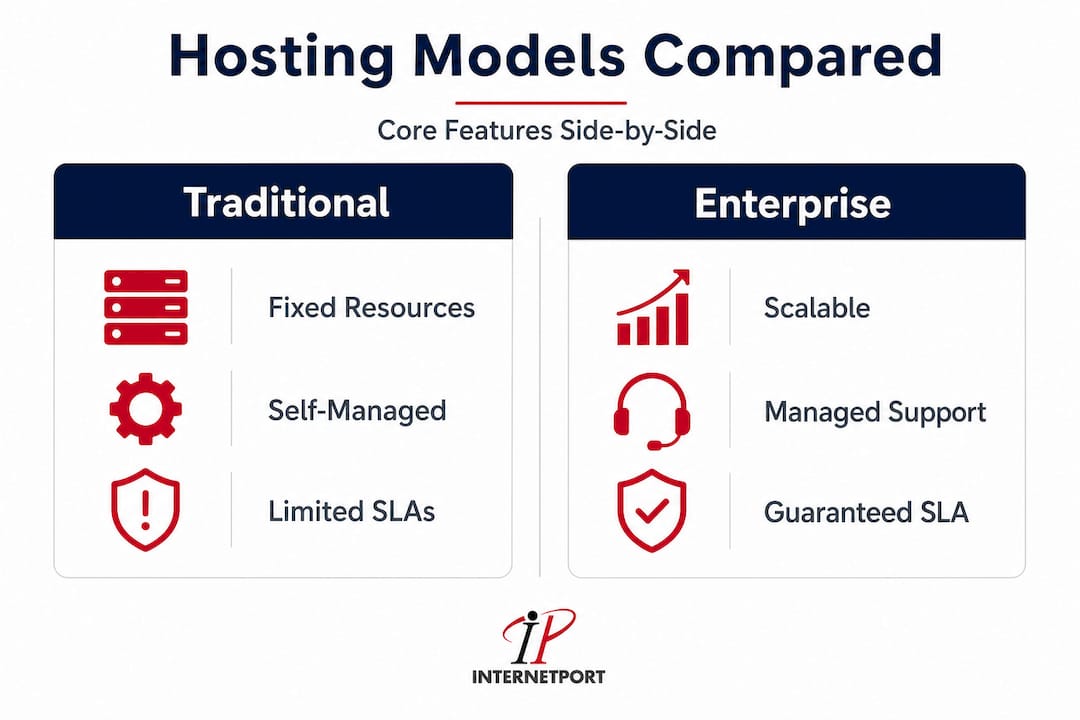
To further clarify, let's see how enterprise hosting stacks up against the main hosting models organizations commonly consider. Enterprise cloud hosting adds managed services, security, compliance, and support to cloud deployment rather than just offering self-service compute and storage. That distinction between self-service and managed operations is what most comparison articles get wrong.
| Feature | Shared hosting | Dedicated hosting | Public cloud | Enterprise hosting |
|---|---|---|---|---|
| Resource isolation | None | Full | Variable | Full or private |
| SLA-backed uptime | Rarely | Sometimes | Yes (basic) | Yes (comprehensive) |
| Managed operations | No | No | No | Yes |
| Compliance support | No | No | Limited | Yes |
| Security management | Self-managed | Self-managed | Self-managed | Provider-managed |
| Escalation procedures | No | No | Ticket-based | Defined, time-bound |
| Cost model | Fixed, low | Fixed, high | Variable | Fixed or hybrid |
| Scalability | None | Limited | High | High (with governance) |
This table reveals why cloud infrastructure explained in detail points to a common trap: organizations often interpret "public cloud" as equivalent to "enterprise hosting." They aren't. A public cloud gives you elastic compute and storage, but the cloud infrastructure explained clearly shows that operational responsibility still sits with your team unless you layer managed services on top.
Here are the top use cases that match each model to the right organizational context:
- Shared hosting: Personal blogs, low-traffic marketing microsites, non-critical content pages with zero transactional requirements.
- Dedicated hosting (unmanaged): Organizations with strong internal DevOps capabilities that want hardware control without a managed services overlay.
- Public cloud (self-service): Development and testing environments, burst workloads where costs are tightly monitored, and teams with full-stack cloud engineering skills.
- Enterprise hosting: Production databases, financial transaction systems, healthcare platforms with compliance requirements, customer-facing applications with uptime SLA obligations, and any workload where downtime has direct revenue or regulatory consequences.
The distinction IT leaders need to hold onto is that enterprise hosting is never the cheapest option. But for workloads where failure is genuinely costly, whether measured in revenue, regulatory penalties, or customer trust, the economics almost always favor the managed model over the self-service alternative.
How enterprise hosting enables reliability and scalability
Beyond big-picture models, let's make it practical by looking at how enterprise hosting empowers reliability and growth in dynamic enterprise IT environments. The architecture and methodology behind enterprise hosting aren't improvised. They follow proven frameworks specifically designed to meet the dual demands of uptime and elasticity under real-world load conditions.
Enterprise cloud architecture targets reliability and elasticity using repeatable methodologies. AWS frames scalable web hosting as achieving elasticity, scalability, and reliability by adapting classic architectures into cloud-native patterns. That framing applies to enterprise hosting broadly: the architecture must be designed to absorb demand spikes, tolerate component failures, and recover automatically without human intervention.

Here is how specific reliability and scalability features translate into real operational outcomes:
| Feature | What it does technically | Practical business impact |
|---|---|---|
| Redundant data centers | Mirrors infrastructure across geographic locations | Protects against regional outages |
| Auto-scaling | Adjusts compute resources based on demand | Prevents performance degradation during traffic spikes |
| Load balancing | Distributes traffic across multiple server instances | Eliminates single points of failure at the application layer |
| Automated failover | Switches to backup systems without manual intervention | Reduces mean time to recovery (MTTR) from hours to seconds |
| SSD storage | Faster read/write speeds than traditional spinning disk | Reduces database query times and application latency |
| 10 Gbps network capacity | High-throughput connectivity for data-intensive workloads | Supports large-scale data transfers without bottlenecks |
"The organizations that survive major infrastructure events are rarely the ones with the best hardware. They're the ones with the most rehearsed recovery procedures and the most transparent escalation paths."
Exploring cloud solutions for scalability confirms that scalability in enterprise hosting isn't just vertical (adding more CPU and RAM to a single server). It's horizontal: distributing workloads across multiple nodes so that growth in demand doesn't create a bottleneck at any single point. This is a fundamentally different architectural philosophy than traditional dedicated hosting, and it's one of the reasons enterprise hosting can support both predictable and unpredictable growth patterns.
Reliability also includes what happens after an incident. A mature enterprise hosting provider doesn't just restore service. They deliver a root cause analysis (RCA), document what failed, what response was taken, and what changes prevent recurrence. That documentation trail is what compliance auditors, IT boards, and risk managers actually need to see.
Choosing the right enterprise hosting model for your organization
With the role of enterprise hosting defined, the final core question is how to choose the right model for your organization's priorities and constraints. For IT decision-makers, the real enterprise hosting differentiator is the operating model: managed monitoring and security and compliance, formal accountability via SLAs, and predictable availability under both demand peaks and incident scenarios. Not just the infrastructure label.
Use this framework to structure your evaluation:
-
Audit your workload criticality. Classify every workload by revenue impact, compliance sensitivity, and acceptable downtime. Tier 1 workloads (payment systems, customer portals, core databases) need enterprise-grade protection. Tier 3 workloads (dev environments, static assets) don't.
-
Define your compliance requirements before shopping. If your environment touches payment card data, healthcare records, or financial reports, your hosting model must support those regulatory frameworks by design. Ask providers for written evidence of their own certifications, not promises about what they can help you achieve.
-
Interrogate the SLA structure. As noted earlier, the headline number isn't the story. Ask what's excluded, how credits are calculated, and what the claims process looks like. A provider confident in their reliability welcomes this scrutiny.
-
Evaluate support accountability, not just support availability. "24/7 support" means nothing if the first-level response is a form submission. Ask what the escalation path looks like, how quickly you can reach a senior engineer, and whether you have a named technical contact.
-
Assess growth compatibility. Your organization's infrastructure needs in two years will look different than today. Does the provider's architecture support horizontal scaling? Can you expand network capacity, add geographic redundancy, or move workloads between environments without re-platforming?
-
Run a reference check on incident history. Ask prospective providers for case studies or references from clients in your industry. Specifically ask about their most significant incident in the past 18 months and how they handled it.
Review your hosting solution selection process against these criteria and you'll quickly narrow the field from a broad vendor list to a shortlist of providers who can genuinely meet your operational requirements. It also helps to understand the full landscape of web hosting options before committing to any model, because the right choice depends heavily on your specific workload mix.
Pro Tip: One of the most revealing questions you can ask a prospective provider is: "Walk me through your last major incident. What happened, how did you communicate it, and what changed afterward?" Providers with genuine operational maturity will answer this confidently with specifics. Providers who deflect or give vague answers are signaling exactly the kind of accountability gap that causes enterprises real pain once a contract is signed.
A fresh take: What most IT leaders miss about enterprise hosting
Most articles on this topic stop at the selection checklist. That's useful, but it misses the deeper pattern that separates organizations that genuinely benefit from enterprise hosting from those that spend significantly and still end up frustrated.
The uncomfortable truth is this: too many enterprises buy enterprise hosting for the hardware specs and then ignore the service layer entirely until something breaks. They negotiate on price per CPU core and terabyte of storage. They skip the deep dive on SLA language. They don't ask about escalation paths until they need one. And then, when an incident hits, they discover that the "enterprise" label on their contract didn't come with the operational culture they assumed was included.
The game-changer in enterprise hosting isn't the technology. It's the relationship between your IT team and the provider's operations team. The providers that actually earn long-term enterprise contracts are the ones that behave like an extension of your internal team, proactively flagging risks, communicating transparently during incidents, and delivering RCAs without being asked.
We've seen organizations switch from well-known public cloud platforms to managed enterprise hosting not because the cloud couldn't handle the workload technically, but because the operational model required too much internal headcount to maintain. Managing your own patching, security monitoring, compliance documentation, and incident response is a full-time operation. For many mid-market and enterprise organizations, that cost in people is far higher than the premium paid for managed services.
The analogy worth holding onto: you don't evaluate a law firm by the books in their library. You evaluate them by how they behave when you're in trouble. Enterprise hosting is exactly the same. Enterprise hosting insights consistently show that the organizations with the best outcomes are those that treat provider selection as a partnership evaluation, not a commodity purchase.
The practical advice here is to spend at least as much time evaluating the provider's operational culture as you do comparing their technical specifications. Request a pre-sales architecture review. Ask to speak with their NOC (Network Operations Center) team directly. See how quickly they respond to technical questions during the sales process. Slow or vague responses before you sign are a very reliable predictor of the support experience after you do.
Explore enterprise-ready hosting solutions with Internetport
The features discussed throughout this article, from managed operations and SLA accountability to redundant infrastructure and compliance-ready environments, aren't theoretical. They're the baseline Internetport was built to deliver.
Internetport has supported enterprise and mid-market organizations since 2008, operating redundant data centers in Sweden with network capacity up to 10 Gbps, SSD-backed infrastructure, and PCI DSS compliance built into the platform. Whether you're evaluating dedicated server solutions for mission-critical workloads, looking at enterprise webhosting for high-availability applications, or exploring a broader cloud hosting overview to find the right fit for your environment, the team at Internetport can help you map your requirements to the right operational model. Reach out to start a conversation grounded in your actual workload needs.
Frequently asked questions
What does 'managed' mean in enterprise hosting?
Managed means the hosting provider takes responsibility for monitoring, maintenance, security, and service uptime, usually backed by service-level agreements. As defined in the enterprise hosting standard, this is the core distinction between enterprise-grade infrastructure and basic hosting options.
How is enterprise hosting different from public cloud services?
Enterprise hosting includes managed security, compliance, and guaranteed SLAs, while public cloud services often require more hands-on management and do not offer the same operational guarantees. The key enterprise cloud distinction is that it adds an operational layer on top of cloud infrastructure, not just self-service compute and storage.
Does enterprise hosting guarantee uptime?
Yes, providers commonly offer uptime guarantees as part of SLA agreements, reflecting their commitment to operational reliability. This is described as a managed service standard delivering secure, resilient, scalable infrastructure for medium-to-large enterprises with uptime guarantees and dedicated support.
Why are SLAs important in enterprise hosting?
SLAs ensure measurable commitments to uptime, performance, and problem resolution between the provider and the enterprise. Formal SLA accountability is one of the primary mechanisms through which enterprise hosting operationalizes its managed monitoring and availability commitments into legally binding obligations.