

TL;DR:
- Enterprise cloud adoption is rapidly increasing, driven by demand for scalability, agility, and cost efficiency.
- Cloud scalability relies on auto-scaling, horizontal scaling, and pay-as-you-go models, enabling resource flexibility.
- Successful cloud strategies depend on organizational alignment, clear objectives, and proactive governance.
Enterprise cloud adoption is accelerating faster than most IT teams anticipated. Public-cloud spending hit $330.4B in 2024, with projections pointing to $723B by 2025, and 92% of organizations investing in generative AI now require scalable cloud infrastructure to support it. Yet many enterprises still struggle to match the right deployment model to their actual workloads, control runaway costs, and maintain compliance across increasingly complex environments. This guide walks through the core advantages of cloud solutions, how they deliver real scalability and efficiency, which security models matter most in 2026, and how to avoid the pitfalls that derail even well-funded cloud programs.
Table of Contents
- Why enterprises are adopting cloud solutions
- How cloud platforms deliver scalability and efficiency
- Enterprise-grade cloud security: Models and approaches
- Cloud deployment models: Public, private, hybrid, multicloud
- Risks, challenges, and mitigation strategies
- Our take: The real challenge is not the cloud—it's cloud strategy
- Explore enterprise-ready cloud and hosting solutions
- Frequently asked questions
Key Takeaways
| Point | Details |
|---|---|
| Cloud boosts enterprise scalability | Cloud platforms provide flexible, pay-as-you-go access to computing power for dynamic business needs. |
| Security models are evolving | New approaches like zero-trust and sovereign clouds address growing security and compliance demands. |
| Deployment choice drives outcomes | Choosing between public, private, hybrid, or multicloud impacts cost, compliance, and agility. |
| Awareness of risks is vital | Proactive planning can mitigate risks like cost overruns, outages, and vendor lock-in. |
Why enterprises are adopting cloud solutions
Cloud adoption is not just a technology trend. It is a fundamental shift in how enterprises build competitive advantage. The ability to scale infrastructure on demand, pay only for what you use, and deploy new services in hours rather than months has reshaped how IT leaders think about capacity planning and innovation cycles.
The numbers reflect this urgency. Projected cloud spending of $723B in 2025 signals that enterprises are not experimenting anymore. They are committing. And with 92% of organizations pursuing generative AI initiatives, the demand for elastic, high-performance infrastructure is only growing. You cannot run large language models or real-time data pipelines on static, on-premises hardware without serious constraints.
Beyond AI, the core drivers are practical and well-understood by most IT decision-makers:
- Scalability: Auto-scaling and horizontal scaling let workloads grow or shrink without manual intervention, as seen in enterprise cloud examples across industries.
- Business agility: Teams can spin up environments, test new services, and retire them without procurement delays.
- Cost efficiency: Pay-as-you-go models eliminate the waste of over-provisioned hardware sitting idle.
- Speed to market: Development and staging environments deploy in minutes, not weeks.
- Global reach: Multi-region deployments reduce latency for customers and distributed teams worldwide.
Not every workload is a good starting candidate, though. Some legacy applications require significant rearchitecting before they benefit from cloud economics. Others move seamlessly.
Pro Tip: Start with workloads that experience natural fluctuation, such as data analytics jobs, batch processing, or customer-facing web applications. These show the fastest ROI and build organizational confidence before you tackle mission-critical migrations.
For enterprises evaluating where to begin, reviewing scalable hosting options and understanding the cloud computing benefits for your specific industry context is a smart first step.
How cloud platforms deliver scalability and efficiency
Knowing why enterprises adopt cloud is one thing. Understanding how the underlying mechanisms actually work helps you make better architecture decisions and avoid common efficiency traps.
Cloud platforms deliver scalability through three primary models:
| Scaling model | How it works | Best for |
|---|---|---|
| Auto-scaling | Automatically adds or removes compute resources based on real-time demand | Variable traffic workloads, web apps |
| Horizontal scaling | Adds more instances of the same resource in parallel | Distributed systems, microservices |
| Pay-as-you-go | Bills only for resources consumed, not reserved capacity | Cost-sensitive or unpredictable workloads |
Cloud auto-scaling, horizontal scaling, and pay-as-you-go models together allow enterprises to handle traffic spikes without over-investing in idle capacity. A retailer running a flash sale, for example, can scale compute by 10x for four hours and return to baseline without touching a single server.
Efficiency gains come from several compounding factors:
- Reduced operational overhead: Managed services handle patching, updates, and hardware replacement.
- Elasticity: Resources match actual demand rather than peak projections.
- Automation: Infrastructure-as-code tools provision and decommission environments programmatically.
- Centralized monitoring: Single-pane-of-glass visibility into utilization across regions.
These advantages are real, but they require active management. Cloud bills can grow silently. Unused snapshots, forgotten test environments, and over-provisioned database instances accumulate costs that erode projected savings faster than most teams expect.
Pro Tip: Implement cloud cost monitoring from day one, not as an afterthought. Set budget alerts, review utilization weekly, and establish a FinOps practice before your cloud footprint grows beyond easy visibility.
For enterprises focused on optimizing scalability with connectivity, the architecture choices made early in a cloud program have outsized long-term impact. Getting examples of scalable hosting right at the design stage prevents expensive rework later.
Enterprise-grade cloud security: Models and approaches
Scalability without security is a liability. Enterprise cloud security has matured significantly, but the threat landscape has evolved in parallel. The good news is that modern cloud platforms now build security into infrastructure design rather than treating it as a bolt-on layer.
Four security models define the current enterprise standard:
- Shared responsibility model: The cloud provider secures the underlying infrastructure. You secure your data, identities, and application configurations. Misunderstanding this boundary is the source of most cloud breaches.
- Zero-trust architecture: No user or system is trusted by default, regardless of network location. Every access request is verified continuously based on identity, device health, and context.
- Compliance automation: Leading platforms now offer built-in controls mapped to GDPR, HIPAA, PCI DSS, and ISO 27001, reducing the manual effort of audit preparation.
- Sovereign cloud: Dedicated infrastructure that keeps data within specific geographic or regulatory boundaries, controlled by local entities.
Regulatory and geopolitical pressures are accelerating sovereign cloud adoption. Over 50% of organizations will use sovereign cloud by 2029, driven by data residency laws and national security requirements.
The shift toward sovereign cloud is particularly relevant for enterprises operating in the EU, healthcare, financial services, or defense sectors. Data locality is no longer optional in many jurisdictions. Choosing infrastructure that supports secure, scalable solutions with built-in compliance features saves significant remediation cost down the line.

For organizations evaluating whether dedicated or shared infrastructure better fits their risk profile, understanding private cloud advantages is essential before committing to a deployment model.
Cloud deployment models: Public, private, hybrid, multicloud
Deployment model selection is where cloud strategy gets concrete. Each model carries distinct trade-offs across cost, compliance, flexibility, and operational risk.
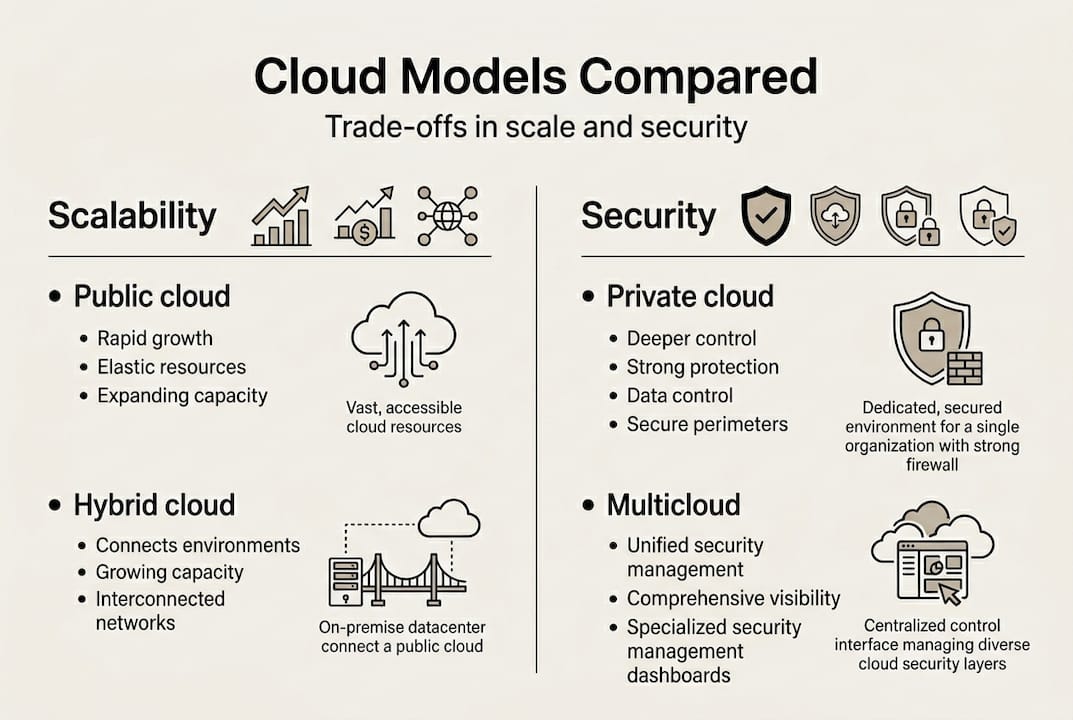
| Model | Cost | Compliance fit | Flexibility | Key risk |
|---|---|---|---|---|
| Public cloud | Low upfront, variable OpEx | Moderate (shared controls) | Very high | Vendor lock-in, data sovereignty |
| Private cloud | Higher CapEx | Strong (full control) | Moderate | Underutilization, maintenance burden |
| Hybrid cloud | Mixed | Strong | High | Integration complexity |
| Multicloud | Variable | Depends on config | Very high | Interoperability, governance overhead |
Hybrid and multicloud adoption is growing as enterprises push back against hyperscaler dependency, seek cost control, and address sovereignty requirements. Over 50% of organizations are shifting workloads away from single-provider public cloud environments.
Choosing the right model depends heavily on your workload profile:
- Regulated industries (finance, healthcare, government): Private or sovereign cloud for sensitive data, public cloud for non-regulated workloads.
- Variable demand workloads: Public cloud for elastic scaling, private for baseline capacity.
- Global enterprises: Multicloud to optimize latency, cost, and regional compliance simultaneously.
- Organizations reducing vendor risk: Hybrid architectures that preserve portability and negotiating leverage.
Understanding private cloud networks and the full spectrum from public cloud pros and cons to the private cloud guide gives decision-makers the context to match architecture to actual business requirements rather than vendor marketing.
Risks, challenges, and mitigation strategies
Cloud programs fail more often from poor planning than from technology limitations. Being clear-eyed about the risks before you commit to a strategy is not pessimism. It is sound engineering judgment.
The most common enterprise cloud risks include:
- Cost overruns: Unchecked resource sprawl and misunderstood pricing models drive budgets well past projections.
- Outages from AI infrastructure upgrades: As providers upgrade GPU clusters and AI services, neighboring workloads can experience unexpected instability.
- Vendor lock-in: Proprietary services and data formats make migration costly and technically complex.
- Multicloud interoperability: Managing identity, networking, and security policies across two or more providers creates significant operational overhead.
- Skills gaps: Cloud-native architecture requires different expertise than traditional on-premises IT.
Up to 25% of organizations are projected to experience significant cloud dissatisfaction by 2028, driven by unmet cost expectations and underestimated complexity. Multicloud deployments, which currently account for a growing share of enterprise environments, amplify interoperability challenges.
Mitigation is straightforward in principle, though it requires discipline in practice:
- Run quarterly cost audits and enforce tagging policies to track resource ownership.
- Build disaster recovery and failover into your architecture from the start, not as a phase-two project.
- Design for portability by favoring open standards and containerized workloads where possible.
- Invest in cloud governance frameworks before scaling, not after problems surface.
Pro Tip: Map your risk tolerance to workload criticality. A development sandbox and a payment processing system should never be managed with the same risk posture. Tier your applications and apply controls proportionally.
The enterprise hosting guide provides a useful framework for aligning infrastructure choices with organizational risk appetite.
Our take: The real challenge is not the cloud—it's cloud strategy
After working with enterprises across a range of infrastructure maturity levels, one pattern stands out clearly: the technology almost never fails on its own. What fails is the strategy surrounding it.
"Cloud-first" became a mantra that many organizations adopted without defining what success actually looks like. Teams migrated workloads because migration was the goal, not because moving a particular application to the cloud solved a real business problem. The result was higher bills, frustrated engineers, and leadership questioning the entire initiative.
The enterprises that get the most from cloud investments share three traits. They define measurable outcomes before selecting a provider or model. They secure cross-functional buy-in from finance, security, and operations before the first workload moves. And they treat cloud governance as a living practice, not a one-time setup task.
Looking at cloud solution examples from organizations that have done this well reveals a consistent theme: success comes from organizational alignment, not from picking the right hyperscaler.
The cloud works. The question is whether your organization is ready to use it with the discipline it requires.
Explore enterprise-ready cloud and hosting solutions
If this guide has clarified your thinking on cloud strategy, the next step is finding infrastructure that matches your actual requirements rather than forcing your workloads into a generic template.
At Internetport, we have been building reliable, high-performance hosting and cloud infrastructure since 2008. Our enterprise web hosting environments, dedicated server options, and scalable VPS solutions are designed for organizations that need predictable performance, PCI DSS-certified data centers, and infrastructure that scales with real business demand. Whether you are evaluating a first cloud deployment or optimizing an existing hybrid environment, our team can help you build a solution that fits your compliance requirements, budget, and growth trajectory.
Frequently asked questions
What is the main benefit of cloud solutions for enterprises?
The primary benefit is scalable infrastructure that adapts to variable demands, reducing both over-provisioning costs and performance bottlenecks. Auto-scaling and pay-as-you-go models make this adaptation automatic and cost-efficient.
How do cloud solutions improve enterprise security?
Modern cloud platforms use shared responsibility, zero-trust, and sovereign cloud models to address threats and automate compliance with regulations like GDPR and HIPAA, reducing the manual audit burden significantly.
What are the risks of cloud deployment for large organizations?
The most significant risks are cost overruns, vendor lock-in, and multicloud interoperability gaps. Up to 25% of organizations are expected to experience cloud dissatisfaction by 2028 due to unmet cost and complexity expectations.
Which cloud deployment model is best for regulated industries?
Private or sovereign cloud models are the strongest fit, as they support strict data residency requirements and give organizations full control over compliance configurations. Sovereign cloud adoption is projected to exceed 50% of organizations by 2029.