

TL;DR:
- Private cloud offers dedicated, scalable infrastructure with automation, not just better servers.
- Managed or hosted private cloud models balance control, security, and operational complexity for SMBs.
- Success depends on proper planning, automation, and operational discipline, not just infrastructure size.
Private cloud is one of the most misunderstood concepts in modern IT infrastructure, and that misunderstanding costs SMBs real money and missed opportunities. Many IT leaders assume private cloud is reserved for Fortune 500 companies with massive budgets and dedicated data center teams. The reality is that private cloud can be a precise fit for mid-sized organizations that need strong security, regulatory compliance, and predictable performance without the unpredictability of shared public infrastructure. This guide breaks down what private cloud actually is, how it works under the hood, which deployment models exist, and how to decide whether it fits your organization's goals.
Table of Contents
- Defining private cloud: Core characteristics and mechanics
- Deployment models: How private cloud is delivered
- Benefits and use cases for SMBs
- Private cloud vs public and hybrid: Key differences and decision factors
- Critical considerations and success factors for implementation
- Our perspective: What most guides miss about private cloud for SMBs
- Explore secure, scalable private cloud solutions
- Frequently asked questions
Key Takeaways
| Point | Details |
|---|---|
| Dedicated and secure | Private cloud infrastructures are built exclusively for one organization, offering superior security and control. |
| Flexible deployment options | You can deploy private cloud on-premises, through a host, as a managed service, or as a VPC depending on your needs. |
| Ideal for SMB compliance | For regulated industries or businesses handling sensitive data, private cloud ensures compliance and predictable performance. |
| Hybrid approaches rising | For SMBs, hybrid models often deliver optimal balance between agility, control, and cost. |
Defining private cloud: Core characteristics and mechanics
At its core, private cloud is dedicated infrastructure operated exclusively for one organization. No shared tenants. No noisy neighbors consuming your compute resources during peak hours. You get cloud features like scalability, self-service provisioning, and elasticity, but on infrastructure that belongs entirely to your organization.
What separates private cloud from simply owning servers is the layer of abstraction and automation on top. Private cloud delivers exclusive, scalable services with dedicated, single-tenant infrastructure, meaning you are not just virtualizing workloads but orchestrating them through policy-driven automation. That distinction matters enormously for IT teams managing compliance requirements.
The mechanics rely on three core technologies:
- Virtualization: Abstracts physical hardware into flexible compute, storage, and network pools
- Orchestration tools: Platforms like OpenStack or VMware vSphere coordinate resource allocation dynamically
- Identity and access management: Enforces who can provision resources and under what conditions
- Self-service portals: Allow teams to spin up environments without waiting for manual IT tickets
- Monitoring and telemetry: Provide real-time visibility into performance, capacity, and security events
When implemented correctly, private cloud behaves like a miniature public cloud that you fully control. When implemented poorly, it becomes an expensive recreation of legacy silos. The difference is almost always in how much automation and orchestration is built into the design from day one.
| Feature | Traditional IT | Private cloud |
|---|---|---|
| Provisioning | Manual, days to weeks | Automated, minutes |
| Scalability | Hardware-limited | Policy-driven elasticity |
| Security control | Perimeter-based | Granular, identity-driven |
| Cost visibility | Opaque CapEx | Metered, chargeback-capable |
"The real power of private cloud is not the hardware. It is the operating model. Organizations that treat private cloud as just 'better servers' consistently underdeliver on its potential." — private cloud fundamentals
For SMBs, this operating model shift is the most important concept to internalize before committing to any deployment path.
Deployment models: How private cloud is delivered
Not every private cloud looks the same. Private cloud can be on-premises, hosted, managed, or a virtual private cloud (VPC), and each model carries different trade-offs for control, cost, and operational complexity.
| Model | Ownership | Management | Control level | Typical cost structure |
|---|---|---|---|---|
| On-premises | You own hardware | Your IT team | Highest | High CapEx, ongoing OpEx |
| Hosted private | Provider owns hardware | Your IT team | High | OpEx, colocation fees |
| Managed private | Provider owns hardware | Provider manages | Medium-high | Fully OpEx, service fees |
| Virtual private cloud | Public cloud provider | Provider manages | Medium | Pay-as-you-go |
Here is how each model maps to common SMB scenarios:
- On-premises private cloud works best when your organization has strict data sovereignty requirements and an experienced IT team. You own the hardware lifecycle, which means planning for refresh cycles every three to five years.
- Hosted private cloud places your dedicated hardware inside a provider's data center. You retain control over the software stack while offloading physical infrastructure concerns like power, cooling, and physical security.
- Managed private cloud is increasingly popular with SMBs because the provider handles both hardware and day-to-day operations. Your team focuses on workloads, not infrastructure management.
- Virtual private cloud (VPC) runs on public cloud infrastructure but creates an isolated network segment for your organization. It is the fastest path to private-cloud-like controls without capital expenditure.
For most SMBs, managed or hosted models offer the best balance. They reduce the burden on internal IT staff while preserving the security and compliance benefits of dedicated infrastructure. If you are evaluating scalable cloud infrastructure options, understanding which model aligns with your staffing capacity is as important as comparing technical specs.
Pro Tip: Before selecting a deployment model, map your current IT team's skill set against the management demands of each option. A technically capable team of three can manage a hosted private cloud effectively, but a managed model is almost always the right call if your team is stretched across multiple priorities.
Benefits and use cases for SMBs
Private cloud is not just a security story. For SMBs in regulated industries, it is a business continuity and cost control story too. Empirical benchmarks show private cloud delivers measurable compliance and performance benefits for sectors like finance, healthcare, and regulated e-commerce.
The numbers back this up. Dell's infrastructure benchmarks have documented 44% cost savings in specific workload scenarios alongside cluster deployment times as fast as 2.5 hours. That kind of speed changes how quickly your team can respond to business demands.
Here is where private cloud delivers the clearest value for SMBs:
- Compliance-heavy workloads: Finance and healthcare organizations dealing with GDPR, PCI DSS, or HIPAA benefit from the granular access controls and audit trails that private cloud enables
- Legacy application migration: Moving older applications to a private cloud environment extends their useful life without a full rewrite
- Predictable performance: Dedicated resources eliminate the performance variance that comes with shared public cloud tenancy
- Cost predictability: Fixed infrastructure costs make budgeting more reliable than variable public cloud billing
- Multi-cloud foundation: A private cloud becomes the anchor in a broader hybrid strategy, giving you a secure home base for sensitive workloads
Consider a mid-sized e-commerce company handling payment card data. Running their transaction processing on a private cloud platform means they can demonstrate PCI DSS compliance with clear infrastructure boundaries, something that is significantly harder to prove on shared public infrastructure.

Pro Tip: If your organization handles any regulated data, start your private cloud business case with a compliance audit. The cost of achieving and maintaining compliance on public cloud often exceeds private cloud infrastructure costs within 18 to 24 months. For more context on how reliable hosting for SMBs supports compliance goals, the underlying infrastructure principles apply directly.
Private cloud vs public and hybrid: Key differences and decision factors
Understanding where private cloud fits requires an honest look at what it does not do well. Private cloud means higher upfront costs but greater security; hybrid cloud often delivers the best balance for scaling; public cloud excels at elasticity for variable or unpredictable workloads.
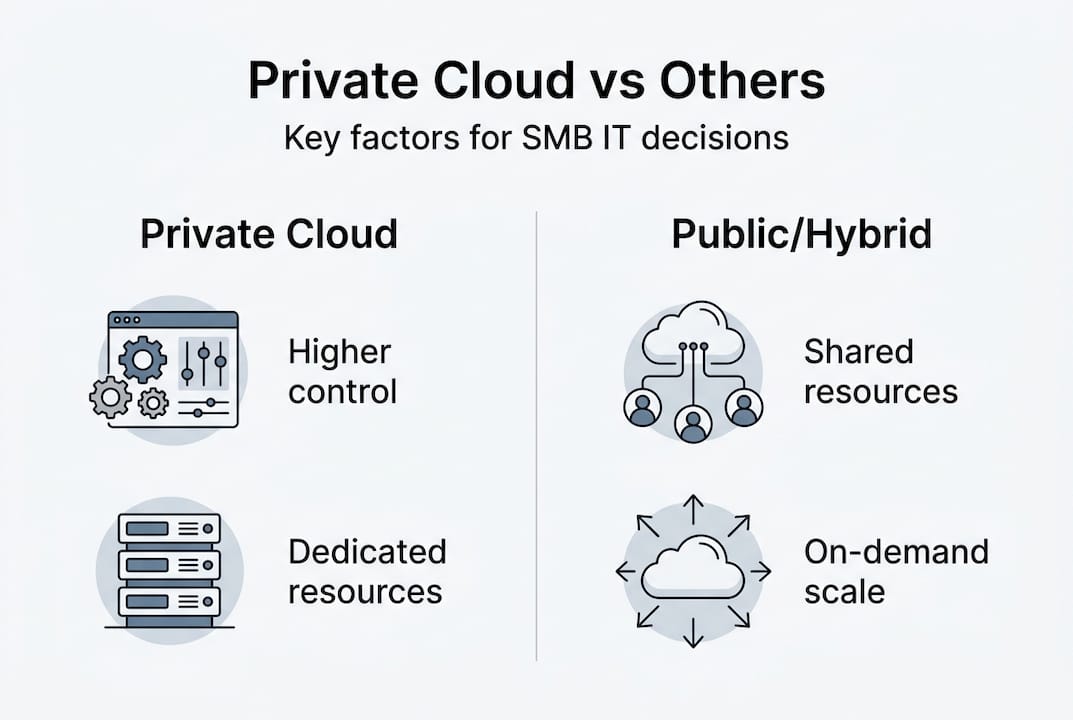
| Factor | Private cloud | Public cloud | Hybrid cloud |
|---|---|---|---|
| Security control | Highest | Shared responsibility | High for private tier |
| Scalability | Capacity-bound | Near-unlimited | Flexible burst capacity |
| Compliance | Easiest to demonstrate | Complex, shared model | Manageable with design |
| Cost structure | Predictable, CapEx/OpEx | Variable, OpEx | Mixed |
| Elasticity | Limited by hardware | Instant | Burst to public as needed |
Here is how the three models break down in practical terms:
- Private cloud is the right choice when data sovereignty, compliance, and performance predictability outweigh the need for instant scalability
- Public cloud fits workloads with highly variable demand, development environments, and situations where speed to market matters more than infrastructure control
- Hybrid cloud is increasingly the default for SMBs that need both, using private cloud in hybrid networks as the secure foundation with public cloud for burst capacity
The trend toward hybrid is accelerating for good reason. It solves the single biggest weakness of pure private cloud: overprovisioning. When you build private cloud capacity for peak demand, you pay for idle resources during normal operations. Hybrid lets you right-size your private footprint and burst to public cloud when needed. Exploring cloud solution examples from organizations similar to yours can clarify which model fits your workload profile.
"Most decision-makers focus on cost comparisons between private and public cloud. The more important question is which workloads genuinely require dedicated infrastructure and which ones do not." — expert nuances for private cloud
Critical considerations and success factors for implementation
Knowing what private cloud is and why it matters is only half the equation. Sustainable success depends on getting the implementation fundamentals right before you commit resources.
Capacity planning, integration for hybrid bursting, identity management, automation, and regulatory requirements are the five pillars that determine whether a private cloud deployment delivers its promised value or becomes a costly headache.
Here is a practical checklist for IT decision-makers:
- Power and cooling: On-premises deployments require honest assessment of data center capacity. Underestimating power density is one of the most common and expensive mistakes
- Hardware ownership and lifecycle: Plan for refresh cycles from day one. Hardware that is four years old creates performance and security gaps
- Staff skills: Private cloud management requires expertise in virtualization, networking, security, and automation. Identify skill gaps before go-live, not after
- Automation investment: Monitoring, patching, and security response must be automated from the start. Manual processes do not scale and create compliance risk
- Container and GPU readiness: If your roadmap includes containerized workloads or AI inference, ensure your private cloud architecture supports these from the beginning
- Integration strategy: Define how your private cloud connects to public cloud providers for hybrid bursting before you need it
The pitfall most SMBs fall into is treating private cloud as a one-time project rather than an ongoing operational discipline. Investing in secure scalable hosting infrastructure is the starting point, but the real work is in the operating model. Organizations that also apply cloud scalability best practices from the outset avoid the painful retrofitting that derails many implementations.
Pro Tip: Build your private cloud capacity plan around your 18-month workload forecast, not your current state. Overbuilding for a five-year horizon ties up capital; underbuilding forces expensive emergency expansions.
Our perspective: What most guides miss about private cloud for SMBs
Most private cloud guides focus on feature comparisons and cost models. What they rarely address is the operational mindset shift required to make private cloud genuinely valuable for an SMB.
The organizations that get the most from private cloud are not the ones that build the biggest infrastructure. They are the ones that right-size their environment, automate aggressively, and resist the temptation to recreate the same manual processes they had before. Private cloud's real advantage is not mimicking public cloud features on dedicated hardware. It is gaining genuine control over compliance, performance, and cost in a way that aligns with how your business actually operates.
We have seen SMBs succeed by starting with a narrow set of workloads, proving the model, and expanding deliberately. Hybrid adoption is the most risk-managed path for most organizations. The real IT advantages of private cloud come from operational discipline, not infrastructure scale. Start smaller than you think you need to, and build from a position of proven success.
Explore secure, scalable private cloud solutions
If you are ready to move from evaluation to action, the right infrastructure partner makes a significant difference in how quickly and confidently you can deploy.
At Internetport, we have been building secure, flexible cloud and server infrastructure for SMBs since 2008. Our private cloud VPS solutions are deployed on SSD-backed hardware with PCI DSS certified data centers, daily backups, and free SSL certificates. Whether you need scalable web hosting as a starting point or fully dedicated server options for mission-critical workloads, our team can help you match the right solution to your compliance and performance requirements. Reach out to explore how we can support your private cloud goals.
Frequently asked questions
How is private cloud different from traditional IT infrastructure?
Private cloud enables automated, self-service provisioning through virtualization and orchestration, while traditional infrastructure requires manual configuration and lacks dynamic resource allocation.
Why would an SMB choose private over public cloud?
Private cloud is the stronger choice when compliance and cost predictability matter more than instant elasticity, particularly for organizations handling sensitive financial, healthcare, or payment data.
What is a virtual private cloud (VPC)?
A VPC is a private, isolated segment running on public cloud infrastructure, giving one organization dedicated network controls without the capital expense of owning physical hardware.
What are the top implementation pitfalls for SMBs moving to private cloud?
Careful planning and automation investment are the most critical success factors; the biggest failures come from underestimating management complexity and neglecting monitoring from day one.