

TL;DR:
- A Tier 3 data center offers full N+1 redundancy and allows maintenance without shutting down the infrastructure. It provides an expected uptime of 99.982%, with less than 1.6 hours of annual unplanned downtime. Certification from the Uptime Institute confirms a facility's compliance with these standards, emphasizing concurrent maintainability and reliability.
A Tier 3 data center is defined by the Uptime Institute as a concurrently maintainable facility: every power and cooling component can be serviced, repaired, or replaced without taking the IT load offline. That single capability separates it from the two tiers below it and explains why most commercial data centers pursue Tier III certification. The expected uptime is 99.982%, which translates to no more than 1.6 hours of downtime per year.
Key characteristics at a glance:
- Concurrent maintainability: planned maintenance never requires a facility-wide shutdown
- N+1 redundancy: every critical component has at least one backup
- Multiple distribution paths: independent power and cooling routes serve the IT load simultaneously
- Dual power inputs: IT equipment must accept power from two separate feeds, or use external transfer switches
- Expected annual downtime: under 1.6 hours
99.982% uptime. That is the Uptime Institute's benchmark for a Tier III data center, capping unplanned downtime at 1.6 hours per year.
How the data center tier classification system works
The tier framework exists to give buyers and operators a common language for infrastructure reliability. Without it, every provider could define "high availability" however they liked.
Two bodies publish the recognized standards. The Uptime Institute created the original Tier I–IV classification and remains the primary certification authority. Its system uses Roman numerals deliberately: a facility labeled "Tier III" (Roman) has passed a formal design or operational audit, while one labeled "Tier 3" (Arabic) may simply be self-reported. The Telecommunications Industry Association publishes the ANSI/TIA-942-C standard, a parallel framework that rates facilities on a 1–4 scale using the same descriptors (Basic, Redundant, Concurrently Maintainable, Fault Tolerant) but applies its own scope and testing criteria.
The two standards overlap but are not interchangeable. TIA-942-C covers a broader set of infrastructure categories and is widely used for international colocation procurement. Uptime Institute certification carries more weight in North American enterprise contracts.
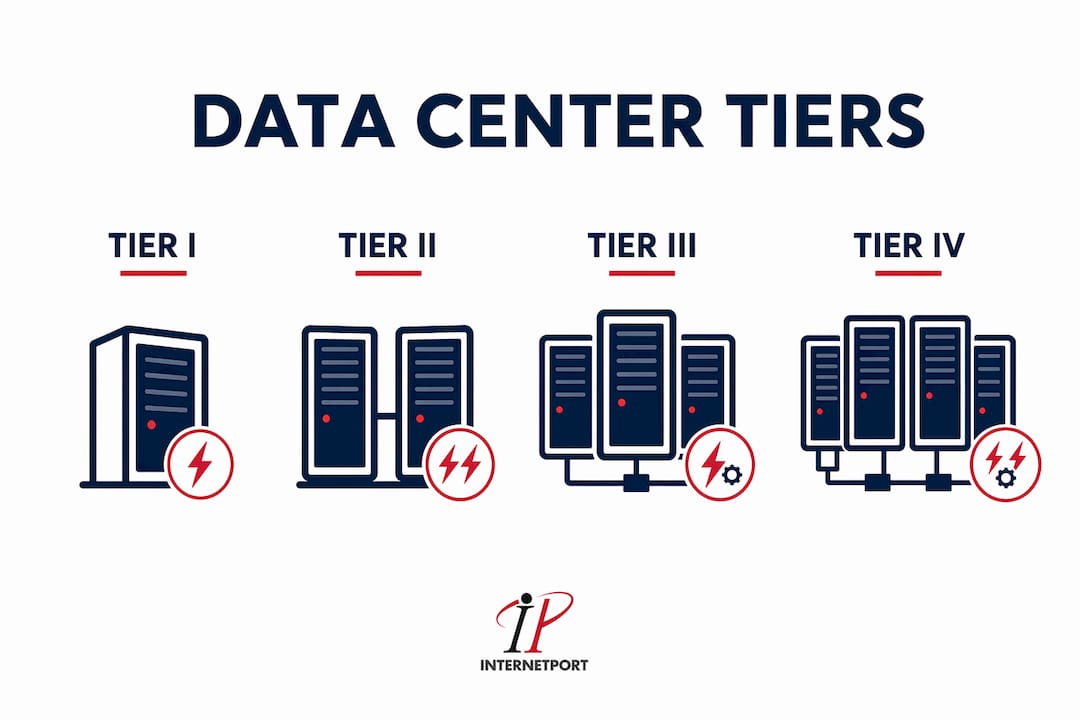
What each tier level requires:
- Tier I / Rating 1: single power and cooling path, no redundant components
- Tier II / Rating 2: partial N+1 redundancy, still a single distribution path
- Tier III / Rating 3: full N+1 redundancy, multiple active distribution paths, concurrent maintainability
- Tier IV / Rating 4: 2N+1 redundancy, fault tolerant, any single failure leaves the load unaffected
Pro Tip: When evaluating a provider's tier claim, ask for the Uptime Institute certificate number or the TIA-942-C audit report. A Roman numeral on a marketing page is not the same as a verified certification.
What actually defines a Tier 3 data center's architecture
The defining feature is not redundancy by itself. It is the combination of redundancy and the ability to use it during live operations.
N+1 redundancy in practice
N+1 means that for every N components required to run the facility, one additional unit sits ready. If a UPS module fails or needs a firmware update, the spare absorbs the load without any interruption to servers. This applies across power distribution units, cooling units, generators, and network paths.
Concurrent maintainability and its real-world implications
Concurrent maintainability means technicians can swap, test, or repair any single component while the facility runs at full capacity. Tier I and Tier II facilities cannot do this: a planned maintenance window at those tiers requires coordinating downtime with every tenant. At Tier III, the maintenance window is an internal operations event, invisible to the IT load.
One technical requirement often overlooked: IT equipment must have dual power inputs compliant with the Uptime Institute Fault Tolerant Power Compliance Specification, or the facility must deploy external automatic transfer switches. Without one of those two configurations, pulling a PDU for maintenance will still drop servers.
Power and cooling infrastructure
A Tier III facility runs at least two independent power distribution paths from the utility feed through to the rack. Cooling follows the same logic: multiple computer room air handlers (CRAHs) or in-row cooling units, each capable of carrying the full load if one path is isolated. The paths are active simultaneously, not in a primary/standby arrangement.
Security at Tier 3 facilities
Physical security at a Tier III facility typically includes multi-factor access control at the perimeter, the data hall, and individual cages or cabinets. CCTV coverage, man-trap entry vestibules, and 24/7 on-site security staff are standard. On the cyber side, network segmentation, intrusion detection systems, and regular penetration testing are common operational requirements. For a deeper look at how these controls layer together, data center security practices cover both the physical and logical dimensions.
Tier 3 vs. lower tiers at a glance:
| Feature | Tier I | Tier II | Tier III |
|---|---|---|---|
| Redundancy | None | Partial N+1 | Full N+1 |
| Maintenance without downtime | No | No | Yes |
| Distribution paths | Single | Single | Multiple |
| Annual downtime ceiling | — | — | 1.6 hours |
| Dual power path to IT load | No | No | Required |
How Tier I through Tier IV compare across the full spectrum
The four tiers form a clear progression in reliability, but the jumps between them are not equal in cost or complexity.
| Tier | Uptime | Max annual downtime | Redundancy | Concurrent maintenance |
|---|---|---|---|---|
| Tier I | 99.671% | — | None | No |
| Tier II | 99.741% | — | Partial N+1 | No |
| Tier III | 99.982% | 1.6 hours | Full N+1 | Yes |
| Tier IV | 99.995% | 26.3 minutes | 2N or 2N+1 | Yes, fault tolerant |
Tier IV adds fault tolerance on top of concurrent maintainability: the facility can absorb any single failure, not just planned maintenance, without affecting the load. That requires fully redundant and independently active power and cooling paths, which roughly doubles the infrastructure cost compared to Tier III.
For most enterprises, the gap between Tier III and Tier IV uptime (1.6 hours vs. 26.3 minutes annually) does not justify that cost. That is why cloud providers distribute services across multiple Tier III availability zones rather than building single Tier IV monoliths. Geographically dispersed Tier III sites deliver comparable resilience at a fraction of the price.
Why Tier 3 data centers make sense for most business workloads
The operational case for Tier III comes down to one practical reality: you can run maintenance on a schedule instead of negotiating downtime windows with your customers.
Core advantages:
- Planned maintenance stays invisible to tenants. No coordination emails, no Saturday-night change windows, no SLA credits.
- Fault tolerance for common failures. A failed UPS, a cooling unit swap, or a generator test does not touch production traffic.
- Predictable uptime for SLA commitments. The 99.982% ceiling gives service providers a credible number to put in contracts.
- Broad workload suitability. E-commerce platforms, financial transaction systems, healthcare data, and SaaS applications all run comfortably at Tier III.
The ability to replace equipment without a facility shutdown is what makes Tier III the default choice for colocation and dedicated server deployments where tenants expect continuous availability. For distributed architectures, pairing Tier III sites with geographic redundancy covers the scenarios that even Tier IV cannot fully address, such as regional power grid failures or natural disasters.
Cost is the other side of the equation. Tier III construction and operational costs run higher than Tier I or II, but the reduction in unplanned outage risk typically offsets that premium quickly for revenue-generating workloads. Tier IV's additional cost is harder to justify unless regulatory requirements or contractual obligations specifically mandate fault-tolerant infrastructure.
How Tier 3 certification actually works
Certification is not self-reported. The Uptime Institute runs a formal process with three distinct tracks: Tier Certification of Design Documents, Tier Certification of Constructed Facility, and Tier Certification of Operational Sustainability. A facility can hold one, two, or all three, and each covers a different phase of the data center lifecycle.
The certification process evaluates topology and infrastructure design, but the Uptime Institute is explicit that certification does not guarantee immunity from outages. Operational processes, staff training, and emergency response plans determine whether the certified infrastructure actually performs as designed.
TIA-942-C certification follows a similar audit-based model but applies to a broader set of infrastructure categories, including telecommunications cabling, architectural elements, and mechanical systems. The two frameworks can be pursued independently or together.
Key points for verifying a provider's claims:
- Ask for the Uptime Institute certificate number and verify it on the Uptime Institute's public registry
- Confirm whether the certification covers design only or also the constructed facility
- Check whether the data center certification is current; certifications can lapse if operational audits are not renewed
- Treat Arabic numeral claims ("Tier 3") as unverified until a certificate is produced
- For TIA-942-C, request the audit report and the rating level (1–4) for each infrastructure domain
The Roman numeral convention matters practically. Uptime Institute mandates Roman numerals for certified facilities, so a provider using "Tier 3" in Arabic numerals may be referencing TIA-942-C, self-certifying, or simply borrowing the terminology without formal verification. For modern distributed infrastructure design, understanding how modern distributed Tier III data center setups map to these tiers helps you ask the right questions before signing a contract.
Key Takeaways
A Tier 3 data center's core value is concurrent maintainability backed by full N+1 redundancy, delivering very high uptime with minimal annual downtime.
| Point | Details |
|---|---|
| Defining capability | Concurrent maintainability lets operators service any component without taking the IT load offline. |
| Uptime benchmark | The Uptime Institute sets Tier III uptime to ensure very high availability with minimal annual downtime. |
| Redundancy standard | Full N+1 redundancy covers power, cooling, and distribution paths across the facility. |
| Certification verification | Roman numeral notation (Tier III) signals Uptime Institute certification; Arabic numerals do not. |
| Industry adoption | Most commercial data centers target Tier III, making it the baseline for business-critical workloads. |
FAQ
What is the difference between Tier 1, 2, 3, and 4 data centers?
Tier I has no redundancy and a single power and cooling path; Tier II adds partial N+1 redundancy but still uses a single distribution path; Tier III provides full N+1 redundancy with multiple paths and concurrent maintainability; Tier IV is fully fault tolerant with 2N or 2N+1 redundancy, meaning any single failure leaves the load unaffected.
What is a Tier 4 data center?
A Tier IV data center is fault tolerant with 2N or 2N+1 redundancy across all systems, delivering 99.995% uptime and no more than 26.3 minutes of downtime per year. Unlike Tier III, it can sustain any single component failure without affecting the IT load, not just planned maintenance.
Does Tier 3 mean the same thing under Uptime Institute and TIA-942-C?
The two standards share the same descriptor ("Concurrently Maintainable") for their third rating level, but they differ in scope and testing criteria. Uptime Institute focuses on topology and operational sustainability; TIA-942-C covers a broader set of infrastructure domains including cabling and architectural elements. Verifying which standard a provider references matters when comparing facilities.
Is a Tier 5 data center a recognized classification?
No. The Uptime Institute's official tier system stops at Tier IV. Any reference to tiers beyond that is a marketing term with no recognized standard behind it.
How do you verify a data center's Tier III certification?
Request the Uptime Institute certificate number and check it against the Uptime Institute's public registry. Certified facilities use Roman numerals (Tier III); providers using Arabic numerals ("Tier 3") may be self-reporting rather than certified.