

TL;DR:
- Database hosting lets businesses run and manage databases on third-party infrastructure, freeing them from hardware and maintenance tasks. Managed services like DBaaS automate backups, security, and scaling, making deployment faster and more cost-effective for many organizations. Choosing the right hosting model depends on control needs, compliance, and latency considerations, with location and hidden costs playing a critical role.
Database hosting is defined as the practice of running and managing databases on infrastructure owned and operated by a third-party provider, freeing businesses from maintaining their own physical hardware. Rather than buying servers, hiring database administrators, and managing uptime in-house, you delegate those tasks to a provider whose entire job is keeping your data available, secure, and performing well. This model covers everything from small business websites storing customer records to enterprise applications processing millions of transactions per day. Understanding database hosting explained clearly means recognizing that the provider handles provisioning, patching, backups, and security, while you focus on using the data to run your business.
What is database hosting, and how does it differ from self-hosting?
Database hosting is a managed service where a provider supplies the servers, network, storage, and software needed to run a database engine such as MySQL, PostgreSQL, or Microsoft SQL Server. The industry term for the most automated form of this service is Database as a Service, or DBaaS. Self-hosted databases give complete control but require managing uptime, security, and backups entirely in-house, which demands a skilled team and significant capital investment.

The core difference comes down to who owns the operational burden. With self-hosting, your IT team patches the database engine, monitors disk usage, tests backups, and responds to outages at 3 AM. With a hosted solution, the provider absorbs those tasks. DBaaS automates patches, scaling, backups, and failover, which means your developers spend time building features rather than maintaining infrastructure.
The financial model also shifts. Self-hosting requires upfront capital expenditure on servers and licenses. DBaaS pricing uses pay-as-you-go or reserved instances, replacing that capital cost with a predictable monthly operating expense. For growing businesses, that shift alone changes how quickly you can spin up new database environments.
What types of database hosting options are available?
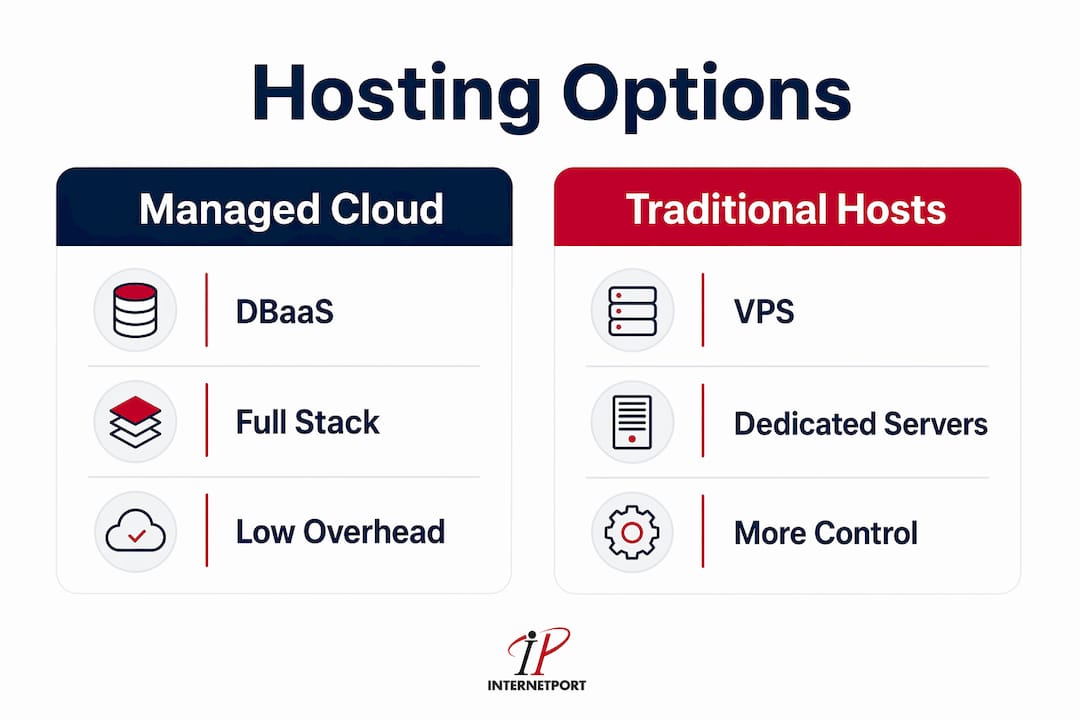
Three primary hosting models cover the vast majority of use cases: managed cloud hosting (DBaaS), virtual private server (VPS) hosting, and bare metal or dedicated server hosting. Each sits at a different point on the control-versus-convenience spectrum.
Managed cloud hosting (DBaaS)
DBaaS is the highest-abstraction option. The provider manages the entire database stack, including the operating system, database engine, replication, and backups. Managed cloud hosting offers low operational overhead, making it the right choice when development velocity matters more than fine-grained control. It maps to the Platform as a Service (PaaS) model in cloud architecture terms. You interact with the database through a connection string and a management console, nothing more.
VPS hosting
A virtual private server gives you a dedicated slice of a physical machine with its own CPU, RAM, and storage allocation. You install and manage the database engine yourself, but the underlying hardware is shared with other tenants at the hypervisor level. This model sits between DBaaS and bare metal: more control than a fully managed service, lower cost than a dedicated server. SSD VPS hosting is a common choice for development teams that need a consistent environment without paying for dedicated hardware.
Bare metal and dedicated servers
Bare metal hosting means you get an entire physical server with no virtualization layer. No other tenant shares your CPU cycles or storage I/O. Bare metal delivers the highest performance and compliance control, which is why regulated industries such as finance and healthcare often require it. The trade-off is that you manage more of the stack yourself, or you choose a provider that offers managed bare metal as a service. Internetport's dedicated server options are built for exactly this workload.
| Hosting type | Control level | Operational overhead | Best for |
|---|---|---|---|
| Managed cloud (DBaaS) | Low | Low | Fast deployment, variable workloads |
| VPS hosting | Medium | Medium | Dev/test, small production apps |
| Bare metal / dedicated | High | High (unless managed) | High performance, compliance-heavy workloads |
Pro Tip: If your team has fewer than three dedicated infrastructure engineers, start with a managed cloud or VPS option. You can always migrate to bare metal once your workload justifies the operational investment.
What are the benefits of using database hosting services?
The most direct benefit of database hosting is that it removes infrastructure management from your team's plate. That sounds simple, but the downstream effects on cost, speed, and security are significant.
57% of surveyed organizations use relational DBaaS, and 44% use NoSQL DBaaS as of late 2023. Those numbers reflect a clear industry consensus: managed hosting has become the default for most database workloads. The reason is straightforward. Small and medium businesses benefit most because they rarely have the budget to staff a full database administration team.
The operational benefits stack up quickly:
- Automated backups and recovery. The provider runs scheduled backups and tests restoration procedures, so you are not relying on a manual process that someone forgot to run.
- Built-in security and patching. Critical security patches get applied without scheduling a maintenance window on your end.
- Elastic scaling. You add CPU, RAM, or storage through a control panel rather than ordering new hardware and waiting for delivery.
- High availability. Most managed services include replication and automatic failover, so a single server failure does not take your application offline.
- Compliance support. Providers operating under standards like PCI DSS handle many of the audit requirements that would otherwise fall on your team.
The cost argument is equally strong. Pay-as-you-go billing means you pay for what you use, not for peak capacity that sits idle 90% of the time. For a business running a seasonal e-commerce platform, that difference is material. The alternative, buying hardware sized for peak Black Friday traffic, leaves expensive servers underutilized for eleven months of the year.
Developer productivity also improves. When your engineers are not troubleshooting replication lag or disk alerts, they ship features faster. That speed compounds over time into a genuine competitive advantage.
How does database hosting work technically?
When you provision a hosted database, the provider allocates compute, memory, and storage resources on their infrastructure and installs the database engine you selected. The entire process takes minutes rather than the days or weeks required to rack, cable, and configure physical hardware.
Provisioning and connectivity
Once provisioned, your application connects to the database over a secure network connection using a standard connection string. Geographic proximity of the database to the application directly impacts latency, and latency is the single biggest factor for application responsiveness. A database hosted in Stockholm will respond faster to an application server in Sweden than one hosted in a US data center, regardless of what the provider's marketing materials say about network speed. Choosing a provider with data centers close to your users is not optional; it is a performance requirement.
Ongoing management
The provider continuously monitors the database engine, the underlying operating system, and the hardware. Automated systems apply patches during low-traffic windows, run integrity checks on backups, and scale storage when thresholds are reached. For hybrid cloud deployments, a unified management platform can handle both on-premises and cloud-hosted databases from a single interface, which reduces the administrative complexity of managing two separate environments.
Billing models
Most database hosting services offer two billing structures. Pay-as-you-go charges by the hour or second based on actual resource consumption. Reserved instances let you commit to a fixed resource level for one or three years in exchange for a lower per-unit price. The right choice depends on how predictable your workload is. Variable or growing workloads suit pay-as-you-go. Stable, well-understood workloads suit reserved pricing.
| Billing model | Best scenario | Cost predictability |
|---|---|---|
| Pay-as-you-go | Variable or unpredictable workloads | Low to medium |
| Reserved instances | Stable, predictable workloads | High |
| Dedicated server (fixed) | Compliance-heavy, high-performance needs | Very high |
Pro Tip: Always request a cost estimate that includes data egress fees before signing a contract. Egress fees are unpredictable and can make a nominally cheap plan expensive once your application starts moving significant data out of the provider's network.
What factors should businesses consider when choosing a database hosting solution?
Choosing the right database hosting solution requires matching your technical requirements to the provider's capabilities, not just comparing price per gigabyte. The following checklist covers the factors that most often determine whether a hosting decision succeeds or creates problems later.
-
Data sovereignty and location. IT teams must carefully evaluate data sovereignty requirements tied to geographic hosting locations. Regulations in the EU, Sweden, and other jurisdictions may require that data remain within specific borders. Confirm the provider's data center locations before signing anything.
-
Latency to your application servers. Connection latency remains the foremost determinant of application performance regardless of cloud provider claims. Map where your application servers run and choose a database host in the same region or data center.
-
Security and compliance certifications. Look for providers that hold certifications relevant to your industry, such as PCI DSS for payment processing or ISO 27001 for information security management. Internetport operates under PCI DSS compliance, which matters directly for businesses handling payment data.
-
Scalability path. Confirm that the provider can scale vertically (more CPU and RAM on the same instance) and horizontally (read replicas, sharding) as your data grows. A provider that caps you at a fixed instance size will force a painful migration later.
-
Egress and hidden costs. Cloud providers charge for data moving out of their network. Egress costs can lead to unexpectedly high monthly expenses in data-heavy applications. Get a written estimate of egress fees based on your expected data transfer volume.
-
Hybrid and multi-cloud compatibility. Unified management of hybrid cloud databases reduces administrative complexity and supports scalability. If you run workloads across on-premises and cloud environments, confirm the provider supports a unified management layer.
-
Support quality and response time. A database outage at 2 AM is not a business-hours problem. Verify that the provider offers 24/7 technical support with defined response time commitments, not just a ticket queue.
-
Backup and recovery guarantees. Ask specifically about recovery point objective (RPO) and recovery time objective (RTO). These numbers tell you how much data you can lose and how long recovery takes. Vague answers are a red flag.
Key Takeaways
The most effective database hosting strategy matches your control requirements, compliance obligations, and workload characteristics to the right hosting model, whether that is managed cloud, VPS, or dedicated bare metal.
| Point | Details |
|---|---|
| DBaaS removes operational burden | Providers handle patching, backups, and failover so your team focuses on the application. |
| Location determines latency | Host your database in the same region as your application servers to maximize responsiveness. |
| Egress fees add up fast | Request a written egress cost estimate before committing to any cloud database contract. |
| Compliance drives architecture | Regulated industries often require bare metal or dedicated hosting to meet audit requirements. |
| Hybrid cloud needs unified management | Managing on-premises and cloud databases through one platform reduces complexity and risk. |
Why most teams underestimate database hosting decisions
I have watched IT teams spend weeks evaluating CPU benchmarks and storage IOPS, then sign a contract without ever asking about egress fees or data center location. Those two factors, not raw performance numbers, are what determine whether a database hosting decision looks smart or embarrassing six months later.
The control-versus-convenience debate gets framed as a binary choice, but the reality is more nuanced. A fully managed DBaaS is not always the right answer, even for teams with limited staff. If your application handles sensitive financial or health data, the compliance requirements may force you toward dedicated infrastructure regardless of how convenient managed cloud sounds. I have seen companies migrate off DBaaS specifically because their auditors required proof of physical isolation, something a shared cloud environment cannot provide.
The latency issue is chronically underestimated. Developers test their applications on local machines where the database is milliseconds away, then deploy to production where the database is in a different continent. The performance difference is not subtle. A 50-millisecond round-trip adds up to seconds of delay in a transaction that makes 40 database calls. Choosing a provider with data centers close to your users, such as Internetport's Swedish facilities for European businesses, is a technical decision with direct user experience consequences.
My practical advice: treat your database hosting selection as a three-year infrastructure commitment, not a monthly subscription you can swap out easily. Migration costs, downtime risk, and data transfer fees make switching providers expensive. Get the location, compliance, and cost structure right the first time.
— Peter
Internetport's hosting options for database workloads
Internetport provides flexible infrastructure for businesses that need reliable, secure database hosting without the complexity of managing physical hardware themselves. Whether you need a VPS for a development database, a dedicated server for a compliance-heavy production environment, or web hosting for a business application backed by a managed database, Internetport's Swedish data centers give you low-latency connectivity and PCI DSS compliance built in.
Internetport's infrastructure supports private networking, colocation, and cloud VPS configurations, so you can match the hosting model to your actual workload rather than forcing your workload into a one-size-fits-all plan. The team provides technical support for businesses that need guidance on architecture, not just a control panel and a ticket queue. If your business is ready to move database infrastructure to a provider that takes security and availability seriously, Internetport is worth a direct conversation.
FAQ
What is database hosting in simple terms?
Database hosting is a service where a third-party provider supplies and manages the servers, storage, and software needed to run your database. You connect to it over the internet and use it like your own database, without managing the underlying hardware.
What is the difference between DBaaS and traditional database hosting?
DBaaS automates patching, backups, scaling, and failover, while traditional hosting gives you a server where you install and manage the database engine yourself. DBaaS trades control for speed and lower operational overhead.
How does server location affect database hosting performance?
Geographic proximity between the database server and your application directly determines latency. A database hosted close to your application servers responds faster, which improves application performance for end users.
Is managed database hosting secure?
Managed database hosting from certified providers is generally more secure than self-hosted databases for most businesses, because providers apply security patches immediately and operate under compliance frameworks such as PCI DSS and ISO 27001.
What are the hidden costs of cloud database hosting?
The most common hidden cost is data egress, the fee charged when data moves out of the provider's network. Egress fees can significantly increase monthly costs for applications that transfer large volumes of data, and they are often not included in headline pricing.