

TL;DR:
- High availability focuses on rapid detection and recovery from failures rather than eliminating all downtime. It involves redundancy, health checks, load balancers, clustering, and failover orchestration to ensure continuous system access. Balancing cost, complexity, and risk, organizations should tailor their HA strategies to actual business needs and regularly test failover processes.
High availability is one of those terms that gets thrown around in infrastructure conversations constantly, yet the practical meaning often gets blurred. If you've ever wondered what is high availability beyond the marketing language, you're not alone. Many IT professionals equate it with "always on" or "zero downtime," which is close but not quite right. High availability is specifically about minimizing perceived downtime through fast detection and recovery, not eliminating failure entirely. This guide breaks down the definition, the mechanics, the tradeoffs, and how to make informed decisions when designing or evaluating resilient systems.
Table of Contents
- Key Takeaways
- What high availability actually means
- The technical components that make HA work
- High availability vs. fault tolerance
- Real-world challenges in HA design
- Applying HA to your infrastructure strategy
- My honest take on high availability planning
- How Internetport supports your high availability goals
- FAQ
Key Takeaways
| Point | Details |
|---|---|
| HA means fast recovery, not zero downtime | High availability accepts brief interruptions but recovers quickly through automated failover. |
| Uptime is measured in "nines" | 99.999% uptime allows only 5.26 minutes of annual downtime, far stricter than the common 99.9% baseline. |
| Redundancy alone is not enough | Failover routing and orchestration are required alongside replication to maintain real availability. |
| HA and fault tolerance serve different needs | Fault tolerance aims for uninterrupted operation; HA prioritizes speed of recovery at lower cost. |
| Overhead can become a bottleneck | Health checks and cluster coordination consume resources and must be tuned carefully to avoid degradation. |
What high availability actually means
At its core, the definition of high availability describes a system's ability to remain accessible to users even when individual components fail. Availability is expressed as a percentage uptime, with downtime defined as any period during which the service is inaccessible to users. The goal is not perfection. It is a pre-agreed level of service continuity that the system is engineered to meet.
The industry measures this using the "nines" convention. Here's what those percentages actually translate to in practice:
| Availability | Annual downtime | Monthly downtime |
|---|---|---|
| 99% (two nines) | ~87.6 hours | ~7.3 hours |
| 99.9% (three nines) | ~8.8 hours | ~43.8 minutes |
| 99.99% (four nines) | ~52.6 minutes | ~4.4 minutes |
| 99.999% (five nines) | ~5.26 minutes | ~26.3 seconds |
The jump from three nines to five nines sounds incremental. It is anything but. Going from 99.9% to 99.999% reduces tolerated annual downtime from roughly 8.8 hours to just over 5 minutes. That compression is what forces organizations to invest in increasingly sophisticated architecture.
Most enterprise SLAs land between 99.9% and 99.99%. "Five nines" (99.999%) is the benchmark for telecom infrastructure, financial trading platforms, and healthcare systems where even seconds of downtime carry measurable financial or safety consequences. For most business applications, monthly downtime limits are mapped from annual targets and used directly in SLA credit calculations.
A few things to keep clear when evaluating your own targets:
- Downtime is from the user's perspective. A backend failover that completes in four seconds still counts as four seconds of downtime if the user's request failed.
- Planned maintenance counts unless excluded. Many SLAs explicitly carve out maintenance windows, so read contracts carefully.
- Availability targets should match the workload. A development environment does not need five nines. Chasing unnecessary nines costs money and adds complexity with no real benefit.
The technical components that make HA work
Understanding the high availability overview at a conceptual level is useful, but the real decisions happen at the architectural layer. High availability systems rely on a combination of mechanisms working together. No single component is sufficient on its own.
Health checks, load balancers, clustering, and failover orchestration form the core architecture in most HA implementations. Each plays a specific role:
- Redundancy means duplicating critical components so that no single failure takes down the entire service. This applies to servers, network paths, storage, and power.
- Health checks continuously probe services or nodes to detect failures. When a node stops responding, the monitoring system flags it as unhealthy and triggers the next step.
- Load balancers distribute traffic across healthy nodes. They also serve as the traffic cop during failover, redirecting connections away from failed resources automatically.
- Clustering groups multiple servers so they act as a single logical service. Active-active clusters share the load simultaneously; active-passive clusters keep a standby node ready to take over.
- Failover orchestration coordinates the actual transition. It promotes a replica, updates routing, and clears stale connections so users reconnect to healthy infrastructure.
One widely misunderstood point: replication alone doesn't guarantee high availability. Many teams set up database replication and assume they've achieved HA. They haven't. If the primary node fails and no mechanism exists to promote the replica and redirect application connections, the application simply connects to a dead endpoint. The data is safe; the service is still down.
The distinction between HA and disaster recovery is also worth clarifying here. HA limits interruption to seconds through automated failover. Disaster recovery addresses longer, planned restoration scenarios measured in hours. They address different failure modes and should not be treated as interchangeable.

Pro Tip: When mapping your failover plan, test what happens to in-flight transactions during the failover window. Most teams test node promotion but never verify whether active sessions, queued jobs, or open database transactions are handled gracefully. That gap is where user-visible errors hide.
High availability vs. fault tolerance
These two terms are not synonyms, and conflating them leads to expensive over-engineering or dangerous under-engineering depending on the direction of the mistake.
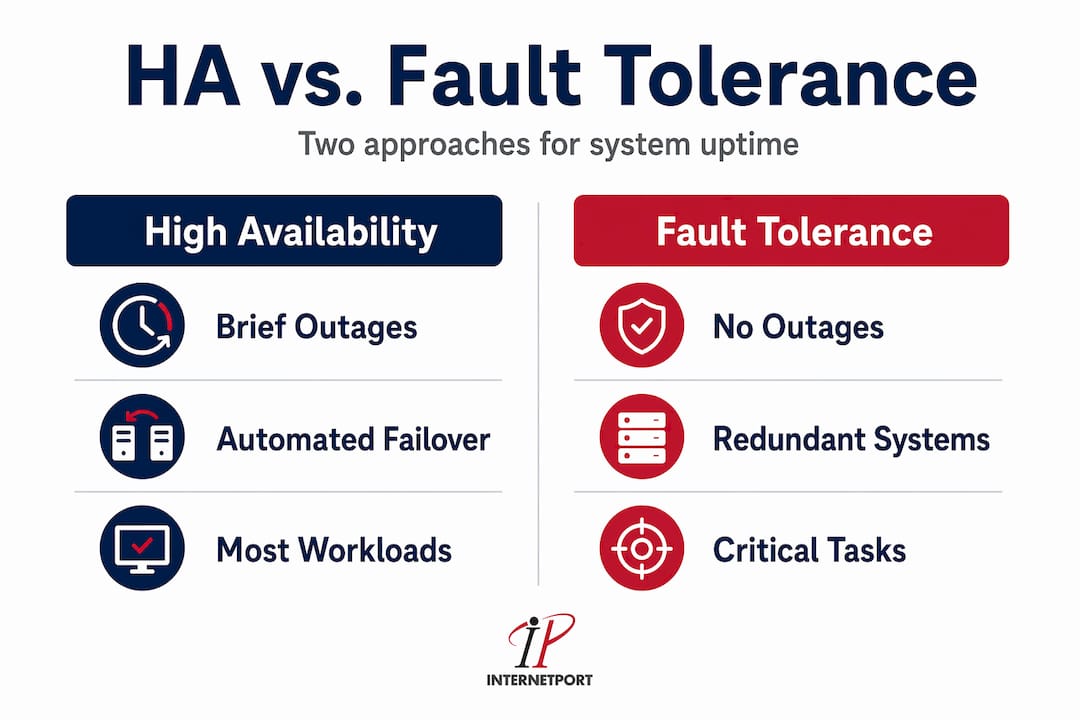
Fault tolerance prioritizes uninterrupted operation; high availability prioritizes minimal downtime and fast recovery. The difference seems subtle until you look at the design implications.
| Feature | High availability | Fault tolerance |
|---|---|---|
| Downtime during failure | Seconds to minutes | Near zero |
| Failover type | Automated switchover | Continuous operation |
| Cost | Moderate | Significantly higher |
| Complexity | Medium | High |
| Typical use case | Web apps, databases, SaaS | Aircraft, nuclear systems, financial trading |
Here's a practical way to think through which approach fits your situation:
- Identify the cost of downtime. Calculate what one hour of unavailability costs in lost revenue, compliance penalties, or safety risk. If the number is catastrophic, fault tolerance deserves serious evaluation.
- Assess the workload characteristics. Stateless applications tolerate brief interruptions far better than stateful transactional systems. A web frontend can usually absorb a ten-second failover. A payment processor cannot.
- Consider safety risk. Medical devices and aviation systems legally require fault tolerance because downtime carries life-safety implications.
- Evaluate the cost ceiling. Fault tolerant systems typically require hardware-level redundancy with lockstep execution or synchronous mirroring, which multiplies infrastructure cost substantially.
For the vast majority of enterprise workloads, high availability is the right answer. It balances resilience and operational simplicity better than fault tolerance for applications where a fast recovery is acceptable and the engineering budget is finite.
The common fantasy of "zero downtime" deserves direct pushback here. Zero downtime in absolute terms is not achievable in any distributed system at scale. What HA gives you is downtime so brief and so infrequent that, from a business standpoint, it becomes operationally irrelevant.
Pro Tip: Apply fault tolerance selectively, not system-wide. A mission-critical payment processing component can use synchronous replication and automatic failover with zero tolerance for data loss, while the reporting layer runs on standard HA with a slightly longer recovery window. This hybrid approach controls cost while protecting what actually matters.
Real-world challenges in HA design
Knowing the theory of high availability systems is useful. Knowing where implementations actually break down is more useful.
HA infrastructure can become a bottleneck when the overhead of maintaining it exceeds the capacity it adds. Cluster coordination processes consume CPU and memory. During a traffic spike, the same resources managing failover readiness may be the ones starved of capacity when you need them most.
Pro Tip: The bottleneck in most HA clusters is not network latency. It is coordination and orchestration overhead. Tuning heartbeat intervals, quorum settings, and health check frequency often yields more performance improvement than adding hardware.
Several practical tensions show up repeatedly in HA deployments:
- Health check frequency. Frequent health checks detect failures quickly but increase system load. Infrequent checks reduce overhead but slow detection and extend the recovery window. There is no universal setting. Tune based on your failure detection time requirements and load profile.
- Geographic distribution. Spreading nodes across data centers or regions dramatically improves resilience against site-level failures. It also introduces latency in synchronous replication and coordination. For write-heavy workloads, cross-region synchronous replication can become a throughput limiter.
- Consistency vs. availability tradeoffs. In distributed systems, when a network partition occurs, you must choose between serving potentially stale data or refusing to serve until consistency is confirmed. This is the CAP theorem in practice, and your HA design needs an explicit answer for it.
- Escalating costs per nine. Each additional nine of availability requires more redundancy, faster failover, and more operational tooling. The cost curve is not linear. Going from 99.9% to 99.99% is a significant investment. Going from 99.99% to 99.999% often requires a complete architectural rethink.
Avoiding these pitfalls requires treating HA as a system-wide discipline rather than a feature you enable on individual components. Every layer of the stack, compute, storage, networking, and DNS, needs to be evaluated for single points of failure.
Applying HA to your infrastructure strategy
Understanding the theory matters. Translating it into organizational decisions is where the real value lies. Here's how to approach high availability architecture as a strategic choice rather than a default setting.
Start by quantifying the cost of downtime for each system in your environment. Not all applications are equal. A public-facing e-commerce platform and an internal reporting dashboard have very different downtime tolerances. Understanding that difference lets you allocate HA investment where it actually matters rather than applying the same standards everywhere.
When setting availability targets, consider:
- Regulatory and contractual obligations. Some industries mandate minimum availability levels for specific systems. Know what applies to your environment before setting internal targets.
- Customer-facing impact. Customer-visible services typically require higher availability than internal tools. Map SLA commitments directly to technical targets.
- Recovery time objectives (RTO) and recovery point objectives (RPO). Your HA design must satisfy both. RTO defines how fast you must recover; RPO defines how much data loss is acceptable.
- Automation of failover and monitoring. Manual failover is not a high availability strategy. Any HA design that requires human intervention to complete a failover will consistently fail its uptime targets during off-hours incidents.
For mission-critical components, consider applying selective fault tolerance where the cost and complexity are justified by the risk. This hybrid model lets you achieve meaningful uptime across the full application without paying fault-tolerance prices for every component.
If you're building or evaluating infrastructure to support these goals, look at the specifics of how a high availability hosting workflow maps to your application's needs. The patterns that work for a stateless API differ significantly from those required for a transactional database. Getting that mapping right before you commit to a platform is worth the time.
My honest take on high availability planning
I've seen organizations spend months optimizing their uptime percentage while their failover plan was never actually tested in production conditions. That's where the real risk lives.
In my experience, the teams with the strongest real-world availability are not necessarily the ones chasing five nines on paper. They're the ones who've invested in making recovery fast, repeatable, and automatic. A system that fails occasionally but recovers in eight seconds, without paging an engineer, is more operationally sound than a system designed for theoretical zero downtime that requires manual intervention when something unexpected happens.
What I've learned through real HA implementations is that the hardest part is not the architecture. It's the testing. Chaos engineering, routine failover drills, and documented runbooks for non-obvious failure scenarios are what separate teams that meet their SLAs from those that scramble during incidents. Most organizations skip this work because it feels optional. It is not.
The overhead question is also underappreciated. I've watched HA clusters consume so much coordination overhead during load events that they degraded performance precisely when the system needed capacity most. Tuning those systems saved more availability than adding another standby node ever would have.
My practical advice: set your availability target based on what downtime actually costs your organization, build the simplest architecture that meets that target, and invest the remainder of your budget in testing, monitoring, and automation. That combination beats a theoretically perfect design that's never been pressure-tested.
One resource I'd point to is Internetport's hosting reliability guide, which covers how scalable infrastructure translates into measurable uptime gains for production environments.
— Peter
How Internetport supports your high availability goals

Building high availability into your infrastructure requires more than the right architecture on paper. It requires a hosting environment that can physically and logistically support the redundancy, failover speed, and network reliability your systems demand.
Internetport has been running enterprise-grade hosting infrastructure since 2008, with data centers in Sweden and international locations designed specifically for organizations with serious uptime requirements. Their dedicated servers give you full hardware control for mission-critical workloads that need predictable performance without resource contention from shared environments. For teams that need flexible scaling alongside strong availability guarantees, their VPS platform supports HA configurations with fast provisioning and SSD-backed storage.
For organizations that want to keep their own hardware while gaining data center-grade redundancy, Internetport's colocation services provide physical security, redundant power, and network connectivity up to 10 Gbps, removing the facility-level single points of failure that undermine even well-designed software HA setups. Everything runs on infrastructure built with redundancy in mind, which means the platform itself is not the weak link in your availability chain.
FAQ
What does high availability mean in IT?
High availability means a system is designed to remain accessible even when individual components fail, typically by using redundancy and automated failover. Availability is measured as a percentage uptime, with higher percentages indicating less tolerated downtime.
What is the difference between high availability and fault tolerance?
High availability accepts brief interruptions and recovers quickly through automated failover. Fault tolerance aims for uninterrupted operation with near-zero downtime, requiring more complex and costly hardware-level redundancy.
What are the nines in high availability?
The "nines" refer to availability percentages: 99.9% allows roughly 8.8 hours of annual downtime, while 99.999% allows only 5.26 minutes per year. Each additional nine requires significantly more engineering effort and cost.
Is replication enough to achieve high availability?
No. Replication copies data to a secondary node, but failover routing must also exist to redirect application traffic when the primary fails. Without that routing, the service goes down even though the data is intact.
How do I know which availability target my systems need?
Start by calculating the actual cost of downtime for each system, including revenue loss, compliance risk, and customer impact. Match your availability target to that cost, then design the simplest architecture that reliably meets it rather than defaulting to the highest possible number.