
TL;DR:
- Multi-tenant hosting involves sharing infrastructure while maintaining strict protections across data, compute, and network layers. Proper isolation prevents performance issues and security risks, but requires continuous validation and layered controls; failing to do so exposes organizations to cross-tenant breaches and operational failures. It offers significant cost savings and scalability benefits for IT, provided organizations actively manage and verify their multi-tenant environment's security and performance.
Multi-tenant hosting is one of those terms that gets used constantly but understood rarely. Most IT managers picture it as a fancier version of shared hosting, where a few websites sit on the same box and hope for the best. The reality is far more sophisticated and far more consequential for your infrastructure decisions. Done right, multi-tenant hosting can dramatically cut your infrastructure costs and simplify operations. Done wrong, it exposes your organization to cross-tenant risk, performance degradation, and compliance failures that no post-incident report can easily explain away. This guide cuts through the noise.
Table of Contents
- Defining multi-tenant hosting: Beyond simple server-sharing
- How multi-tenant hosting works: Under the hood
- Isolation models: Understanding the trade-offs
- The business case: Why multi-tenant hosting matters for IT decision-makers
- Key challenges and best practices for secure multi-tenant hosting
- Why most businesses underestimate the complexity of multi-tenant hosting
- Secure your infrastructure with flexible multi-tenant hosting solutions
- Frequently asked questions
Key Takeaways
| Point | Details |
|---|---|
| True multi-tenancy | Genuine multi-tenant hosting goes far beyond shared servers by enforcing isolation across data, compute, and network layers. |
| Layered isolation is essential | Robust isolation using multiple technical layers is critical for both operational resilience and security. |
| Choose your model wisely | The ideal isolation model depends on your company's threat profile, compliance needs, and risk tolerance. |
| Continuous validation needed | Effective multi-tenant hosting requires ongoing testing and vigilance to prevent cross-tenant incidents. |
Defining multi-tenant hosting: Beyond simple server-sharing
Let's start by clearing up the most persistent misconception. Shared hosting and multi-tenant hosting are not the same thing. In shared hosting, multiple websites or applications sit on a single server with minimal logical separation. Think of it as tenants sharing a house with no locks on any of the bedroom doors. Multi-tenant hosting, by contrast, is an architectural strategy where multiple distinct organizations, or "tenants," share the same underlying infrastructure but operate within enforced boundaries that protect their data, compute, and network resources from each other.
A "tenant" in this context is any distinct organizational unit whose workloads run on shared infrastructure. That might be a separate business customer, a department within a single company, or a distinct application environment with its own compliance requirements. The infrastructure below them, servers, storage, networking equipment, is shared. But the experience for each tenant should feel exclusive and protected.
The critical insight: Tenant isolation is not just about data. You must also manage compute, network, and operational isolation so one tenant's activity doesn't impair others. This distinction separates genuine multi-tenant hosting from basic server-sharing arrangements.
This is where most organizations get tripped up. They negotiate a "multi-tenant" agreement with a provider, assume the isolation is handled, and then discover that noisy workloads, misconfigured access controls, or shared logging pipelines are creating real exposure. The isolation has to span multiple dimensions:
- Data isolation: Each tenant's stored data is inaccessible to other tenants, enforced through encryption, access controls, and separate storage contexts.
- Compute isolation: Processing resources are bounded so one tenant's CPU-intensive job doesn't starve neighboring tenants.
- Network isolation: Traffic between tenants is segmented using VLANs, software-defined networking, or container network policies.
- Operational isolation: Monitoring, logging, and management planes are separated so one tenant's events don't bleed into another's observability stack.
Understanding these dimensions is foundational before you can evaluate any provider's claims. When you're evaluating a secure, scalable environment hosting arrangement, ask explicitly which of these isolation dimensions the provider addresses and how they verify them.
How multi-tenant hosting works: Under the hood
The mechanics of multi-tenant hosting depend on which layer of the stack you're looking at, and providers use different tools to achieve separation at each level.
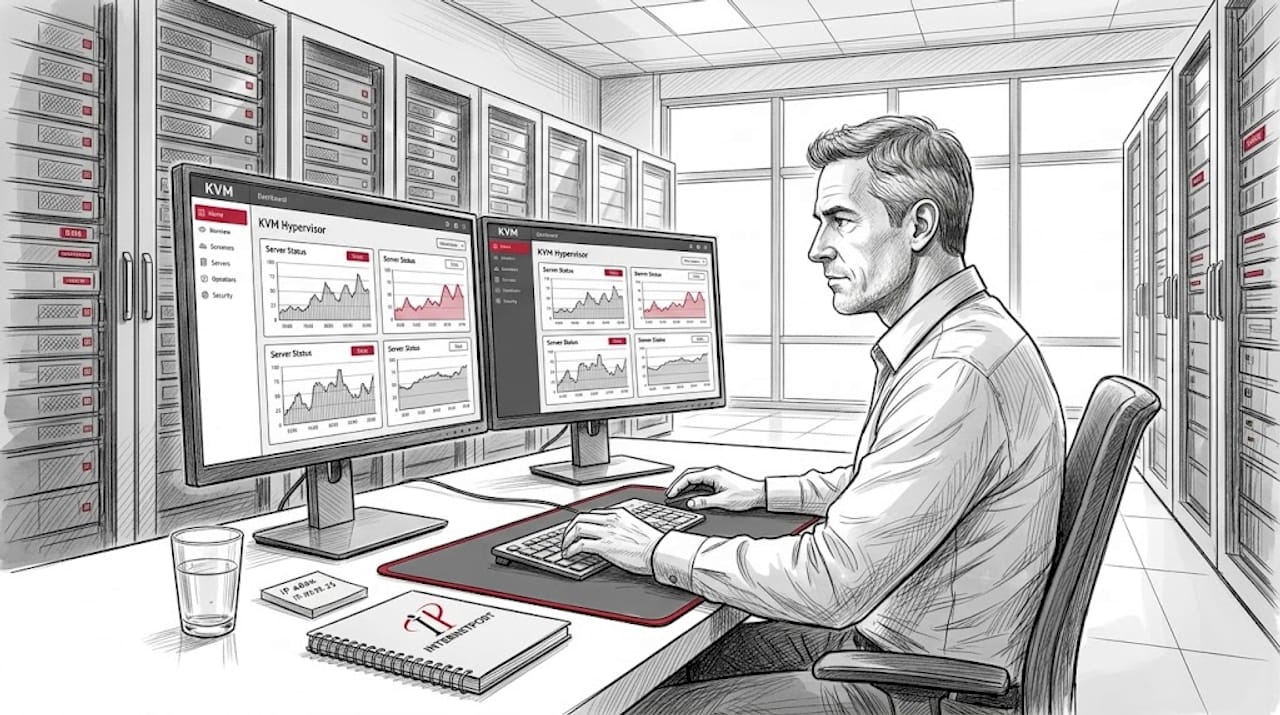
Virtualization is the most common foundation. Hypervisors like KVM or VMware carve physical servers into virtual machines (VMs), each with its own allocated CPU, RAM, and storage. VMs offer strong compute isolation because each one runs its own operating system kernel. The tradeoff is resource overhead: you're carrying the weight of multiple OS instances.
Containers take a lighter approach. Docker or Kubernetes containers share the host OS kernel but run isolated processes with their own file systems, network namespaces, and resource limits. Containers are far more efficient than VMs, but the isolation is thinner. A kernel vulnerability can potentially affect all containers on a host, which is why container-based multi-tenancy requires more careful configuration.
Application-level controls sit above the infrastructure entirely. Some platforms enforce multi-tenancy through software logic: separate database schemas per tenant, tenant ID propagation through every API call, and row-level security in relational databases. This approach is flexible and cost-efficient, but it places the isolation burden squarely on the application code.
Isolation can be achieved in different layers, including data, compute, network, observability, and identity, and well-architected multi-tenant systems address all of them simultaneously rather than relying on a single mechanism.
The noisy neighbor problem
One of the most instructive real-world scenarios is the "noisy neighbor" effect. Imagine Tenant A runs a batch analytics job that saturates disk I/O every night at 2 AM. In a poorly configured multi-tenant environment, Tenant B's database response times spike at the same time, with no apparent cause on Tenant B's side. This is a compute and I/O isolation failure. The fix involves I/O throttling, quality-of-service policies, and often dedicated storage queues per tenant.
| Isolation layer | Tools and mechanisms | What failure looks like |
|---|---|---|
| Data | Encryption at rest, separate schemas, row-level security | Cross-tenant data reads, leaked query results |
| Compute | VM resource limits, container CPU/memory quotas | Noisy neighbor CPU spikes, latency degradation |
| Network | VLANs, container network policies, firewalls | Cross-tenant traffic, lateral movement risk |
| Observability | Per-tenant logging pipelines, separate dashboards | Mixed logs, billing attribution errors |
| Identity | Per-tenant IAM roles, OIDC scopes | Privilege escalation, cross-tenant API access |
When evaluating providers, ask for specifics on each row of this table. Vague answers like "we use containers" or "we have firewalls" are not sufficient. You need to understand how each layer is enforced and monitored. Reviewing hosting security best practices alongside your provider discussions will give you a sharper checklist for those conversations.
Pro Tip: Ask your provider what happens during resource contention events. Specifically, ask whether resource limits are hard caps or soft throttles. Hard caps protect neighboring tenants. Soft throttles only suggest limits and can be exceeded under load.
The practical steps for assessing a provider's isolation readiness:
- Request documentation of their isolation architecture, not just a sales one-pager.
- Ask for evidence of regular penetration testing that specifically targets cross-tenant access scenarios.
- Verify that their monitoring stack separates tenant telemetry at ingestion, not just at display.
- Confirm that identity and access management is enforced at the infrastructure level, not just the application level.
- Ask how tenant-specific incidents are detected, contained, and communicated without exposing other tenants.
Isolation models: Understanding the trade-offs
Not all multi-tenant hosting setups offer the same isolation guarantees, and choosing the wrong model for your organization's risk profile can be expensive to fix after the fact.
Here's a practical comparison of the most common models:
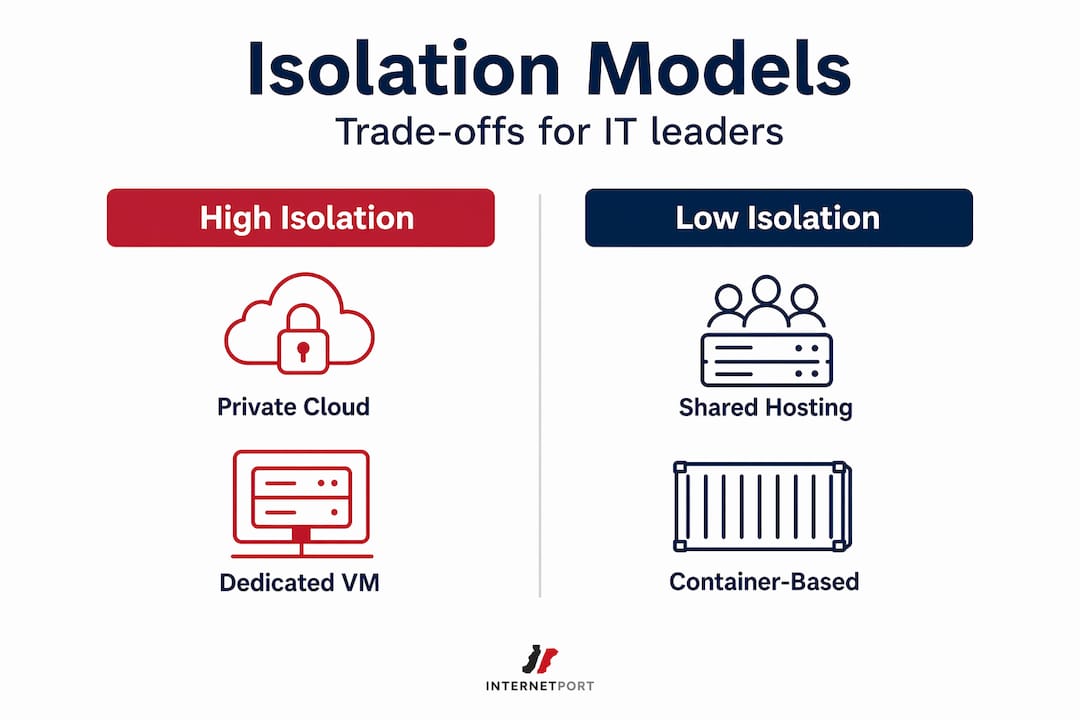
| Model | How it works | Isolation strength | Cost | Compliance suitability |
|---|---|---|---|---|
| Fully shared | All tenants share application, compute, and data layers | Low | Lowest | Limited (low-regulation only) |
| Logically separated | Shared infrastructure, separate data schemas and access controls | Medium | Low to moderate | Moderate (depends on implementation) |
| Physically isolated | Separate VMs or containers per tenant, shared host | Medium to high | Moderate | Good for most regulated workloads |
| Per-tenant environment | Dedicated infrastructure stack per tenant | Very high | High | Excellent (PCI DSS, healthcare data) |
The right model depends on your threat model and your tenants' expectations. The appropriate isolation level depends on whether you're dealing with cooperative tenants in a controlled environment or genuinely hostile tenants who might actively probe boundaries. In the cooperative scenario, logical separation with strong application-level controls may be entirely sufficient. In the hostile scenario, you need physical or per-environment separation that doesn't rely on any single tenant behaving well.
What does a "hostile tenant" scenario actually look like in practice? Consider a SaaS platform where any organization can sign up and onboard. Some users may deliberately attempt to access resources outside their tenant boundary by manipulating API parameters, exploiting shared caches, or probing network endpoints. This isn't paranoia, it's a documented attack surface. If your isolation model relies entirely on your application code to enforce boundaries, a single coding error can expose every tenant on the platform.
Key factors to weigh when selecting a model:
- Compliance requirements: PCI DSS, GDPR, and healthcare data regulations may mandate physical isolation or specific encryption controls. Check whether your chosen model satisfies those requirements before committing.
- Performance expectations: Physically isolated environments protect against noisy neighbors but cost more. If your tenants have strict SLA commitments, logical separation alone may not be adequate.
- Cost constraints: Fully dedicated environments per tenant can be 3 to 5 times more expensive than logically separated models. For SMBs, this trade-off is real and significant.
- Operational complexity: Each step toward stronger isolation adds configuration and maintenance overhead. Make sure your team has the capacity to manage what you're committing to.
Finding reliable hosting for SMBs that offers graduated isolation models is a practical starting point. You don't have to start at the most expensive tier. You need a provider that can scale isolation as your requirements grow.
The business case: Why multi-tenant hosting matters for IT decision-makers
Let's talk about the numbers and the risks, because both deserve equal attention.
The cost argument is real. Multi-tenant hosting optimizes cost by increasing resource density on shared infrastructure, which directly reduces per-tenant compute and management costs. Instead of running five separate servers at 20% utilization each, you run one or two at 80% utilization with appropriate isolation controls. That efficiency gain compounds over time, especially as your tenant count grows.
For an SMB running internal business units as separate tenants, a properly configured multi-tenant environment can cut infrastructure spend by 30 to 50% compared to fully dedicated environments per department. That's meaningful budget that can be redirected toward security tooling, development resources, or business operations.
The complexity warning: The cost savings don't come free. Design complexity increases because you must build and continuously validate isolation controls. This is the part most organizations underestimate during the purchasing decision.
Here's a checklist of questions every IT manager should ask their multi-tenant hosting provider before signing a contract:
- How do you enforce compute quotas per tenant, and are those limits hard or soft?
- What monitoring do you provide per tenant, and is it isolated from other tenants' telemetry?
- How do you handle tenant offboarding? Is data deletion verified and documented?
- What is your process when a cross-tenant access event is detected?
- Can you provide audit logs per tenant for compliance reporting?
- What security certifications does your infrastructure carry, such as PCI DSS or ISO 27001?
- How do you manage shared dependencies, such as DNS, load balancers, or certificate authorities?
Pro Tip: Request a tabletop exercise with your provider where you walk through a hypothetical cross-tenant security incident together. How they respond to that conversation tells you more about their preparedness than any certification document.
Multi-tenancy also introduces risks that don't appear in single-tenant deployments. Tenant interference, where one tenant's actions degrade another's performance or security posture, is the most common. But isolation failure, where access controls break and one tenant can read another's data, is the most serious. Exploring scalable hosting options and enterprise-hosting advantages alongside provider documentation helps you calibrate what's standard and what's cutting corners.
Continuous monitoring is not optional. The isolation controls that work today may be undermined by tomorrow's software update, new tenant onboarding, or configuration drift. Budget and plan for ongoing validation from day one.
Key challenges and best practices for secure multi-tenant hosting
Knowing the risks is one thing. Having a tested approach to managing them is what separates IT leaders who succeed with multi-tenant hosting from those who get burned by it.
The most common pitfalls in multi-tenant environments are not exotic. They're operational failures hiding in plain sight:
- Cross-tenant data access: Usually caused by missing or misconfigured row-level security, shared caches that don't scope by tenant, or API endpoints that don't validate tenant context on every request.
- Weak context propagation: In complex microservice architectures, tenant identity must be passed through every service call. A single service that drops the tenant context can produce mixed results or expose data to the wrong requestor.
- Inadequate offboarding: When a tenant leaves, their data, encryption keys, access credentials, and network policies must all be explicitly revoked. Missing any one of these creates residual exposure.
- Shared dependency vulnerabilities: Shared load balancers, DNS resolvers, or certificate management systems are often overlooked as isolation risks. A misconfiguration in any of these can affect all tenants.
- Insufficient threat modeling: Teams that threat model at initial deployment but never revisit it miss the ways that new tenants, new features, and new attack techniques change the risk landscape.
Edge cases to plan for include tenant-aware routing, context propagation failures, and preventing cross-tenant access in shared deployments. Weaker isolation models shift responsibility to the application code to enforce tenant boundaries, which means a development team error can become a security incident.
Best practices that consistently reduce risk in multi-tenant deployments:
- Automate isolation validation. Don't rely on manual checks. Build automated tests that attempt cross-tenant access and alert on any success. Run them continuously, not just at deployment.
- Use dedicated encryption keys per tenant. Even if the storage layer is shared, encrypting each tenant's data with a unique key limits the blast radius of any breach.
- Implement zero-trust network policies. Assume no tenant should be able to reach any other tenant's network endpoints by default, and enforce that assumption at the infrastructure level.
- Define and test your incident response plan specifically for cross-tenant scenarios. A generic incident response plan won't cover the notification and containment steps unique to multi-tenant breaches.
- Review application code for tenant context handling. Static analysis tools can help identify code paths where tenant identity is not validated or is not passed through correctly.
The work of building reliable, secure hosting environments requires treating isolation as a living system, not a one-time configuration. Threats evolve. Tenants change. And the only way to stay ahead is to validate continuously.
Pro Tip: Establish a formal cadence for reviewing your isolation controls, quarterly at minimum, and align it with your broader security review cycle. Treat isolation drift the same way you treat patch lag: as a measurable, trackable risk.
Why most businesses underestimate the complexity of multi-tenant hosting
Here's the uncomfortable truth that most hosting guides skip over. The convenience of multi-tenant hosting is also its biggest operational trap.
When a provider sells you on the cost savings and the flexibility, everything sounds manageable. You'll share infrastructure, get strong logical isolation, save 40% versus dedicated, and move on to other priorities. And for the first few months, it often works exactly like that. The isolation holds, performance is fine, and your team moves on to the next project.
Then something shifts. A new tenant joins with an unusually aggressive workload pattern. A software update changes how tenant context is propagated through your application stack. A compliance audit requires you to demonstrate isolation controls you assumed were working but had never formally tested. These are the moments where under-investment in ongoing validation becomes visible and expensive.
The conventional wisdom treats multi-tenant hosting as an infrastructure decision. The reality is that it's also an organizational commitment. It requires dedicated ownership, not just initial configuration. Someone on your team needs to be responsible for isolation validation, threat model updates, and provider accountability on an ongoing basis.
Comparing this to a private cloud vs. multi-tenant model is instructive. Private cloud shifts more control to your team, which sounds appealing until you're managing the operational burden that comes with it. Multi-tenant hosting offloads infrastructure management but demands that you stay actively engaged in verifying that the isolation guarantees you're paying for are actually being delivered. Neither model is "set and forget."
The organizations that get the most value from multi-tenant hosting are the ones who treat provider relationships as technical partnerships, not vendor transactions. They ask hard questions, they validate answers, and they don't assume that a compliance certification replaces direct verification of isolation controls. That posture is what separates organizations that scale securely from those that discover their hosting assumptions were wrong at the worst possible moment.
Secure your infrastructure with flexible multi-tenant hosting solutions
The technical depth in this guide reflects how seriously the right hosting decision deserves to be taken. If you're ready to move from understanding to implementation, choosing a provider built for exactly these requirements makes all the difference.
Internetport's infrastructure is purpose-built for businesses that need both efficiency and robust isolation. With SSD-backed storage, network capacity up to 10 Gbps, and data centers in Sweden and international locations that carry PCI DSS compliance, you get the foundation that multi-tenant security actually demands. Whether you need flexible webhosting services that scale with your tenant footprint or customizable VPS options that give you granular control over isolation boundaries, Internetport's team can help you design an architecture that fits your risk profile and your budget. Reach out to discuss your infrastructure requirements and see how the right hosting foundation changes what's possible.
Frequently asked questions
What is the main difference between multi-tenant and shared hosting?
Multi-tenant hosting provides strategic resource isolation across data, compute, and network layers, while shared hosting typically offers only basic resource sharing with minimal enforced separation. As Microsoft notes, proper tenant isolation extends well beyond data and must include compute, network, and operational controls.
Is multi-tenant hosting secure for SMBs?
Multi-tenant hosting can be highly secure for SMBs when isolation controls are layered across multiple dimensions, including data, compute, network, observability, and identity, and when those controls are validated regularly rather than assumed to be working.
How can IT managers ensure proper isolation in a multi-tenant environment?
IT managers should require layered isolation from their provider, run automated cross-tenant access tests on an ongoing basis, and specifically address edge cases like tenant-aware routing and context propagation failures in their security validation process.
Does multi-tenant hosting reduce IT infrastructure costs?
Yes, multi-tenant hosting reduces costs by increasing resource density on shared infrastructure, though IT teams must budget for the ongoing complexity of maintaining and validating isolation controls to protect those savings over time.