

TL;DR:
- Secure infrastructure protects business-critical systems and reduces downtime through deliberate design choices rather than just software tools.
- Leadership must oversee governance, assign accountability, and ensure continuous monitoring to build resilient, compliant security environments.
Secure infrastructure is the foundational layer that protects business-critical systems, networks, and data from unauthorized access, misconfiguration, and disruption. For small and medium-sized businesses, the stakes are identical to those facing large enterprises, but the internal resources to absorb a serious incident are far smaller. Infrastructure security reduces downtime by protecting servers, networks, and access controls from the threats that cause the most damage. Controls like Multi-Factor Authentication (MFA), Endpoint Detection and Response (EDR), and network segmentation are no longer optional additions. They are the baseline that separates organizations that recover quickly from those that do not. Understanding why secure infrastructure is vital means understanding that security is not a product you buy. It is a design discipline built into every layer of your IT environment.
What are the main components of secure infrastructure?
Security controls begin with infrastructure design choices, not software tools purchased after the fact. Architecture and configuration decisions lay the real foundation for resilience. Buying a firewall and calling the job done is the most common mistake SMBs make.
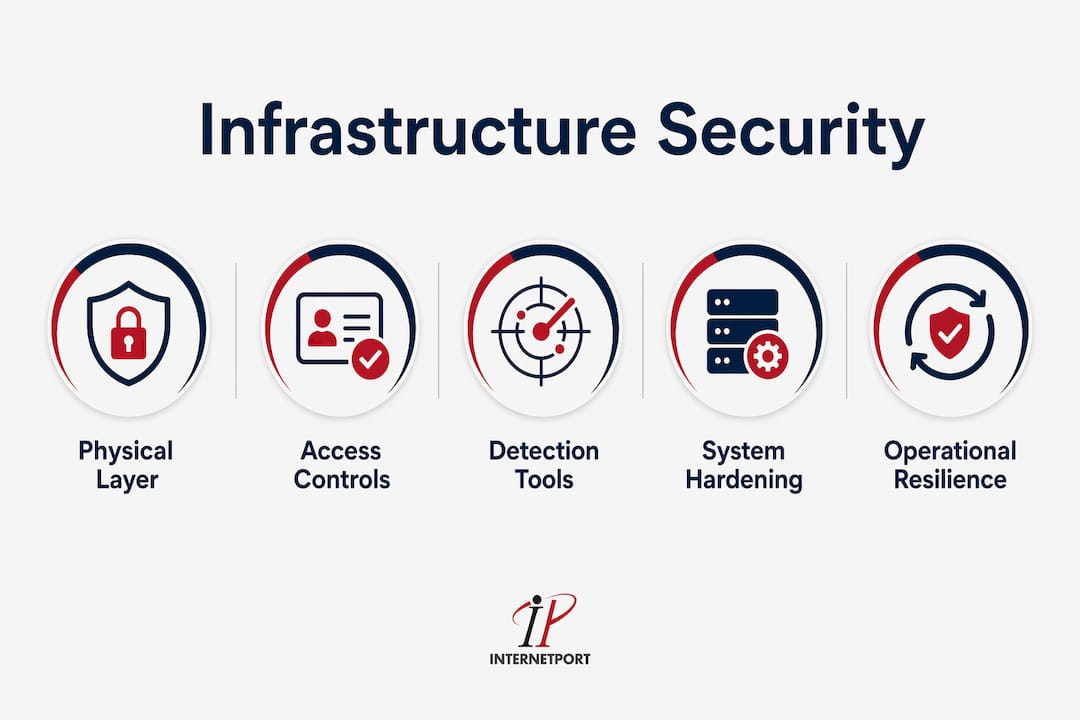
Physical and network architecture
The physical layer matters as much as the software layer. Routers, switches, and firewalls must be positioned deliberately, not just connected in whatever order is convenient. Network segmentation divides your environment into isolated zones so that a breach in one area cannot spread freely across the entire organization. Without segmentation, an attacker who compromises a single workstation can reach your financial systems, your customer database, and your backup servers in minutes.

Critical access controls
MFA on VPNs and administrative access points is the most reliable control to prevent credential theft, which remains the dominant attacker entry method. This single control blocks the majority of automated credential attacks. Every administrative account without MFA is an open door.
Detection and response technologies
EDR and Network Detection and Response (NDR) tools catch attacks that exploit unknown vulnerabilities by watching for behavioral signals rather than known signatures. Continuous monitoring means your team sees anomalies in real time rather than discovering a breach weeks after it occurred. The gap between intrusion and detection is where the most damage happens.
System hardening
Hardening systems using CIS benchmarks and golden images reduces your attack surface significantly. A golden image is a pre-configured, locked-down system template that removes unnecessary services before deployment. Removing default services and enabling controls like Credential Guard eliminates entire categories of vulnerability that attackers routinely exploit.
The table below shows how common infrastructure weaknesses map to the controls that address them.
| Weakness | Control | Impact |
|---|---|---|
| Unrestricted admin access | MFA on all admin accounts | Blocks credential theft attacks |
| Flat network design | Network segmentation | Contains lateral movement |
| Unmonitored endpoints | EDR and NDR deployment | Detects behavioral anomalies |
| Default system configurations | CIS benchmark hardening | Reduces exploitable attack surface |
| Reactive incident response | Continuous monitoring | Shortens detection-to-response time |
Pro Tip: Apply CIS benchmark hardening to every new server before it goes live. Retrofitting security onto a running production system is far harder and riskier than building it in from the start.
How does secure infrastructure support operational resilience?
A security incident does not just expose data. It stops your business from operating. Downtime caused by ransomware, a misconfigured firewall, or a compromised admin account translates directly into lost revenue, broken customer commitments, and reputational damage that takes months to repair.
Resilience depends on decoupling critical services from single points of failure in both physical and cloud infrastructure. A business that runs all critical workloads through a single cloud region, a single identity provider, or a single network path is one outage away from a full operational stop. That is not a theoretical risk. Regional cloud degradation affects multiple customers simultaneously, and the businesses with no survivability path are the ones that go dark.
Segmentation does double duty here. It contains breaches and it limits the blast radius of infrastructure failures. When a compromised segment goes offline for investigation, the rest of your environment keeps running. That containment capability is what separates a manageable incident from a catastrophic one.
"The strategic challenge is to design infrastructure capable of sustaining extended operational constraints, not just isolated disruptions." — BCG, Reframing Resilience in Digital Infrastructure, 2026
The operational benefits of proactive infrastructure security are concrete:
- Faster recovery times because failure domains are small and well-defined
- Reduced cascading failures because services are not tightly coupled
- Clearer incident response because monitoring covers the full environment
- Lower insurance claims because incidents are contained before they escalate
- Stronger vendor and partner confidence because your uptime record is provable
Relying solely on cloud providers does not guarantee resilience. Active architectural design is required to manage shared infrastructure dependencies. Your cloud provider's SLA does not cover the gaps in your own design.
Why is leadership and governance crucial in infrastructure security?
Cyber resilience is a leadership and governance issue, not solely an IT department function. Business owners and board members who treat security as a technical problem to be solved by the IT team are making a governance error with real financial consequences. The decision to fund proper infrastructure, enforce access policies, and require accountability sits at the leadership level.
Leadership must treat cybersecurity as a core public trust obligation. Failing to maintain the safety and continuity of services is seen as a dereliction of duty toward customers and the communities that depend on your operations. That framing changes the conversation from "how much security is enough" to "what level of risk are we willing to accept and defend."
The regulatory environment reinforces this. Governments are moving from voluntary frameworks to enforceable minimum cybersecurity standards. Organizations that have not built provable security controls will face compliance gaps that carry legal and financial penalties.
A practical governance model for SMBs includes these steps:
- Assign a named owner for infrastructure security accountability, whether internal or through a managed service provider.
- Conduct a formal risk assessment at least once per year, covering network architecture, access controls, and vendor dependencies.
- Document your security controls and test them. Undocumented controls cannot be audited, insured, or improved.
- Review cyber insurance requirements annually. Insurers now require evidence of specific controls like MFA and EDR before issuing policies.
- Report security posture to leadership quarterly. Security cannot be governed if leadership has no visibility into it.
Organizations with mature, provable security controls gain advantages in meeting regulatory mandates and market expectations. That includes better cyber insurance terms, stronger customer trust, and a competitive edge in procurement processes where security questionnaires are now standard. For guidance on managing server security as part of your governance model, the practical steps are well-documented for SMB environments.
Pro Tip: Treat your security documentation as a business asset. When a customer, auditor, or insurer asks for evidence of your controls, a well-maintained security register closes deals and reduces premiums.
How can SMBs implement practical steps for secure infrastructure?
The importance of secure infrastructure is clear. The harder question for most SMB leaders is where to start. The answer is not to buy more tools. The answer is to fix the architecture first.
Here is a practical sequence that works for organizations without large internal security teams:
- Assess your current gaps. Map every system, network connection, and administrative account. You cannot secure what you have not inventoried. Pay particular attention to flat network designs and accounts with shared credentials.
- Deploy MFA everywhere. Start with VPN access and administrative accounts. Extend to email and any system that holds customer or financial data. This single step eliminates the most common attack vector.
- Segment your network. Separate your operational systems from your guest network, your payment systems from your general office network, and your backup infrastructure from your production environment. Each boundary limits how far an attacker can move.
- Harden every system before deployment. Use CIS benchmark configurations and build golden images for your standard server and workstation builds. Remove every service that is not required for the system's function.
- Deploy continuous monitoring. EDR on endpoints and NDR on your network give you behavioral visibility. Reactive fixes leave you vulnerable. Managed network services deliver the continuous oversight that most SMBs cannot staff internally.
- Test your resilience. Run tabletop exercises that simulate a ransomware attack or a regional cloud outage. Identify which services go down and in what order. Fix the single points of failure you find.
The table below compares a reactive security posture against a proactive one across the dimensions that matter most to SMBs.
| Dimension | Reactive posture | Proactive posture |
|---|---|---|
| Breach detection | Days to weeks | Hours to days |
| Incident containment | Full environment at risk | Segmented, limited blast radius |
| Recovery time | Weeks of disruption | Hours to days |
| Insurance eligibility | Limited, high premiums | Broader coverage, lower premiums |
| Customer trust impact | Severe reputational damage | Minimal if contained quickly |
For teams managing their own servers, VPS security best practices cover the specific hardening steps that apply to virtual environments. The principles are the same as physical infrastructure: reduce the attack surface, control access, and monitor continuously.
Strong security foundations built before breaches occur offer better protection in an accelerated threat environment driven by AI-assisted attacks. Waiting until after an incident to invest in infrastructure security is the most expensive approach available.
Key Takeaways
Secure infrastructure is the single most effective investment an SMB can make to protect data, maintain operations, and build the trust that drives long-term business growth.
| Point | Details |
|---|---|
| Architecture comes first | Security controls built into network design stop breaches from spreading across your environment. |
| MFA is non-negotiable | Multi-Factor Authentication on VPNs and admin accounts blocks the most common attacker entry method. |
| Resilience requires decoupling | Critical services must not depend on a single region, provider, or identity system to survive outages. |
| Leadership owns governance | Business owners must assign accountability, document controls, and report security posture regularly. |
| Proactive beats reactive | Continuous monitoring and hardened configurations reduce detection time and limit incident damage. |
The infrastructure conversation SMB leaders keep avoiding
I have spent years watching SMB leaders make the same mistake: they treat infrastructure security as a cost center to be minimized rather than a foundation to be built correctly. The result is always the same. They spend far more money recovering from an incident than they would have spent preventing it.
The uncomfortable truth is that most SMBs are not attacked because they are specifically targeted. They are attacked because they are easy. Flat networks, shared admin passwords, and unmonitored endpoints are visible to automated scanning tools that probe millions of addresses every day. You do not need to be a high-value target to be a victim. You just need to be easier than the next organization on the list.
What I have found actually works is treating infrastructure security as a design discipline from day one. Every new server gets a hardened image. Every new network segment gets a firewall rule. Every new admin account gets MFA. These are not expensive decisions. They are habits. The organizations that build these habits early are the ones that contain incidents in hours rather than discovering them weeks later.
The governance piece is where most SMB leaders underinvest. Security without accountability is just wishful thinking. Assigning a named owner, running annual risk assessments, and reporting to leadership quarterly are not bureaucratic exercises. They are the mechanisms that keep security from drifting back to the reactive posture that leaves you exposed.
My advice to any SMB leader reading this: partner with a hosting provider that has already built the physical and network security layer for you. That frees your team to focus on the controls and governance that sit above the infrastructure. Internetport's data centers in Sweden and internationally give you a foundation that meets PCI DSS requirements without building it yourself. That is not a small advantage. That is months of work and significant capital expenditure that you do not have to make.
— Peter
Internetport's infrastructure solutions for SMB security
Businesses that need a secure, reliable foundation without building a data center from scratch have a direct path forward with Internetport.
Internetport's dedicated server options give your organization isolated, high-performance hardware in PCI DSS-compliant data centers located in Sweden and internationally. For teams that need flexible, cost-effective environments, secure web hosting delivers the architecture and uptime guarantees that SMBs require without the overhead of managing physical hardware. Internetport's expert technical support team provides ongoing guidance, so your infrastructure stays current with evolving security requirements. For organizations evaluating their full hosting options, cloud infrastructure best practices offer a practical framework for making the right architectural decisions.
FAQ
What is secure infrastructure?
Secure infrastructure is the combination of physical hardware, network architecture, access controls, and monitoring systems designed to protect IT environments from unauthorized access and disruption. It includes controls like MFA, network segmentation, EDR, and hardened system configurations.
Why do SMBs need secure infrastructure?
Small and medium-sized businesses face the same operational risks as large enterprises but have fewer resources to recover from incidents. Infrastructure security reduces downtime and protects the systems that keep the business running.
What is the biggest security mistake SMBs make?
The most common mistake is treating security as a software purchase rather than an architectural discipline. Flat network designs and unprotected admin accounts create vulnerabilities that no endpoint tool can fully compensate for.
How does network segmentation improve security?
Network segmentation divides your environment into isolated zones so that a compromised system cannot freely access the rest of your infrastructure. It limits lateral movement and contains the damage from any single breach.
Does using a cloud provider mean my infrastructure is secure?
No. Relying solely on cloud providers does not guarantee resilience. Active architectural design, including tested survivability paths and independent identity management, is required to manage shared infrastructure dependencies.